

2026 Latest 2V0-21.23 dumps Exam Material with 107 Questions
VMware 2V0-21.23 Questions and Answers Guarantee you Oass the Test Easily
To take the VMware 2V0-21.23 exam, candidates should have a strong understanding of virtualization concepts, experience with vSphere 8.x, and knowledge of networking and storage technologies. They should also be familiar with vSphere's automation capabilities and have experience with scripting languages such as PowerCLI or Python. VMware recommends that candidates attend its official training course, VMware vSphere 7: Install, Configure, Manage, or VMware vSphere 7: Optimize and Scale, before taking the exam.
VMware 2V0-21.23 exam is designed for IT professionals who want to demonstrate their expertise in managing and deploying VMware vSphere 8.x technologies. VMware vSphere 8.x Professional certification exam is intended for individuals with a solid foundation in virtualization concepts and hands-on experience working with VMware vSphere. Passing 2V0-21.23 exam validates your skills and knowledge in configuring, deploying, and managing virtual data centers using VMware vSphere 8.x technologies.
NEW QUESTION # 59
f\n administrator needs to provide encryption for workloads within an existing vSphere cluster. The following requirements must be met:
* Workloads should be encrypted at rest.
* Encrypted workloads must automatically be encrypted during transit.
* Encryption should not require any specific hardware.
What should the administrator configure to meet these requirements?
- A. Host Encryption
- B. Encrypted vSphere vMotion
- C. Unified Extensible Firmware Interface (UEFI) Secure Boot
- D. VM Encryption
Answer: D
Explanation:
The feature that should be configured to provide encryption for workloads within an existing vSphere cluster without requiring any specific hardware is VM Encryption, which allows encrypting VMs at rest and during vMotion.
NEW QUESTION # 60
An administrator creates a new corporate virtual machine (VM) template every month to include all of the latest patches. The administrator needs to ensure that the new VM template is synchronized from the primary data center site (London) to two secondary data center sites (Tokyo and New York). The administrator is aware that datastore space is limited within the secondary data center sites. The administrator needs to ensure that the VM template is available in the secondary sites the first time a new virtual machine is requested.
Which four steps should the administrator take to meet these requirements? (Choose four.)
- A. Configure the subscribed content library to download content when needed.
- B. Configure each subscribed content library to download content immediately.
- C. Add the virtual machine template to the published content library.
- D. Add the virtual machine template to the subscribed content library.
- E. Create a new published content library at the primary site.
- F. Create a new published content library in each secondary site.
- G. Create a new subscribed content library in each secondary site.
Answer: A,C,E,G
Explanation:
Explanation
To meet the requirements of synchronizing and protecting images and templates with limited datastore space, the administrator needs to create a new published content library at the primary site, which makes it available for subscription by other vCenter Server instances; create a new subscribed content library in each secondary site, which allows accessing content from a published content library; configure the subscribed content library to download content when needed, which saves datastore space by only downloading content on demand; and add the virtual machine template to the published content library, which makes it available for other hosts to use.
References:
https://docs.vmware.com/en/VMware-vSphere/7.0/com.vmware.vsphere.vm_admin.doc/GUID-FBEED81C-F9D
NEW QUESTION # 61
An administrator is tasked with looking into the disaster recovery options for protecting a database server using VMware vSphere Replication.
The following requirements must be met:
* The virtual machine must remain online during the protection.
* The virtual machine's snapshots must be used as part of the replication process.
Which step must the administrator complete to accomplish this task?
- A. Perform a full initial synchronization of the source virtual machine to the target location.
- B. Configure network traffic isolation for vSphere Replication.
- C. Configure the virtual machine storage policy.
- D. Enable guest OS VSS quiescing for this virtual machine.
Answer: A
Explanation:
https://docs.vmware.com/en/vSphere-Replication/8.7/com.vmware.vsphere.replication-admin.doc/GUID-C249300C-2BC0-4128-88B5-046C3DE6BC5B.html
NEW QUESTION # 62
An administrator notices a Fibre Channel adapter in an ESXi host has been experiencing inconsistent connectivity states Which trigger can be used to quickly identify the issue and alert the administrator so that the issue can be resolved?
- A. Lost Network Connectivity
- B. Lost Network Path Redundancy
- C. Host Connection Lost
- D. Lost Storage Connectivity
Answer: B
Explanation:
Complicated, the question does not comment on whether the path is redundant, if not redundant the correct answer would be D, but if we take into account good practices, the FC would be redundant.
https://kb.vmware.com/s/article/2014553
Book course: 6-23 Fibre Channel SAN Components Using SAN switches, you can set up path redundancy to address any path failures from host server to switch, or from storage array to switch. 6-25 Multipathing with Fibre Channel By default, ESXi hosts use only one path from a host to a given LUN at any one time. If the path actively being used by the ESXi host fails, the server selects another available path.
NEW QUESTION # 63
A vSphere environment is experiencing intermittent short bursts of CPU contention, causing brief production outages for some of the virtual machines (VMs). To understand the cause of the issue, the administrator wants to observe near real-time statistics for all VMs.
Which two vSphere reporting tools could the administrator use? (Choose two.)
- A. Overview Performance Charts
- B. resxtop
- C. esxcli
- D. Advanced Performance Charts
- E. esxtop
Answer: D,E
Explanation:
Advanced Performance Charts and esxtop are both vSphere reporting tools that can be used to observe near real-time statistics for all VMs. Advanced Performance Charts provides a graphical view of performance data, while esxtop is a command-line tool that provides more detailed information.
NEW QUESTION # 64
An administrator needs to configure a content library solution based on the following information:
*A new corporate virtual machine (VM) template is created every month to include all of the latest patches.
*The new VM template should be downloaded from the primary data center site (London) to two secondary data center sites (Tokyo and New York) as soon as possible.
*There is limited disk space available at one of the secondary data center sites (Tokyo) due to an ongoing data center consolidation project.
Which four steps should the administrator take to configure the content library solution before adding a VM template? (Choose four.)
- A. Configure the Tokyo subscribed content library to download content when needed
- B. Create a new subscribed content library in each secondary site
- C. Create a new published content library at the primary site
- D. Configure the New York subscribed content library to download content when needed.
- E. Configure the Tokyo subscribed content library to download content immediately
- F. Configure the New York subscribed content library to download content immediately.
- G. Create a new published content library In each secondary site
Answer: A,B,C,F
Explanation:
Explanation
The administrator should take these four steps to configure the content library solution before adding a VM template:
Create a new published content library at the primary site, which allows the administrator to share the VM template with other sites.
Configure the New York subscribed content library to download content immediately, which ensures that the new VM template is downloaded from the primary site as soon as possible.
Configure the Tokyo subscribed content library to download content when needed, which saves disk space at the secondary site by downloading only the metadata of the VM template until it is deployed.
Create a new subscribed content library in each secondary site, which allows the administrator to subscribe to the published content library at the primary site and synchronize the VM template.
References:
https://docs.vmware.com/en/VMware-vSphere/7.0/com.vmware.vsphere.vm_admin.doc/GUID-E8E854DD
NEW QUESTION # 65
An administrator Is looking to deploy a new VMware vCenter Instance. The current environment consists of
75 hosts and is expected to grow up to 100 hosts over the next three years.
Which deployment size should the administrator select?
- A. Tiny
- B. Small
- C. Medium
- D. Large
Answer: B
Explanation:
Explanation
VMWare: Small environment (up to 100 hosts or 1,000 virtual machines) Medium environment (up to 400 hosts or 4,000 virtual machine)
https://docs.vmware.com/en/VMware-vSphere/7.0/com.vmware.vcenter.install.doc/GUID-88571D8A-46E1-464 The administrator should select the small deployment size for the new vCenter Server instance, which is suitable for an environment with up to 100 hosts or 1,000 virtual machines. The small deployment size has 4 vCPUs and 19 GB of memory, which can handle the current and expected growth of the environment. The other deployment sizes are either too large or too small for the environment. References:
https://docs.vmware.com/en/VMware-vSphere/7.0/com.vmware.vcenter.install.doc/GUID-88571D8A-46E1-464
NEW QUESTION # 66
An administrator is tasked with implementing a backup solution capable of backing up the Supervisor cluster, vSphere Pods, and persistent volumes.
Which two solutions must be used to meet this requirement? (Choose two.)
- A. vSphere Host Client
- B. VMware vCenter
- C. Velero Plugin for vSphere
- D. NSX-T Manager
- E. Standalone Velero and Restic
Answer: C,E
NEW QUESTION # 67
An administrator needs to perform maintenance on a datastore that Is running the vSphere Cluster Services (vCLS) virtual machines (VMs).
Which feature can the administrator use in this scenario to avoid the use of Storage vMotion on the vCLS VMs?
- A. vCLS Retreat Mode
- B. vSphere Distributed Resource Scheduler (DRS)
- C. vSphere vMotion
- D. vSphere Faull Tolerance
Answer: A
Explanation:
Explanation
The feature that can be used to avoid the use of Storage vMotion on the vCLS VMs when performing maintenance on a datastore is vCLS Retreat Mode, which allows temporarily removing the vCLS VMs from the cluster without affecting the cluster services.
References:
https://docs.vmware.com/en/VMware-vSphere/7.0/com.vmware.vsphere.vcenterhost.doc/GUID-8E7C1D6D-8E1
NEW QUESTION # 68
An administrator plans to update the Supervisor cluster and has noticed some of the Tanzu Kubemetes Grid clusters are running an incompatible version.
Which action must the administrator take before proceeding with the Supervisor cluster update?
- A. Update incompatible Tanzu Kubernetes Grid clusters prior to the Supervisor cluster update.
- B. No action is needed - Incompatible Tanzu Kubernetes Grid clusters can be manually updated after the Supervisor cluster update.
- C. No action is needed - Tanzu Kubernetes Grid clusters will be updated automatically as part of the update process.
- D. Update all Tanzu Kubernetes Grid clusters to the latest version prior to the Supervisor cluster update.
Answer: A
Explanation:
Explanation
Option D is correct because it indicates that the administrator must update incompatible Tanzu Kubernetes Grid clusters prior to the Supervisor cluster update, as this will ensure that there are no compatibility issues or disruptions during or after the update process. Option A is incorrect because it is not necessary to update all Tanzu Kubernetes Grid clusters to the latest version prior to the Supervisor cluster update, as some clusters may already be compatible with the new version. Option B is incorrect because Tanzu Kubernetes Grid clusters will not be updated automatically as part of the update process, as they require manual intervention from the administrator. Option C is incorrect because incompatible Tanzu Kubernetes Grid clusters cannot be manually updated after the Supervisor cluster update, as they may become inaccessible or unstable due to compatibility issues. References:
https://docs.vmware.com/en/VMware-vSphere/7.0/vmware-vsphere-with-tanzu/GUID-9F9E3F8C-0E2B-4B6A-8
NEW QUESTION # 69
An administrator decides to restore VMware vCenter from a file-based backup following a failed upgrade.
Which interface should the administrator use to complete the restore?
- A. vCenter GUI Installer
- B. Direct Console User Interface (DCUI)
- C. vCenter Management Interface (VAMI)
- D. vSphere Client
Answer: A
Explanation:
Explanation
https://docs.vmware.com/en/VMware-vSphere/8.0/vsphere-vcenter-installation/GUID-F02AF073-7CFD-45B2-A You can use the vCenter Server appliance GUI installer to restore a vCenter Server to an ESXi host or a vCenter Server instance. The restore procedure has two stages. The first stage deploys a new vCenter Server appliance. The second stage populates the newly deployed vCenter Server appliance with the data stored in the file-based backup.
https://docs.vmware.com/en/VMware-vSphere/8.0/vsphere-vcenter-installation/GUID-F02AF073-7CFD-45B2-A
NEW QUESTION # 70
An administrator has mapped three vSphere zones to three vSphere clusters.
Which two statements are true for this vSphere with Tanzu zonal Supervisor enablement? (Choose two.)
- A. Individual vSphere Namespaces will be spread across all zones.
- B. Individual vSphere Namespaces will be placed into a specific zone.
- C. Three Supervisors will be created in Linked Mode.
- D. One Supervisor will be created across all zones.
- E. One Supervisor will be created in a specific zone.
Answer: B,E
Explanation:
Explanation
When mapping vSphere zones to vSphere clusters, one Supervisor will be created in each zone, and individual vSphere Namespaces will be placed into a specific zone based on their resource requirements and availability constraints.
References:
https://docs.vmware.com/en/VMware-vSphere/7.0/vmware-vsphere-with-tanzu/GUID-C2E9B5C1-D6F1-4E9B-
NEW QUESTION # 71
An administrator is responsible for the management of a VMware vCenter instance that is currently experience performance issues. The administrator quickly identifies that the CPU and memory utilization of vCenter is consistently over 90%. Upon further analysis, it seems that the vpxd process is contributing significantly to the performance issue.
A combination of which four steps should the administrator take to resolve the performance issues and ensure that a similar issue can be rectified without required downtime to vCenter moving forward? (Choose four.)
- A. Add a additional CPU and memory to the vCenter Server Appliance.
- B. Power on the vCenter Server Appliance using the vSphere Host Client.
- C. Add a additional CPU and memory to the vCenter Server Appliance.
- D. Enable CPU Hot add on the vCenter virtual machine.
- E. Gracefully shut down vCenter using the vSphere Client.
- F. Enable CPU an Memory Hot add on the vCenter virtual machine.
Answer: B,C,E,F
Explanation:
Explanation
References:
https://docs.vmware.com/en/VMware-vSphere/7.0/com.vmware.vsphere.vcenterhost.doc/GUID-8E7C1D6D-8E1
https://docs.vmware.com/en/VMware-vSphere/7.0/com.vmware.vsphere.vcenterhost.doc/GUID-3B41119A-1276
https://docs.vmware.com/en/VMware-vSphere/7.0/com.vmware.vsphere.vm_admin.doc/GUID-38F4D574-ADE
NEW QUESTION # 72
An administrator needs better performance and near-zero CPU utilization from the ESXI hosts for networking functions and processing. The administrator creates a new vSphere Distributed Switch and enables network offloads compatibility.
Which solution would help achieve this goal?
- A. Data Processing Units (DPUs)
- B. Universal Passthrough version 2
- C. vSphere Network I/O Control
- D. VSphere Distributed Services Engine
Answer: A
Explanation:
The solution that would help achieve better performance and near-zero CPU utilization from the ESXi hosts for networking functions and processing is Data Processing Units (DPUs), which are specialized processors that offload network services from the CPU and provide hardware acceleration.
https://docs.vmware.com/en/VMware-vSphere/8.0/vsphere-networking/GUID-41AB1101-D943-490A-BF1A-E53433855C07.html
NEW QUESTION # 73
An administrator creates a virtual machine that contains the latest company-approved software, tools and security updates. Company policy requires that only full clones are allowed for server workloads.
A combination of which two tasks should the administrator complete to prepare for the deployment of this virtual machine for multiple users? (Choose two.)
- A. Take a snapshot of the virtual machine.
- B. Create a virtual machine customization specification.
- C. Upgrade the virtual hardware.
- D. Convert the virtual machine to a template.
- E. Set appropriate permissions on the virtual machine.
Answer: B,D
Explanation:
Explanation
Option B and D are correct because they allow the administrator to create a virtual machine customization specification, which can be used to customize guest operating system settings for multiple virtual machines, and convert the virtual machine to a template, which can be used to create full clones of server workloads.
Option A is incorrect because assigning appropriate permissions on the virtual machine does not prepare it for deployment for multiple users. Option C is incorrect because upgrading the virtual hardware does not prepare it for deployment for multiple users. Option E is incorrect because taking a snapshot of the virtual machine does not prepare it for deployment for multiple users. References:
https://docs.vmware.com/en/VMware-vSphere/7.0/com.vmware.vsphere.vm_admin.doc/GUID-9F9E3F8C-0E2B
NEW QUESTION # 74
An administrator is attempting to configure Storage I/O Control (SIOC) on five datastores within a vSphere environment. The administrator is being asked to determine why SIOC configuration completed successfully on only four of the datastores.
What are two possible reasons why the configuration was not successful? (Choose two.)
- A. SAS disks are used for the datastore.
- B. The datastore is using ISCSI.
- C. The datastore has multiple extents.
- D. The datastore contains Raw Device Mappings (RDMs).
- E. The administrator is using NFS storage.
Answer: C,D
Explanation:
Explanation
SIOC configuration may fail if the datastore contains RDMs or has multiple extents, as these are not supported by SIOC.
References:
https://docs.vmware.com/en/VMware-vSphere/7.0/com.vmware.vsphere.storage.doc/GUID-FB3F5C5C-D3F6-4
NEW QUESTION # 75
After a number of outages within a production VMware software-defined data center, an administrator is tasked with identifying a solution to meet the following requirements:
* Reduce the risk of outages by proactively identifying issues with the environment and resolving them.
* Reduce the complexity of uploading log bundles when raising support tickets.
Which solution should the administrator recommend to meet these requirements?
- A. VMware Aria Operations for Logs
- B. VMware Aria Operations
- C. VMware Skyline Health
- D. VMware Skyline Advisor Pro
Answer: C
Explanation:
Explanation
The solution that should be recommended to reduce the risk of outages by proactively identifying and resolving issues with the environment and reducing the complexity of uploading log bundles is VMware Skyline Health, which provides automated support and proactive recommendations for vSphere.
References:
https://docs.vmware.com/en/VMware-vSphere/7.0/com.vmware.vsphere.monitoring.doc/GUID-8E7C1D6D-8E1
NEW QUESTION # 76
When configuring vCenter High Availability (HA), which two statements are true regarding the active, passive, and witness nodes? (Choose two.)
- A. They must have a minimum of a 1 Gbps network adapter.
- B. They must have a minimum of a 10 Gbps network adapter
- C. Network latency must be more than 10 milliseconds.
- D. They must have a supported Wide Area Network (WAN).
- E. Network latency must be less than 10 milliseconds.
Answer: A,E
Explanation:
When configuring vCenter High Availability (HA), two of the requirements for the active, passive, and witness nodes are that network latency must be less than 10 milliseconds, which ensures reliable communication between them; and they must have a minimum of a 1 Gbps network adapter, which provides sufficient bandwidth for data replication.
NEW QUESTION # 77
Refer to the exhibit.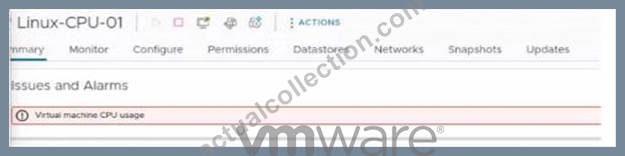
After removing an ESXi host from a cluster for maintenance, a number of virtual machines have encountered the warning seen in the exhibit. After re-adding the ESXi, the issue is resolved. Which step should the administrator take to move the triggered alarm to its normal state?
- A. Ignore
- B. Reset to Green
- C. Disable
- D. Acknowledge
Answer: B
Explanation:
Explanation
https://communities.vmware.com/t5/ESXi-Discussions/Alert-on-virtual-machine-that-i-cant-quot-clear-quot-or-r
NEW QUESTION # 78
Refer to the exhibit.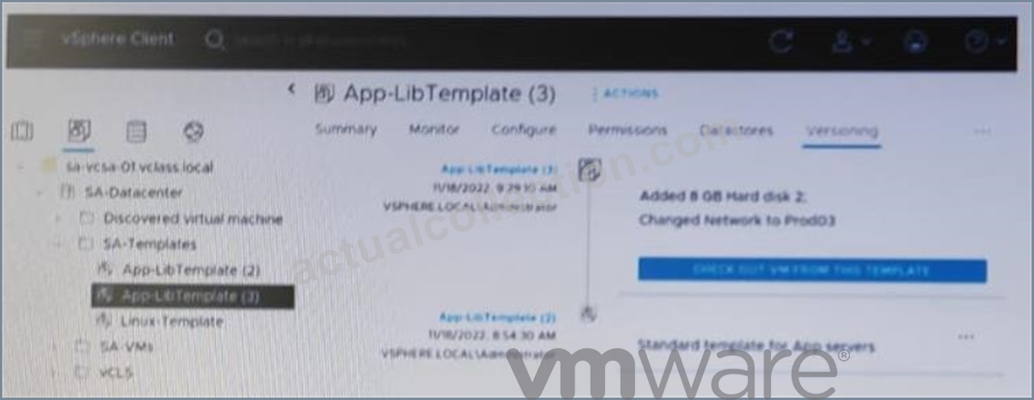
Given the configuration shown in the exhibit, what should the administrator do if the latest VM template contains changes that are no longer needed?
- A. Check out App-LibTemplate (3)
- B. Delete App-LibTemplate (2)
- C. Revert to App-LibTernplate (2)
- D. Delete App-LibTemplate (3)
Answer: D
Explanation:
Deleting App-LibTemplate (3) will remove the changes that are no longer needed and revert to the previous version of the template.
Reference:
https://docs.vmware.com/en/VMware-vSphere/7.0/com.vmware.vsphere.vm_admin.doc/GUID-D69B0279-CC9B-495B-9CA3-AE975AF9C865.html
NEW QUESTION # 79
An administrator is creating a content library to manage VM templates and ISO images. The administrator wants to password-protect the images and templates and share them with a remote site.
Which two tasks must the administration perform when creating the content library? (Choose two.)
- A. Enable the security policy.
- B. Create a subscribed content library.
- C. Enable authentication.
- D. Publish the local content library.
- E. Select an NFS datastore.
Answer: C,D
Explanation:
Explanation
To password-protect and share images and templates with a remote site, the administrator needs to publish the local content library, which makes it available for subscription by other vCenter Server instances; and enable authentication, which requires users to enter credentials when accessing the content library.
References:
https://docs.vmware.com/en/VMware-vSphere/7.0/com.vmware.vsphere.vm_admin.doc/GUID-FBEED81C-F9D
NEW QUESTION # 80
Refer to Exhibit: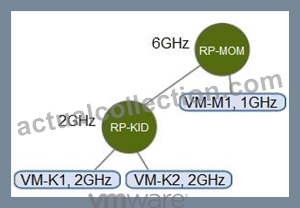
An environment has the following configuration:
* Resource Pool "RP-MOM? has a reservation of 6GHz and one running virtual machine (VM) "VM-M1? with 1 GHz reserved
* Resource Pool ^RP-KID? has a reservation of 2GHz, and expandable reservations is activated The administrator creates two VMs, "VM-K1? and 'VM-K2?, in the ''RP-KID? resource pool with 2GHz reserved for each, and turns on "VM-M1 ?
Given this scenario, which statement is true?
- A. VM-K2 cannot be powered on because there are not enough resources in RP-KID.
- B. VM-K2 can be powered on because it can get the resources needed from RP-MOM.
- C. The administrator can create a third VM ( VM-K3?) at RP-KID and reserve 6GHz
- D. The administrator must deactivate expandable reservations to turn on VM-K2
Answer: B
Explanation:
https://docs.vmware.com/en/VMware-vSphere/8.0/vsphere-resource-management/GUID-60077B40-66FF-4625-934A-641703ED7601.html
NEW QUESTION # 81
An administrator manages VM templates and ISO images for a remote office. Their main requirements are to store these templates in a single repository and manage different versions of the templates.
What solution should the administrator deploy to meet these requirements?
- A. A subscribed content library
- B. A shared VMFS datastore
- C. A local content library
- D. A vSAN datastore
Answer: C
Explanation:
https://4sysops.com/archives/how-to-create-a-vmware-content-library/#:~:text=A%20VMware%20content%20library%20provides,maintain%20consistency%20across%20VM%20deployments.
NEW QUESTION # 82
Refer to Exhibit: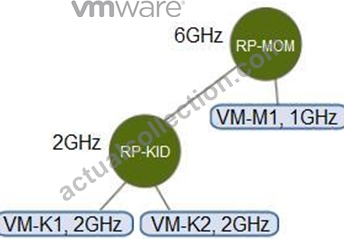
An environment has the following configuration:
*Resource Pool "RP-MOM? has a reservation of 6GHz and one running virtual machine (VM) "VM-M1? with
1 GHz reserved
*Resource Pool ^RP-KID? has a reservation of 2GHz, and expandable reservations is activated The administrator creates two VMs, "VM-K1? and 'VM-K2?, in the ''RP-KID? resource pool with 2GHz reserved for each, and turns on "VM-M1 ?
Given this scenario, which statement is true?
- A. VM-K2 cannot be powered on because there are not enough resources in RP-KID.
- B. VM-K2 can be powered on because it can get the resources needed from RP-MOM.
- C. The administrator can create a third VM ( VM-K3?) at RP-KID and reserve 6GHz
- D. The administrator must deactivate expandable reservations to turn on VM-K2
Answer: B
Explanation:
Explanation
https://docs.vmware.com/en/VMware-vSphere/8.0/vsphere-resource-management/GUID-60077B40-66FF-4625-
NEW QUESTION # 83
......
Share Latest 2V0-21.23 DUMP Questions and Answers: https://www.actualcollection.com/2V0-21.23-exam-questions.html
PDF Dumps 2026 Exam Questions with Practice Test: https://drive.google.com/open?id=1DkWZ8rJPcgp2FE2_cDjQ9Kzz2_yjc8NR