

IIA-CIA-Part2 PDF Dumps 2026 Exam Questions with Practice Test
Dumps for Free IIA-CIA-Part2 Practice Exam Questions
NEW QUESTION # 105
An internal auditor s testing tor proper authorization of contracts and finds that the rate of deviations discovered in the sample is equal to the tolerable deviation rate. When of the following is the most appropriate conclusion for the internal auditor to make based on this result?
- A. The internal auditor concludes that additional testing will be required to evaluate the specified control
- B. The internal auditor concludes that the specified control is more effective than it really is.
- C. The internal auditor concludes that the specified control is acceptably effective
- D. The internal auditor concludes that management may be placing undue reliance on me specified control
Answer: C
Explanation:
When the rate of deviations discovered in the sample equals the tolerable deviation rate, it means that the control is functioning at the level deemed acceptable by the auditor's predefined criteria. This does not necessarily imply that the control is flawless, but rather that its effectiveness meets the minimum standards set by the audit plan. Therefore, the internal auditor can conclude that the control is acceptably effective, but should also note the potential need for improvement.
:
The Institute of Internal Auditors (IIA) - Standards for the Professional Practice of Internal Auditing, Standard
2320 - Analysis and Evaluation
COSO Framework - Control Activities
NEW QUESTION # 106
Which of the following does not represent a difficulty in using red flags as fraud indicators?
- A. Many common red flags are also associated with situations where no fraud exists.
- B. The red flags literature is not well enough established to have a positive impact on auditing.
- C. Red flag information is only gathered in extraordinary circumstances.
- D. Some red flags are difficult to quantify or to evaluate.
Answer: B
NEW QUESTION # 107
The internal audit activity has become aware of public complaints regarding the sales practices of telephone marketing personnel in a large organization. The internal auditors decide to review a sample of all complaints within the last three months to ensure they are reflective of current marketing practices. Which of the following best describes this sampling technique?
- A. Random sampling
- B. Statistical sampling
- C. Judgmental sampling
- D. Discovery sampling
Answer: C
Explanation:
Judgmental sampling, also known as non-statistical sampling, is a technique where the internal auditor uses their professional judgment to select a sample that they believe is most representative of the population. In this scenario, the internal auditors are choosing to review a sample of complaints from the last three months based on their professional judgment that these complaints are reflective of current marketing practices. This method is particularly useful when the auditor has specific knowledge about the population that allows them to make informed selections.
References:
* Institute of Internal Auditors (IIA) Standards: Performance Standards 2320: Analysis and Evaluation
* Internal Audit Manual: Sampling Techniques and Methodologies
NEW QUESTION # 108
An internal audit activity is planning its first audit of IT shared services. Which of the following controls would typically be evaluated first?
- A. Entity-level controls
- B. Application controls
- C. Transaction controls
- D. General controls.
Answer: A
Explanation:
When planning the first audit of IT shared services, it is typical to evaluate entity-level controls first. Entity- level controls are overarching controls that affect the entire organization and are foundational for ensuring that specific application and transaction controls operate effectively. These controls include the organization's governance, risk management processes, and the overall control environment. Assessing entity-level controls provides a broad understanding of the control environment and highlights any pervasive issues that might impact more detailed areas of the audit.
The IIA's Global Technology Audit Guide (GTAG) and COSO's Internal Control - Integrated Framework.
NEW QUESTION # 109
All of the following tools are employed to control large-scale projects except:
- A. Program evaluation and review technique (PERT).
- B. Critical path method.
- C. Statistical process control.
- D. Gantt charts.
Answer: C
Explanation:
Section: Volume B
NEW QUESTION # 110
Which of the following is not a primary purpose for conducting a walk-through during the initial stages of an assurance engagement?
- A. To identify residual risks.
- B. To determine segregation of duties.
- C. To help develop process maps.
- D. To test the adequacy of controls.
Answer: D
Explanation:
The primary purposes of a walk-through during the initial stages of an assurance engagement are to help develop process maps (A), determine segregation of duties (B), and identify residual risks (C). Testing the adequacy of controls (D) is generally performed after these initial steps to ensure a thorough understanding of the process and risks involved. Reference: = IIA Standard 2201 - Planning Considerations and IIA Practice Guide: "Walkthroughs for Internal Auditors".
NEW QUESTION # 111
An organization has a mature control environment but limited internal audit resources Given this scenario, on which of the following should the internal auditors focus their testing?
- A. Detective Key controls
- B. Preventive key controls
- C. Detective compensating controls
- D. Preventive compensating controls
Answer: B
Explanation:
In a mature control environment with limited internal audit resources, internal auditors should focus their testing on preventive key controls. Preventive controls are designed to stop errors or irregularities before they occur, making them crucial for maintaining control effectiveness. Key controls are the most important controls in mitigating risks to an acceptable level. By focusing on these, internal auditors can ensure that the most critical risks are managed effectively despite limited resources. References:
* The IIA's International Standards for the Professional Practice of Internal Auditing (Standards), specifically Standard 2320 - Analysis and Evaluation.
* The IIA's Practice Guide on Assessing the Adequacy of Control Processes.
NEW QUESTION # 112
A bank uses a risk analysis matrix to quantify the relative risk of auditable entities. The analysis involves rating auditable entities on risk factors using a scale of 1 to 10, with 10 representing the greatest risk. A partial list of risk factors and the ratings given to three of the bank's departments is provided below: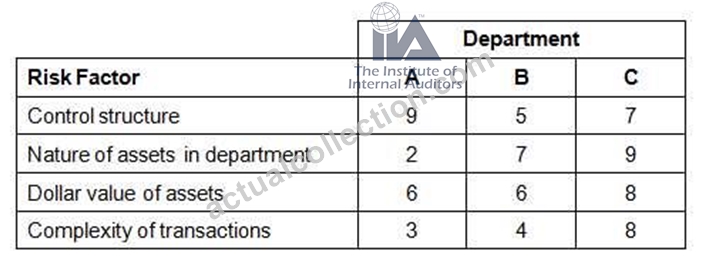
Which of the following statements regarding risk in the department is true?
- A. As compared to departments A and C, department B has a stronger control system to compensate for the greater complexity of the department's transactions and dollar value of its assets.
- B. The nature of department A's control structure may be justified by the nature of the department's assets and the complexity of its transactions.
- C. The internal audit activity should schedule audits of department B more often than audits of department C because of the relative control strength of department C as compared to department B.
- D. The relative ranking of the departments in order of their risk, from greatest to least risk, is: A; C; B.
Answer: B
Explanation:
Section: Volume C
Explanation/Reference:
NEW QUESTION # 113
An internal auditor s examination of accounts receivable generates the following results:
What is the projected misstatement for the population if ratio estimation is used?
- A. $84,000
- B. $2100.000
- C. $700,000
- D. $238,095
Answer: B
Explanation:
To determine the projected misstatement for the population using ratio estimation, the following calculation can be used:
Projected Misstatement=(Sample MisstatementSample Book Value)
×Population Book ValueProjected Misstatement=(Sample Book ValueSample Misstatement)
×Population Book Value
Given:
* Sample Misstatement = $420,000
* Sample Book Value = $12,000,000
* Population Book Value = $20,000,000
Projected Misstatement=(420,00012,000,000)×20,000,000Projected Misstatement=(12,000,000420,000)×20,
000,000
Projected Misstatement=0.035×20,000,000=700,000Projected Misstatement=0.035×20,000,000=700,000 Therefore, the projected misstatement is $700,000.
IIA Standards: 2320 - Analysis and Evaluation
IIA Practice Guide: Statistical Sampling
NEW QUESTION # 114
An organization owns vehicles that are kept off-site by employees to pick up and deliver orders. An internal auditor selects a specific vehicle from the fixed asset register for testing. Which of the following would best provide sufficient, indirect evidence for the auditor to confirm the existence of the vehicle?
- A. Seek independent confirmation of the vehicle's details from one of the delivery employees.
- B. Compare the registered details of the vehicle in the fixed asset register to a date-stamped photograph of the vehicle.
- C. Visit the home address of the specific employee to see the selected vehicle.
- D. Review logs of the vehicles assigned to employees for the delivery of goods during the engagement period.
Answer: B
Explanation:
To confirm the existence of a specific vehicle selected from the fixed asset register, the best indirect evidence would be to compare the registered details of the vehicle with a date-stamped photograph. This method provides a verifiable form of evidence that the vehicle exists and matches the details recorded in the asset register. It ensures that the vehicle is still in possession of the organization and can be indirectly verified without the need for physical presence at an off-site location.
IIA Practice Guide: "Auditing Fixed Assets"
COSO Internal Control - Integrated Framework
NEW QUESTION # 115
After the team member who specialized in fraud investigations left the internal audit team, the chief audit executive decided to outsource fraud investigations to a third party service provider on an as needed basis.
Which of the following is most likely to be a disadvantage of this outsourcing decision?
- A. Cost.
- B. Independence.
- C. Familiarity.
- D. Flexibility.
Answer: C
Explanation:
Outsourcing fraud investigations to a third-party service provider can result in a lack of familiarity with the organization's specific operations, culture, and history. This can be a disadvantage as external investigators may require more time to understand the context and nuances of the organization, potentially affecting the efficiency and effectiveness of the investigation. References: = IIA Standard 1210 - Proficiency and IIA Practice Guide: "Internal Audit and Fraud".
NEW QUESTION # 116
What is the primary purpose of issuing a preliminary communication to management of the area under review?
- A. To build good relations with management
- B. To help management develop more responsive and timely action plans
- C. To formally report medium- and high-risk observations in writing
- D. To improve the internal audit key performance indicators
Answer: B
Explanation:
The primary purpose of issuing a preliminary communication to management of the area under review is to help them develop more responsive and timely action plans. Preliminary communications, such as interim reports or discussions, inform management about the audit's progress, preliminary findings, and potential issues. This early communication allows management to begin addressing identified issues before the final report, leading to more timely and effective corrective actions. It also fosters collaboration and ensures management is engaged in the remediation process from the outset.References: The IIA's International Standards for the Professional Practice of Internal Auditing, Standard 2410.A1 - Communication Criteria.
NEW QUESTION # 117
An internal auditor is conducting an assurance engagement in the procurement area. The auditor follows a checklist of tasks prepared for the engagement. During the process, the auditor notices some deviations from the procurement procedure requirements. However, these deviations are not directly linked to and do not prevent the auditor from completing the checklist tasks. So, the auditor does not investigate these deviations further. Which checklist drawback most likely applies to this situation?
- A. Inability to keep the checklist up to date
- B. Over-reliance and a false sense of security
- C. Limited flexibility
- D. Standardization and a systematic approach
Answer: B
Explanation:
Checklists are helpful tools to ensure systematic coverage of procedures. However, one drawback noted in the CIA study materials is the risk of over-reliance, which can create a false sense of security. Auditors may feel that completing the checklist ensures engagement sufficiency, while overlooking important deviations outside the checklist. In this case, the auditor ignored procurement deviations because they were not on the checklist
- demonstrating the risk of over-reliance.
NEW QUESTION # 118
Which of the following types of internal audit consulting engagements is an example of a facilitation service?
I. Conducting control self-assessment workshops.
II. Participating on standing committees.
III. Reviewing regulatory compliance.
IV.
Benchmarking.
V.Estimating savings from outsourcing processes.
- A. II, III, and V only
- B. I, III, and IV only
- C. I, II, III, IV, and V.
- D. I and IV only
Answer: D
NEW QUESTION # 119
In which of the following populations would the internal auditor most likely choose to use a stratified sampling approach?
- A. Batches of materials that must be confirmed as meeting quality standards
- B. Inventory comprised of the same items stored in different warehouses
- C. Tax reports submitted to meet the requirements of the local taxation authority
- D. Revenue that is earned by an organization through cash receipts or as receivable.
Answer: D
Explanation:
Stratified sampling is used when the population can be divided into distinct subgroups (strata) that differ significantly from each other but are internally homogeneous. In the context of auditing, revenue earned through cash receipts or as receivables would have different characteristics and risk profiles. Stratifying the population allows the auditor to ensure that each subgroup is adequately represented in the sample, leading to more reliable and accurate audit conclusions.
References:
* The Institute of Internal Auditors (IIA) Practice Guide: Audit Sampling
* IIA Standard 2320 - Analysis and Evaluation
NEW QUESTION # 120
Which of the following statements is false regarding audit criteria?
- A. Audit criteria should be consistent across audit assignments.
- B. Audit criteria should provide flexibility but allow identification of nonadherence.
- C. Audit criteria should represent reasonable standards against which to assess existing conditions.
- D. Audit criteria should equate to good or acceptable management practices.
Answer: A
NEW QUESTION # 121
A recent survey indicated that residents of a small town take the train to a nearby city eight times per month, on average. The same survey showed that the number of train trips that a resident takes per month (y) is determined by the number of days per month that the resident works in the nearby city (x), according to the equation: y = 2 + 2x. A person who never works in the nearby city is expected to take the train:
- A. Four times per month.
- B. Eight times per month.
- C. Zero times per month.
- D. Two times per month.
Answer: D
Explanation:
Section: Volume B
NEW QUESTION # 122
Which of the following files, when compared with billing records, would provide the best source of information for determining if all goods shipped are billed to customers?
- A. Prenumbered customer invoices.
- B. Accounts receivable transactions.
- C. Prenumbered shipping documents.
- D. Customer purchase orders.
Answer: C
NEW QUESTION # 123
Which of the following actions by management would reduce an employee's opportunity to commit fraud?
- A. Defining ethical behavior expectations in the company handbook.
- B. Establishing physical controls over company assets.
- C. Eliminating bonuses tied to sales or other performance goals.
- D. Identifying consequences, such as termination, for fraudulent activities.
Answer: B
NEW QUESTION # 124
Five brand managers in a consumer products company met to determine how well certain promotions had performed. The data that they needed to analyze consisted of approximately 50 gigabytes of daily point-of-sale (POS) data for each month. The brand managers tried to download the POS data from the mainframe and import it into microcomputer spreadsheets for analysis. Their efforts were unsuccessful, most likely because of:
- A. Inconsistencies in the mainframe data due to lack of integrity constraints on the data files.
- B. Error-prone transmission links for downloading the data from the mainframe data files.
- C. The difficulty of establishing access privileges for each subset of the mainframe data.
- D. The complexity of the mainframe data structure and the large volume of data.
Answer: D
Explanation:
Section: Volume B
NEW QUESTION # 125
......
The IIA IIA-CIA-Part2 exam is comprised of 100 multiple choice questions and is administered in a computer-based format. Candidates are given a time limit of two hours to complete the exam. The passing score for the exam is 600 out of a possible 800 points.
Check your preparation for IIA IIA-CIA-Part2 On-Demand Exam: https://www.actualcollection.com/IIA-CIA-Part2-exam-questions.html
IIA-CIA-Part2 Dumps PDF And Certification Training: https://drive.google.com/open?id=1qMPl0JWMYBcA7_poVDQiiZ7f9X82ZHHt