

New 2026 Databricks-Generative-AI-Engineer-Associate exam questions Welcome to download the newest ActualCollection Databricks-Generative-AI-Engineer-Associate PDF dumps (75 Q&As)
P.S. Free 2026 Generative AI Engineer Databricks-Generative-AI-Engineer-Associate dumps are available on Google Drive shared by ActualCollection
NEW QUESTION # 40
A Generative Al Engineer has created a RAG application to look up answers to questions about a series of fantasy novels that are being asked on the author's web forum. The fantasy novel texts are chunked and embedded into a vector store with metadata (page number, chapter number, book title), retrieved with the user's query, and provided to an LLM for response generation. The Generative AI Engineer used their intuition to pick the chunking strategy and associated configurations but now wants to more methodically choose the best values.
Which TWO strategies should the Generative AI Engineer take to optimize their chunking strategy and parameters? (Choose two.)
- A. Choose an appropriate evaluation metric (such as recall or NDCG) and experiment with changes in the chunking strategy, such as splitting chunks by paragraphs or chapters.
Choose the strategy that gives the best performance metric. - B. Change embedding models and compare performance.
- C. Add a classifier for user queries that predicts which book will best contain the answer. Use this to filter retrieval.
- D. Pass known questions and best answers to an LLM and instruct the LLM to provide the best token count. Use a summary statistic (mean, median, etc.) of the best token counts to choose chunk size.
- E. Create an LLM-as-a-judge metric to evaluate how well previous questions are answered by the most appropriate chunk. Optimize the chunking parameters based upon the values of the metric.
Answer: A,E
Explanation:
To optimize a chunking strategy for a Retrieval-Augmented Generation (RAG) application, the Generative AI Engineer needs a structured approach to evaluating the chunking strategy, ensuring that the chosen configuration retrieves the most relevant information and leads to accurate and coherent LLM responses. Here's why C and E are the correct strategies:
Strategy C: Evaluation Metrics (Recall, NDCG)
Define an evaluation metric: Common evaluation metrics such as recall, precision, or NDCG (Normalized Discounted Cumulative Gain) measure how well the retrieved chunks match the user's query and the expected response.
Recall measures the proportion of relevant information retrieved.
NDCG is often used when you want to account for both the relevance of retrieved chunks and the ranking or order in which they are retrieved.
Experiment with chunking strategies: Adjusting chunking strategies based on text structure (e.g., splitting by paragraph, chapter, or a fixed number of tokens) allows the engineer to experiment with various ways of slicing the text. Some chunks may better align with the user's query than others.
Evaluate performance: By using recall or NDCG, the engineer can methodically test various chunking strategies to identify which one yields the highest performance. This ensures that the chunking method provides the most relevant information when embedding and retrieving data from the vector store.
Strategy E: LLM-as-a-Judge Metric
Use the LLM as an evaluator: After retrieving chunks, the LLM can be used to evaluate the quality of answers based on the chunks provided. This could be framed as a "judge" function, where the LLM compares how well a given chunk answers previous user queries.
Optimize based on the LLM's judgment: By having the LLM assess previous answers and rate their relevance and accuracy, the engineer can collect feedback on how well different chunking configurations perform in real-world scenarios.
This metric could be a qualitative judgment on how closely the retrieved information matches the user's intent.
Tune chunking parameters: Based on the LLM's judgment, the engineer can adjust the chunk size or structure to better align with the LLM's responses, optimizing retrieval for future queries.
By combining these two approaches, the engineer ensures that the chunking strategy is systematically evaluated using both quantitative (recall/NDCG) and qualitative (LLM judgment) methods. This balanced optimization process results in improved retrieval relevance and, consequently, better response generation by the LLM.
NEW QUESTION # 41
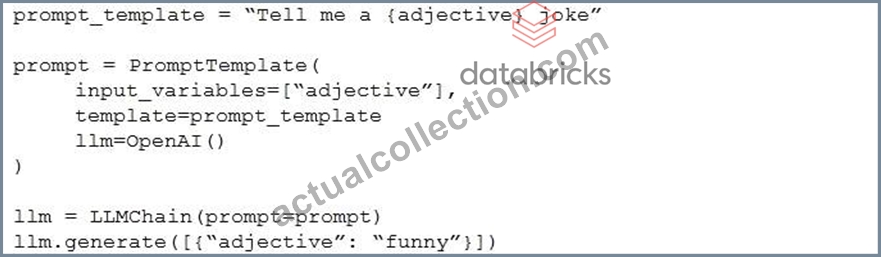
A Generative AI Engineer is testing a simple prompt template in LangChain using the code below, but is getting an error.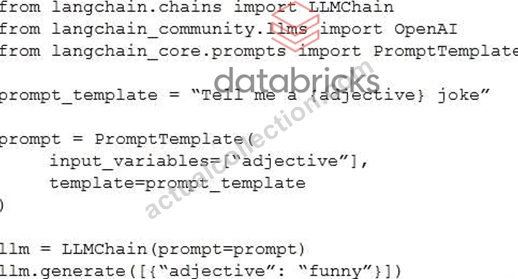
Assuming the API key was properly defined, what change does the Generative AI Engineer need to make to fix their chain?
- A.
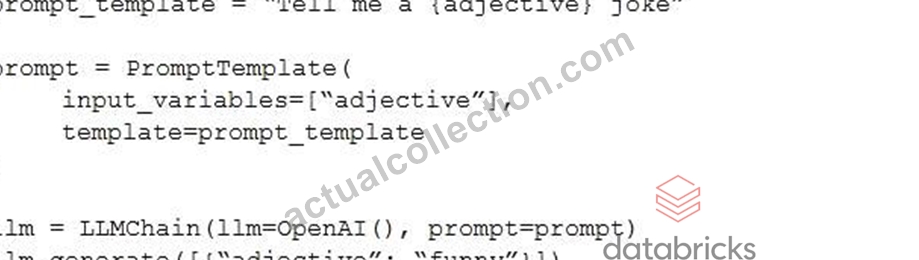
- B.
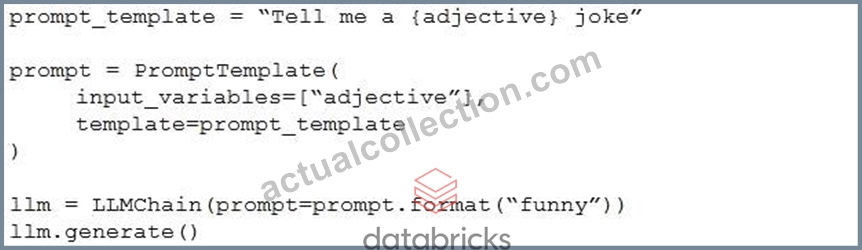
- C.
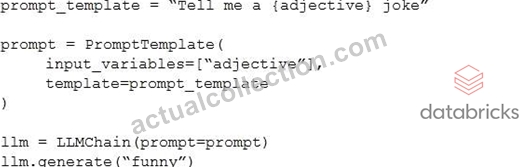
- D.
Answer: D
Explanation:
To fix the error in the LangChain code provided for using a simple prompt template, the correct approach is Option C. Here's a detailed breakdown of why Option C is the right choice and how it addresses the issue:
* Proper Initialization: In Option C, the LLMChain is correctly initialized with the LLM instance specified as OpenAI(), which likely represents a language model (like GPT) from OpenAI. This is crucial as it specifies which model to use for generating responses.
* Correct Use of Classes and Methods:
* The PromptTemplate is defined with the correct format, specifying that adjective is a variable within the template. This allows dynamic insertion of values into the template when generating text.
* The prompt variable is properly linked with the PromptTemplate, and the final template string is passed correctly.
* The LLMChain correctly references the prompt and the initialized OpenAI() instance, ensuring that the template and the model are properly linked for generating output.
Why Other Options Are Incorrect:
* Option A: Misuses the parameter passing in generate method by incorrectly structuring the dictionary.
* Option B: Incorrectly uses prompt.format method which does not exist in the context of LLMChain and PromptTemplate configuration, resulting in potential errors.
* Option D: Incorrect order and setup in the initialization parameters for LLMChain, which would likely lead to a failure in recognizing the correct configuration for prompt and LLM usage.
Thus, Option C is correct because it ensures that the LangChain components are correctly set up and integrated, adhering to proper syntax and logical flow required by LangChain's architecture. This setup avoids common pitfalls such as type errors or method misuses, which are evident in other options.
NEW QUESTION # 42
A Generative AI Engineer is testing a simple prompt template in LangChain using the code below, but is getting an error:
Python
from langchain.chains import LLMChain
from langchain_community.llms import OpenAI
from langchain_core.prompts import PromptTemplate
prompt_template = "Tell me a {adjective} joke"
prompt = PromptTemplate(input_variables=["adjective"], template=prompt_template)
# ... (Error-prone section)
Assuming the API key was properly defined, what change does the Generative AI Engineer need to make to fix their chain?
- A. (Incorrect structure)
- B. prompt_template = "Tell me a {adjective} joke"
prompt = PromptTemplate(input_variables=["adjective"], template=prompt_template) llm = OpenAI() llm_chain = LLMChain(prompt=prompt, llm=llm) llm_chain.generate([{"adjective": "funny"}]) - C. (Incorrect structure)
- D. (Incorrect structure)
Answer: B
Explanation:
The error in the original snippet usually stems from the improper instantiation of the LLMChain or the incorrect call to the .generate() method. In LangChain, an LLMChain requires two primary components: an LLM (the engine) and a Prompt (the template). Option C provides the correct syntax: first, the PromptTemplate is defined with the correct input_variables. Second, the OpenAI model is instantiated. Third, the LLMChain binds the model and the prompt together. Finally, the .generate() method expects a list of dictionaries, where each dictionary represents a set of inputs for the prompt variables. Options A, B, and D in the original image contain syntax errors such as passing the variable directly into the chain initialization or missing the dictionary list format required by the standard LangChain API for batch-like generation.
NEW QUESTION # 43
A Generative AI Engineer has a provisioned throughput model serving endpoint as part of a RAG application and would like to monitor the serving endpoint's incoming requests and outgoing responses. The current approach is to include a micro-service in between the endpoint and the user interface to write logs to a remote server.
Which Databricks feature should they use instead which will perform the same task?
- A. DBSQL
- B. Vector Search
- C. Lakeview
- D. Inference Tables
Answer: D
Explanation:
Problem Context: The goal is to monitor theserving endpointfor incoming requests and outgoing responses in aprovisioned throughput model serving endpointwithin aRetrieval-Augmented Generation (RAG) application. The current approach involves using a microservice to log requests and responses to a remote server, but the Generative AI Engineer is looking for a more streamlined solution within Databricks.
Explanation of Options:
* Option A: Vector Search: This feature is used to perform similarity searches within vector databases.
It doesn't provide functionality for logging or monitoring requests and responses in a serving endpoint, so it's not applicable here.
* Option B: Lakeview: Lakeview is not a feature relevant to monitoring or logging request-response cycles for serving endpoints. It might be more related to viewing data in Databricks Lakehouse but doesn't fulfill the specific monitoring requirement.
* Option C: DBSQL: Databricks SQL (DBSQL) is used for running SQL queries on data stored in Databricks, primarily for analytics purposes. It doesn't provide the direct functionality needed to monitor requests and responses in real-time for an inference endpoint.
* Option D: Inference Tables: This is the correct answer.Inference Tablesin Databricks are designed to store the results and metadata of inference runs. This allows the system to logincoming requests and outgoing responsesdirectly within Databricks, making it an ideal choice for monitoring the behavior of a provisioned serving endpoint. Inference Tables can be queried and analyzed, enabling easier monitoring and debugging compared to a custom microservice.
Thus,Inference Tablesare the optimal feature for monitoring request and response logs within the Databricks infrastructure for a model serving endpoint.
NEW QUESTION # 44
A generative AI engineer is deploying an AI agent authored with MLflow's ChatAgent interface for a retail company's customer support system on Databricks. The agent must handle thousands of inquiries daily, and the engineer needs to track its performance and quality in real-time to ensure it meets service-level agreements. Which metrics are automatically captured by default and made available for monitoring when the agent is deployed using the Mosaic AI Agent Framework?
- A. Operational metrics like request volume, latency, and errors
- B. Both operational and quality metrics
- C. No metrics are automatically captured
- D. Quality metrics like correctness and guideline adherence
Answer: A
Explanation:
When deploying an agent via the Mosaic AI Agent Framework (which leverages Databricks Model Serving), operational metrics are captured automatically by default. These include system-level telemetry such as the number of requests per second (volume), the time taken for the model to respond (latency), and the rate of 4xx/5xx HTTP errors. These are essential for monitoring Service Level Agreements (SLAs). However, Quality metrics (B), such as correctness, groundedness, or adherence to custom guidelines, cannot be determined "automatically" by the serving infrastructure because they require either human feedback or an LLM-as-a-judge evaluation (using Databricks Agent Evaluation). While Databricks makes it easy to generate quality metrics using the mlflow.evaluate API or the inference table, they are not "default operational metrics" that appear without additional evaluation configuration.
NEW QUESTION # 45
A Generative Al Engineer is tasked with developing an application that is based on an open source large language model (LLM). They need a foundation LLM with a large context window.
Which model fits this need?
- A. DistilBERT
- B. MPT-30B
- C. DBRX
- D. Llama2-70B
Answer: D
Explanation:
* Problem Context: The engineer needs an open-source LLM with a large context window to develop an application.
* Explanation of Options:
* Option A: DistilBERT: While an efficient and smaller version of BERT, DistilBERT does not provide a particularly large context window.
* Option B: MPT-30B: This model, while large, is not specified as being particularly notable for its context window capabilities.
* Option C: Llama2-70B: Known for its large model size and extensive capabilities, including a large context window. It is also available as an open-source model, making it ideal for applications requiring extensive contextual understanding.
* Option D: DBRX: This is not a recognized standard model in the context of large language models with extensive context windows.
Thus,Option C(Llama2-70B) is the best fit as it meets the criteria of having a large context window and being available for open-source use, suitable for developing robust language understanding applications.
NEW QUESTION # 46
A Generative Al Engineer is developing a RAG system for their company to perform internal document Q&A for structured HR policies, but the answers returned are frequently incomplete and unstructured It seems that the retriever is not returning all relevant context The Generative Al Engineer has experimented with different embedding and response generating LLMs but that did not improve results.
Which TWO options could be used to improve the response quality?
Choose 2 answers
- A. Add the section header as a prefix to chunks
- B. Increase the document chunk size
- C. Use a larger embedding model
- D. Split the document by sentence
- E. Fine tune the response generation model
Answer: A,B
Explanation:
The problem describes a Retrieval-Augmented Generation (RAG) system for HR policy Q&A where responses are incomplete and unstructured due to the retriever failing to return sufficient context. The engineer has already tried different embedding and response-generating LLMs without success, suggesting the issue lies in the retrieval process-specifically, how documents are chunked and indexed. Let's evaluate the options.
* Option A: Add the section header as a prefix to chunks
* Adding section headers provides additional context to each chunk, helping the retriever understand the chunk's relevance within the document structure (e.g., "Leave Policy: Annual Leave" vs. just "Annual Leave"). This can improve retrieval precision for structured HR policies.
* Databricks Reference:"Metadata, such as section headers, can be appended to chunks to enhance retrieval accuracy in RAG systems"("Databricks Generative AI Cookbook," 2023).
* Option B: Increase the document chunk size
* Larger chunks include more context per retrieval, reducing the chance of missing relevant information split across smaller chunks. For structured HR policies, this can ensure entire sections or rules are retrieved together.
* Databricks Reference:"Increasing chunk size can improve context completeness, though it may trade off with retrieval specificity"("Building LLM Applications with Databricks").
* Option C: Split the document by sentence
* Splitting by sentence creates very small chunks, which could exacerbate the problem by fragmenting context further. This is likely why the current system fails-it retrieves incomplete snippets rather than cohesive policy sections.
* Databricks Reference: No specific extract opposes this, but the emphasis on context completeness in RAG suggests smaller chunks worsen incomplete responses.
* Option D: Use a larger embedding model
* A larger embedding model might improve vector quality, but the question states that experimenting with different embedding models didn't help. This suggests the issue isn't embedding quality but rather chunking/retrieval strategy.
* Databricks Reference: Embedding models are critical, but not the focus when retrieval context is the bottleneck.
* Option E: Fine tune the response generation model
* Fine-tuning the LLM could improve response coherence, but if the retriever doesn't provide complete context, the LLM can't generate full answers. The root issue is retrieval, not generation.
* Databricks Reference: Fine-tuning is recommended for domain-specific generation, not retrieval fixes ("Generative AI Engineer Guide").
Conclusion: Options A and B address the retrieval issue directly by enhancing chunk context-either through metadata (A) or size (B)-aligning with Databricks' RAG optimization strategies. C would worsen the problem, while D and E don't target the root cause given prior experimentation.
NEW QUESTION # 47
A Generative Al Engineer is setting up a Databricks Vector Search that will lookup news articles by topic within 10 days of the date specified An example query might be "Tell me about monster truck news around January 5th 1992". They want to do this with the least amount of effort.
How can they set up their Vector Search index to support this use case?
- A. pass the query directly to the vector search index and return the best articles.
- B. Create separate indexes by topic and add a classifier model to appropriately pick the best index.
- C. Split articles by 10 day blocks and return the block closest to the query.
- D. Include metadata columns for article date and topic to support metadata filtering.
Answer: D
Explanation:
The task is to set up a Databricks Vector Search index for news articles, supporting queries like "monster truck news around January 5th, 1992," with minimal effort. The index must filter by topic and a 10-day date range. Let's evaluate the options.
* Option A: Split articles by 10-day blocks and return the block closest to the query
* Pre-splitting articles into 10-day blocks requires significant preprocessing and index management (e.g., one index per block). It's effort-intensive and inflexible for dynamic date ranges.
* Databricks Reference:"Static partitioning increases setup complexity; metadata filtering is preferred"("Databricks Vector Search Documentation").
* Option B: Include metadata columns for article date and topic to support metadata filtering
* Adding date and topic as metadata in the Vector Search index allows dynamic filtering (e.g., date
± 5 days, topic = "monster truck") at query time. This leverages Databricks' built-in metadata filtering, minimizing setup effort.
* Databricks Reference:"Vector Search supports metadata filtering on columns like date or category for precise retrieval with minimal preprocessing"("Vector Search Guide," 2023).
* Option C: Pass the query directly to the vector search index and return the best articles
* Passing the full query (e.g., "Tell me about monster truck news around January 5th, 1992") to Vector Search relies solely on embeddings, ignoring structured filtering for date and topic. This risks inaccurate results without explicit range logic.
* Databricks Reference:"Pure vector similarity may not handle temporal or categorical constraints effectively"("Building LLM Applications with Databricks").
* Option D: Create separate indexes by topic and add a classifier model to appropriately pick the best index
* Separate indexes per topic plus a classifier model adds significant complexity (index creation, model training, maintenance), far exceeding "least effort." It's overkill for this use case.
* Databricks Reference:"Multiple indexes increase overhead; single-index with metadata is simpler"("Databricks Vector Search Documentation").
Conclusion: Option B is the simplest and most effective solution, using metadata filtering in a single Vector Search index to handle date ranges and topics, aligning with Databricks' emphasis on efficient, low-effort setups.
NEW QUESTION # 48
A Generative Al Engineer is using an LLM to classify species of edible mushrooms based on text descriptions of certain features. The model is returning accurate responses in testing and the Generative Al Engineer is confident they have the correct list of possible labels, but the output frequently contains additional reasoning in the answer when the Generative Al Engineer only wants to return the label with no additional text.
Which action should they take to elicit the desired behavior from this LLM?
- A. Use zero shot prompting to instruct the model on expected output format
- B. Use a system prompt to instruct the model to be succinct in its answer
- C. Use few snot prompting to instruct the model on expected output format
- D. Use zero shot chain-of-thought prompting to prevent a verbose output format
Answer: B
Explanation:
The LLM classifies mushroom species accurately but includes unwanted reasoning text, and the engineer wants only the label. Let's assess how to control output format effectively.
* Option A: Use few shot prompting to instruct the model on expected output format
* Few-shot prompting provides examples (e.g., input: description, output: label). It can work but requires crafting multiple examples, which is effort-intensive and less direct than a clear instruction.
* Databricks Reference:"Few-shot prompting guides LLMs via examples, effective for format control but requires careful design"("Generative AI Cookbook").
* Option B: Use zero shot prompting to instruct the model on expected output format
* Zero-shot prompting relies on a single instruction (e.g., "Return only the label") without examples. It's simpler than few-shot but may not consistently enforce succinctness if the LLM's default behavior is verbose.
* Databricks Reference:"Zero-shot prompting can specify output but may lack precision without examples"("Building LLM Applications with Databricks").
* Option C: Use zero shot chain-of-thought prompting to prevent a verbose output format
* Chain-of-Thought (CoT) encourages step-by-step reasoning, which increases verbosity-opposite to the desired outcome. This contradicts the goal of label-only output.
* Databricks Reference:"CoT prompting enhances reasoning but often results in detailed responses"("Databricks Generative AI Engineer Guide").
* Option D: Use a system prompt to instruct the model to be succinct in its answer
* A system prompt (e.g., "Respond with only the species label, no additional text") sets a global instruction for the LLM's behavior. It's direct, reusable, and effective for controlling output style across queries.
* Databricks Reference:"System prompts define LLM behavior consistently, ideal for enforcing concise outputs"("Generative AI Cookbook," 2023).
Conclusion: Option D is the most effective and straightforward action, using a system prompt to enforce succinct, label-only responses, aligning with Databricks' best practices for output control.
NEW QUESTION # 49
A Generative Al Engineer is building a RAG application that answers questions about internal documents for the company SnoPen AI.
The source documents may contain a significant amount of irrelevant content, such as advertisements, sports news, or entertainment news, or content about other companies.
Which approach is advisable when building a RAG application to achieve this goal of filtering irrelevant information?
- A. Consolidate all SnoPen AI related documents into a single chunk in the vector database.
- B. Include in the system prompt that any information it sees will be about SnoPenAI, even if no data filtering is performed.
- C. Include in the system prompt that the application is not supposed to answer any questions unrelated to SnoPen Al.
- D. Keep all articles because the RAG application needs to understand non-company content to avoid answering questions about them.
Answer: C
Explanation:
In a Retrieval-Augmented Generation (RAG) application built to answer questions about internal documents, especially when the dataset contains irrelevant content, it's crucial to guide the system to focus on the right information. The best way to achieve this is by including a clear instruction in the system prompt (option C).
System Prompt as Guidance:
The system prompt is an effective way to instruct the LLM to limit its focus to SnoPen AI-related content. By clearly specifying that the model should avoid answering questions unrelated to SnoPen AI, you add an additional layer of control that helps the model stay on-topic, even if irrelevant content is present in the dataset.
Why This Approach Works:
The prompt acts as a guiding principle for the model, narrowing its focus to specific domains. This prevents the model from generating answers based on irrelevant content, such as advertisements or news unrelated to SnoPen AI.
Why Other Options Are Less Suitable:
A (Keep All Articles): Retaining all content, including irrelevant materials, without any filtering makes the system prone to generating answers based on unwanted data.
B (Include in the System Prompt about SnoPen AI): This option doesn't address irrelevant content directly, and without filtering, the model might still retrieve and use irrelevant data.
D (Consolidating Documents into a Single Chunk): Grouping documents into a single chunk makes the retrieval process less efficient and won't help filter out irrelevant content effectively.
Therefore, instructing the system in the prompt not to answer questions unrelated to SnoPen AI (option C) is the best approach to ensure the system filters out irrelevant information.
NEW QUESTION # 50
A Generative Al Engineer interfaces with an LLM with prompt/response behavior that has been trained on customer calls inquiring about product availability. The LLM is designed to output "In Stock" if the product is available or only the term "Out of Stock" if not.
Which prompt will work to allow the engineer to respond to call classification labels correctly?
- A. Respond with "In Stock" if the customer asks for a product.
- B. You will be given a customer call transcript where the customer inquires about product availability.Respond with "In Stock" if the product is available or "Out of Stock" if not.
- C. You will be given a customer call transcript where the customer asks about product availability. The outputs are either "In Stock" or "Out of Stock". Format the output in JSON, for example: {"call_id":
"123", "label": "In Stock"}. - D. Respond with "Out of Stock" if the customer asks for a product.
Answer: C
Explanation:
* Problem Context: The Generative AI Engineer needs a prompt that will enable an LLM trained on customer call transcripts to classify and respond correctly regarding product availability. The desired response should clearly indicate whether a product is "In Stock" or "Out of Stock," and it should be formatted in a way that is structured and easy to parse programmatically, such as JSON.
* Explanation of Options:
* Option A: Respond with "In Stock" if the customer asks for a product. This prompt is too generic and does not specify how to handle the case when a product is not available, nor does it provide a structured output format.
* Option B: This option is correctly formatted and explicit. It instructs the LLM to respond based on the availability mentioned in the customer call transcript and to format the response in JSON.
This structure allows for easy integration into systems that may need to process this information automatically, such as customer service dashboards or databases.
* Option C: Respond with "Out of Stock" if the customer asks for a product. Like option A, this prompt is also insufficient as it only covers the scenario where a product is unavailable and does not provide a structured output.
* Option D: While this prompt correctly specifies how to respond based on product availability, it lacks the structured output format, making it less suitable for systems that require formatted data for further processing.
Given the requirements for clear, programmatically usable outputs,Option Bis the optimal choice because it provides precise instructions on how to respond and includes a JSON format example for structuring the output, which is ideal for automated systems or further data handling.
NEW QUESTION # 51
A Generative AI Engineer is building a RAG application that will rely on context retrieved from source documents that are currently in PDF format. These PDFs can contain both text and images. They want to develop a solution using the least amount of lines of code.
Which Python package should be used to extract the text from the source documents?
- A. numpy
- B. beautifulsoup
- C. unstructured
- D. flask
Answer: B
Explanation:
* Problem Context: The engineer needs to extract text from PDF documents, which may contain both text and images. The goal is to find a Python package that simplifies this task using the least amount of code.
* Explanation of Options:
* Option A: flask: Flask is a web framework for Python, not suitable for processing or extracting content from PDFs.
* Option B: beautifulsoup: Beautiful Soup is designed for parsing HTML and XML documents, not PDFs.
* Option C: unstructured: This Python package is specifically designed to work with unstructured data, including extracting text from PDFs. It provides functionalities to handle various types of content in documents with minimal coding, making it ideal for the task.
* Option D: numpy: Numpy is a powerful library for numerical computing in Python and does not provide any tools for text extraction from PDFs.
Given the requirement,Option C(unstructured) is the most appropriate as it directly addresses the need to efficiently extract text from PDF documents with minimal code.
NEW QUESTION # 52
A Generative Al Engineer has built an LLM-based system that will automatically translate user text between two languages. They now want to benchmark multiple LLM's on this task and pick the best one. They have an evaluation set with known high quality translation examples. They want to evaluate each LLM using the evaluation set with a performant metric.
Which metric should they choose for this evaluation?
- A. NDCG metric
- B. ROUGE metric
- C. RECALL metric
- D. BLEU metric
Answer: D
Explanation:
The task is to benchmark LLMs for text translation using an evaluation set with known high-quality examples, requiring a performant metric. Let's evaluate the options.
* Option A: ROUGE metric
* ROUGE (Recall-Oriented Understudy for Gisting Evaluation) measures overlap between generated and reference texts, primarily for summarization. It's less suited for translation, where precision and word order matter more.
* Databricks Reference:"ROUGE is commonly used for summarization, not translation evaluation"("Generative AI Cookbook," 2023).
* Option B: BLEU metric
* BLEU (Bilingual Evaluation Understudy) evaluates translation quality by comparing n-gram overlap with reference translations, accounting for precision and brevity. It's widely used, performant, and appropriate for this task.
* Databricks Reference:"BLEU is a standard metric for evaluating machine translation, balancing accuracy and efficiency"("Building LLM Applications with Databricks").
* Option C: NDCG metric
* NDCG (Normalized Discounted Cumulative Gain) assesses ranking quality, not text generation.
It's irrelevant for translation evaluation.
* Databricks Reference:"NDCG is suited for ranking tasks, not generative output scoring" ("Databricks Generative AI Engineer Guide").
* Option D: RECALL metric
* Recall measures retrieved relevant items but doesn't evaluate translation quality (e.g., fluency, correctness). It's incomplete for this use case.
* Databricks Reference: No specific extract, but recall alone lacks the granularity of BLEU for text generation tasks.
Conclusion: Option B (BLEU) is the best metric for translation evaluation, offering a performant and standard approach, as endorsed by Databricks' guidance on generative tasks.
NEW QUESTION # 53
A Generative AI Engineer has been asked to design an LLM-based application that accomplishes the following business objective: answer employee HR questions using HR PDF documentation.
Which set of high level tasks should the Generative AI Engineer's system perform?
- A. Split HR documentation into chunks and embed into a vector store. Use the employee question to retrieve best matched chunks of documentation, and use the LLM to generate a response to the employee based upon the documentation retrieved.
- B. Use an LLM to summarize HR documentation. Provide summaries of documentation and user query into an LLM with a large context window to generate a response to the user.
- C. Calculate averaged embeddings for each HR document, compare embeddings to user query to find the best document. Pass the best document with the user query into an LLM with a large context window to generate a response to the employee.
- D. Create an interaction matrix of historical employee questions and HR documentation. Use ALS to factorize the matrix and create embeddings. Calculate the embeddings of new queries and use them to find the best HR documentation. Use an LLM to generate a response to the employee question based upon the documentation retrieved.
Answer: A
Explanation:
To design an LLM-based application that can answer employee HR questions using HR PDF documentation, the most effective approach is option D. Here's why:
Chunking and Vector Store Embedding:
HR documentation tends to be lengthy, so splitting it into smaller, manageable chunks helps optimize retrieval. These chunks are then embedded into a vector store (a database that stores vector representations of text). Each chunk of text is transformed into an embedding using a transformer-based model, which allows for efficient similarity-based retrieval.
Using Vector Search for Retrieval:
When an employee asks a question, the system converts their query into an embedding as well. This embedding is then compared with the embeddings of the document chunks in the vector store. The most semantically similar chunks are retrieved, which ensures that the answer is based on the most relevant parts of the documentation.
LLM to Generate a Response:
Once the relevant chunks are retrieved, these chunks are passed into the LLM, which uses them as context to generate a coherent and accurate response to the employee's question.
Why Other Options Are Less Suitable:
A (Calculate Averaged Embeddings): Averaging embeddings might dilute important information. It doesn't provide enough granularity to focus on specific sections of documents.
B (Summarize HR Documentation): Summarization loses the detail necessary for HR-related queries, which are often specific. It would likely miss the mark for more detailed inquiries.
C (Interaction Matrix and ALS): This approach is better suited for recommendation systems and not for HR queries, as it's focused on collaborative filtering rather than text-based retrieval.
Thus, option D is the most effective solution for providing precise and contextual answers based on HR documentation.
NEW QUESTION # 54
After changing the response generating LLM in a RAG pipeline from GPT-4 to a model with a shorter context length that the company self-hosts, the Generative AI Engineer is getting the following error:
What TWO solutions should the Generative AI Engineer implement without changing the response generating model? (Choose two.)
- A. Reduce the number of records retrieved from the vector database
- B. Decrease the chunk size of embedded documents
- C. Use a smaller embedding model to generate
- D. Reduce the maximum output tokens of the new model
- E. Retrain the response generating model using ALiBi
Answer: A,B
Explanation:
* Problem Context: After switching to a model with a shorter context length, the error message indicating that the prompt token count has exceeded the limit suggests that the input to the model is too large.
* Explanation of Options:
* Option A: Use a smaller embedding model to generate- This wouldn't necessarily address the issue of prompt size exceeding the model's token limit.
* Option B: Reduce the maximum output tokens of the new model- This option affects the output length, not the size of the input being too large.
* Option C: Decrease the chunk size of embedded documents- This would help reduce the size of each document chunk fed into the model, ensuring that the input remains within the model's context length limitations.
* Option D: Reduce the number of records retrieved from the vector database- By retrieving fewer records, the total input size to the model can be managed more effectively, keeping it within the allowable token limits.
* Option E: Retrain the response generating model using ALiBi- Retraining the model is contrary to the stipulation not to change the response generating model.
OptionsCandDare the most effective solutions to manage the model's shorter context length without changing the model itself, by adjusting the input size both in terms of individual document size and total documents retrieved.
NEW QUESTION # 55
A Generative Al Engineer is developing a RAG application and would like to experiment with different embedding models to improve the application performance.
Which strategy for picking an embedding model should they choose?
- A. Pick the most recent and most performant open LLM released at the time
- B. Pick an embedding model with multilingual support to support potential multilingual user questions
- C. pick the embedding model ranked highest on the Massive Text Embedding Benchmark (MTEB) leaderboard hosted by HuggingFace
- D. Pick an embedding model trained on related domain knowledge
Answer: D
Explanation:
The task involves improving a Retrieval-Augmented Generation (RAG) application's performance by experimenting with embedding models. The choice of embedding model impacts retrieval accuracy, which is critical for RAG systems. Let's evaluate the options based on Databricks Generative AI Engineer best practices.
Option A: Pick an embedding model trained on related domain knowledge
Embedding models trained on domain-specific data (e.g., industry-specific corpora) produce vectors that better capture the semantics of the application's context, improving retrieval relevance. For RAG, this is a key strategy to enhance performance.
Databricks Reference: "For optimal retrieval in RAG systems, select embedding models aligned with the domain of your data" ("Building LLM Applications with Databricks," 2023).
Option B: Pick the most recent and most performant open LLM released at the time LLMs are not embedding models; they generate text, not embeddings for retrieval. While recent LLMs may be performant for generation, this doesn't address the embedding step in RAG. This option misunderstands the component being selected.
Databricks Reference: Embedding models and LLMs are distinct in RAG workflows: "Embedding models convert text to vectors, while LLMs generate responses" ("Generative AI Cookbook").
Option C: Pick the embedding model ranked highest on the Massive Text Embedding Benchmark (MTEB) leaderboard hosted by HuggingFace The MTEB leaderboard ranks models across general tasks, but high overall performance doesn't guarantee suitability for a specific domain. A top-ranked model might excel in generic contexts but underperform on the engineer's unique data.
Databricks Reference: General performance is less critical than domain fit: "Benchmark rankings provide a starting point, but domain-specific evaluation is recommended" ("Databricks Generative AI Engineer Guide").
Option D: Pick an embedding model with multilingual support to support potential multilingual user questions Multilingual support is useful only if the application explicitly requires it. Without evidence of multilingual needs, this adds complexity without guaranteed performance gains for the current use case.
Databricks Reference: "Choose features like multilingual support based on application requirements" ("Building LLM-Powered Applications").
Conclusion: Option A is the best strategy because it prioritizes domain relevance, directly improving retrieval accuracy in a RAG system-aligning with Databricks' emphasis on tailoring models to specific use cases.
NEW QUESTION # 56
What is the most suitable library for building a multi-step LLM-based workflow?
- A. LangChain
- B. TensorFlow
- C. Pandas
- D. PySpark
Answer: A
Explanation:
* Problem Context: The Generative AI Engineer needs a tool to build amulti-step LLM-based workflow. This type of workflow often involves chaining multiple steps together, such as query generation, retrieval of information, response generation, and post-processing, with LLMs integrated at several points.
* Explanation of Options:
* Option A: Pandas: Pandas is a powerful data manipulation library for structured data analysis, but it is not designed for managing or orchestrating multi-step workflows, especially those involving LLMs.
* Option B: TensorFlow: TensorFlow is primarily used for training and deploying machine learning models, especially deep learning models. It is not designed for orchestrating multi-step tasks in LLM-based workflows.
* Option C: PySpark: PySpark is a distributed computing framework used for large-scale data processing. While useful for handling big data, it is not specialized for chaining LLM-based operations.
* Option D: LangChain: LangChain is a purpose-built framework designed specifically for orchestrating multi-step workflowswith large language models (LLMs). It enables developers to easily chain different tasks, such as retrieving documents, summarizing information, and generating responses, all in a structured flow. This makes it the best tool for building complex LLM-based workflows.
Thus,LangChainis the most suitable library for creating multi-step LLM-based workflows.
NEW QUESTION # 57
A Generative Al Engineer would like an LLM to generate formatted JSON from emails. This will require parsing and extracting the following information: order ID, date, and sender email. Here's a sample email: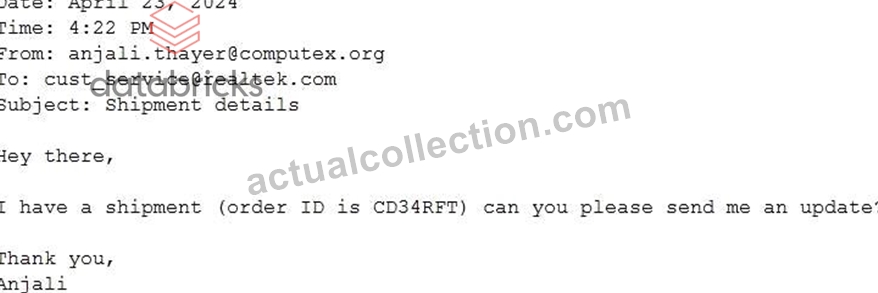
They will need to write a prompt that will extract the relevant information in JSON format with the highest level of output accuracy.
Which prompt will do that?
- A. You will receive customer emails and need to extract date, sender email, and order ID. You should return the date, sender email, and order ID information in JSON format.
- B. You will receive customer emails and need to extract date, sender email, and order ID. Return the extracted information in a human-readable format.
- C. You will receive customer emails and need to extract date, sender email, and order ID. Return the extracted information in JSON format.
- D. You will receive customer emails and need to extract date, sender email, and order ID. Return the extracted information in JSON format.
Here's an example: {"date": "April 16, 2024", "sender_email": "[email protected]", "order_id":
"RE987D"}
Answer: D
Explanation:
Problem Context: The goal is to parse emails to extract certain pieces of information and output this in a structured JSON format. Clarity and specificity in the prompt design will ensure higher accuracy in the LLM' s responses.
Explanation of Options:
* Option A: Provides a general guideline but lacks an example, which helps an LLM understand the exact format expected.
* Option B: Includes a clear instruction and a specific example of the output format. Providing an example is crucial as it helps set the pattern and format in which the information should be structured, leading to more accurate results.
* Option C: Does not specify that the output should be in JSON format, thus not meeting the requirement.
* Option D: While it correctly asks for JSON format, it lacks an example that would guide the LLM on how to structure the JSON correctly.
Therefore,Option Bis optimal as it not only specifies the required format but also illustrates it with an example, enhancing the likelihood of accurate extraction and formatting by the LLM.
NEW QUESTION # 58
A Generative Al Engineer is ready to deploy an LLM application written using Foundation Model APIs. They want to follow security best practices for production scenarios Which authentication method should they choose?
- A. Use OAuth machine-to-machine authentication
- B. Use a frequently rotated access token belonging to either a workspace user or a service principal
- C. Use an access token belonging to any workspace user
- D. Use an access token belonging to service principals
Answer: D
Explanation:
The task is to deploy an LLM application using Foundation Model APIs in a production environment while adhering to security best practices. Authentication is critical for securing access to Databricks resources, such as the Foundation Model API. Let's evaluate the options based on Databricks' security guidelines for production scenarios.
* Option A: Use an access token belonging to service principals
* Service principals are non-human identities designed for automated workflows and applications in Databricks. Using an access token tied to a service principal ensures that the authentication is scoped to the application, follows least-privilege principles (via role-based access control), and avoids reliance on individual user credentials. This is a security best practice for production deployments.
* Databricks Reference:"For production applications, use service principals with access tokens to authenticate securely, avoiding user-specific credentials"("Databricks Security Best Practices,"
2023). Additionally, the "Foundation Model API Documentation" states:"Service principal tokens are recommended for programmatic access to Foundation Model APIs."
* Option B: Use a frequently rotated access token belonging to either a workspace user or a service principal
* Frequent rotation enhances security by limiting token exposure, but tying the token to a workspace user introduces risks (e.g., user account changes, broader permissions). Including both user and service principal options dilutes the focus on application-specific security, making this less ideal than a service-principal-only approach. It also adds operational overhead without clear benefits over Option A.
* Databricks Reference:"While token rotation is a good practice, service principals are preferred over user accounts for application authentication"("Managing Tokens in Databricks," 2023).
* Option C: Use OAuth machine-to-machine authentication
* OAuth M2M (e.g., client credentials flow) is a secure method for application-to-service communication, often using service principals under the hood. However, Databricks' Foundation Model API primarily supports personal access tokens (PATs) or service principal tokens over full OAuth flows for simplicity in production setups. OAuth M2M adds complexity (e.g., managing refresh tokens) without a clear advantage in this context.
* Databricks Reference:"OAuth is supported in Databricks, but service principal tokens are simpler and sufficient for most API-based workloads"("Databricks Authentication Guide," 2023).
* Option D: Use an access token belonging to any workspace user
* Using a user's access token ties the application to an individual's identity, violating security best practices. It risks exposure if the user leaves, changes roles, or has overly broad permissions, and it's not scalable or auditable for production.
* Databricks Reference:"Avoid using personal user tokens for production applications due to security and governance concerns"("Databricks Security Best Practices," 2023).
Conclusion: Option A is the best choice, as it uses a service principal's access token, aligning with Databricks' security best practices for production LLM applications. It ensures secure, application-specific authentication with minimal complexity, as explicitly recommended for Foundation Model API deployments.
NEW QUESTION # 59
A Generative Al Engineer interfaces with an LLM with prompt/response behavior that has been trained on customer calls inquiring about product availability. The LLM is designed to output "In Stock" if the product is available or only the term "Out of Stock" if not.
Which prompt will work to allow the engineer to respond to call classification labels correctly?
- A. Respond with "In Stock" if the customer asks for a product.
- B. You will be given a customer call transcript where the customer inquires about product availability.
Respond with "In Stock" if the product is available or "Out of Stock" if not. - C. You will be given a customer call transcript where the customer asks about product availability. The outputs are either "In Stock" or "Out of Stock". Format the output in JSON, for example: {"call_id":
"123", "label": "In Stock"}. - D. Respond with "Out of Stock" if the customer asks for a product.
Answer: C
Explanation:
* Problem Context: The Generative AI Engineer needs a prompt that will enable an LLM trained on customer call transcripts to classify and respond correctly regarding product availability. The desired response should clearly indicate whether a product is "In Stock" or "Out of Stock," and it should be formatted in a way that is structured and easy to parse programmatically, such as JSON.
* Explanation of Options:
* Option A: Respond with "In Stock" if the customer asks for a product. This prompt is too generic and does not specify how to handle the case when a product is not available, nor does it provide a structured output format.
* Option B: This option is correctly formatted and explicit. It instructs the LLM to respond based on the availability mentioned in the customer call transcript and to format the response in JSON.
This structure allows for easy integration into systems that may need to process this information automatically, such as customer service dashboards or databases.
* Option C: Respond with "Out of Stock" if the customer asks for a product. Like option A, this prompt is also insufficient as it only covers the scenario where a product is unavailable and does not provide a structured output.
* Option D: While this prompt correctly specifies how to respond based on product availability, it lacks the structured output format, making it less suitable for systems that require formatted data for further processing.
Given the requirements for clear, programmatically usable outputs,Option Bis the optimal choice because it provides precise instructions on how to respond and includes a JSON format example for structuring the output, which is ideal for automated systems or further data handling.
NEW QUESTION # 60
A Generative AI Engineer is building a Generative AI system that suggests the best matched employee team member to newly scoped projects. The team member is selected from a very large team. Thematch should be based upon project date availability and how well their employee profile matches the project scope. Both the employee profile and project scope are unstructured text.
How should the Generative Al Engineer architect their system?
- A. Create a tool for finding team member availability given project dates, and another tool that uses an LLM to extract keywords from project scopes. Iterate through available team members' profiles and perform keyword matching to find the best available team member.
- B. Create a tool to find available team members given project dates. Create a second tool that can calculate a similarity score for a combination of team member profile and the project scope. Iterate through the team members and rank by best score to select a team member.
- C. Create a tool for finding available team members given project dates. Embed team profiles into a vector store and use the project scope and filtering to perform retrieval to find the available best matched team members.
- D. Create a tool for finding available team members given project dates. Embed all project scopes into a vector store, perform a retrieval using team member profiles to find the best team member.
Answer: C
NEW QUESTION # 61
......
Databricks-Generative-AI-Engineer-Associate exam questions from ActualCollection dumps: https://www.actualcollection.com/Databricks-Generative-AI-Engineer-Associate-exam-questions.html (75 Q&As)