

[UPDATED 2026] Free Microsoft AZ-305 Exam Questions Self-Assess Preparation
AZ-305 Free Sample Questions to Practice One Year Update
To prepare for the Microsoft AZ-305 certification exam, candidates should familiarize themselves with the exam objectives and study materials provided by Microsoft. They can also take online training courses or attend instructor-led training sessions to gain practical experience in Azure infrastructure design. Additionally, candidates can take practice exams to assess their readiness for the actual exam and identify areas where they need to improve.
Skills measured
- Download the study guide in the preceding “Tip” box for more details about the skills measured on this exam.
- Design business continuity solutions (10-15%)
- Design identity, governance, and monitoring solutions (25-30%)
- Design data storage solutions (25-30%)
- Design infrastructure solutions (25-30%)
NEW QUESTION # 257
You have an Azure subscription. The subscription contains Azure virtual machines that run Windows Server
2016 and Linux.
You need to use Azure Log Analytics design an alerting strategy for security-related events.
Which Log Analytics tables should you query? To answer, drag the appropriate tables to the correct log types.
Each value may be used once, more than once, or not at all. You may need to drag the split bar between panes or scroll to view content.
NOTE: Each correct selection is worth one point.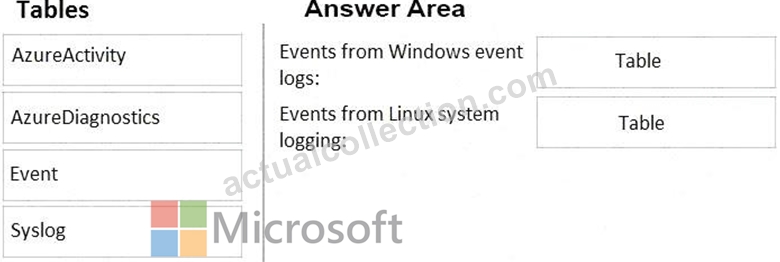
Answer:
Explanation: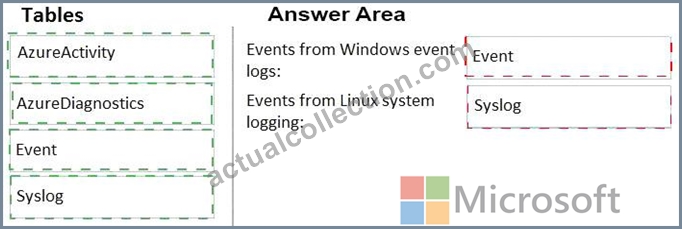
Explanation: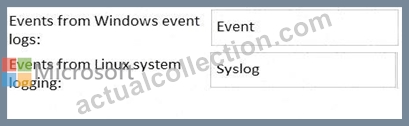
https://docs.microsoft.com/en-us/azure/azure-monitor/platform/log-analytics-agent Windows Event logs --> Information sent to the Windows event logging system. Syslog --> Information sent to the Linux event logging system.
NEW QUESTION # 258
You need to design an architecture to capture the creation of users and the assignment of roles. The captured data must be stored in Azure Cosmos DB.
Which Azure services should you include in the design? To answer, drag the appropriate services to the correct targets. Each service may be used once, more than once, or not at all. You may need to drag the split bar between panes or scroll to view content.
NOTE:Each correct selection is worth one point.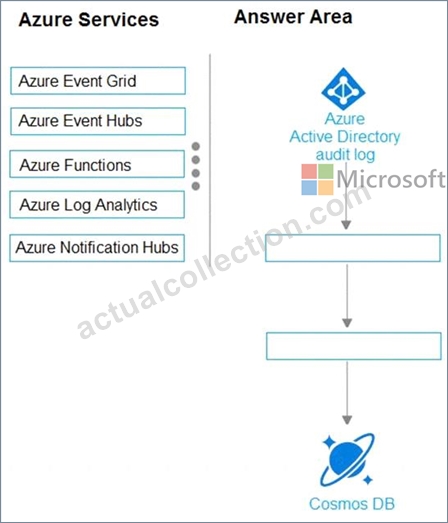
Answer:
Explanation: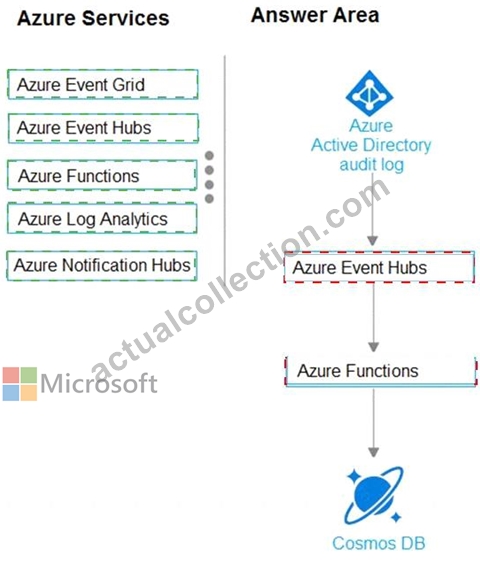
Explanation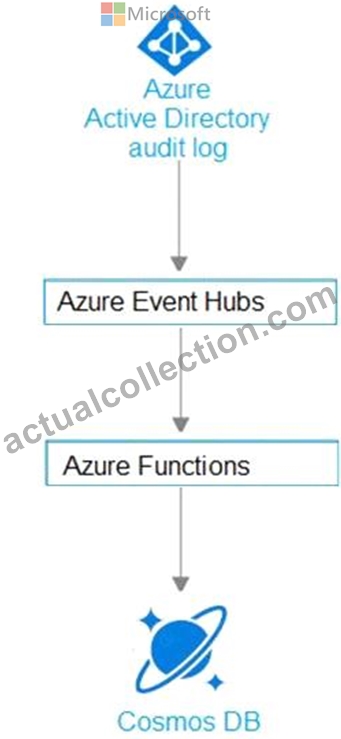
Diagram Description automatically generated
1. AAD audit log -> Event Hub (other two choices, LAW, storage, but not available in this question)
https://docs.microsoft.com/en-us/azure/active-directory/reports-monitoring/tutorial-azure-monitor-stream-logs-to
2. Azure function has the Event hub trigger and Cosmos output binding
a. Event Hub trigger for function
https://docs.microsoft.com/en-us/azure/azure-functions/functions-bindings-event-hubs-trigger?tabs=csharp
NEW QUESTION # 259
You are designing an Azure Cosmos DB solution that will host multiple writable replicas in multiple Azure regions.
You need to recommend the strongest database consistency level for the design. The solution must meet the following requirements:
* Provide a latency-based Service Level Agreement (SLA) for writes.
* Support multiple regions.
Which consistency level should you recommend?
- A. session
- B. consistent prefix
- C. strong
- D. bounded staleness
Answer: D
Explanation:
Explanation
Each level provides availability and performance tradeoffs. The following image shows the different consistency levels as a spectrum.
Timeline Description automatically generated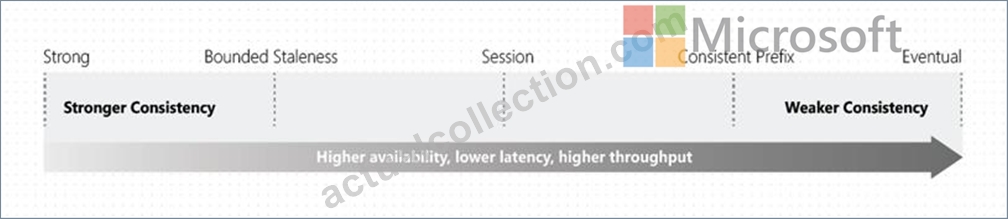
Note: The service offers comprehensive 99.99% SLAs which covers the guarantees for throughput, consistency, availability and latency for the Azure Cosmos DB Database Accounts scoped to a single Azure region configured with any of the five Consistency Levels or Database Accounts spanning multiple Azure regions, configured with any of the four relaxed Consistency Levels.
Reference:
https://azure.microsoft.com/en-us/support/legal/sla/cosmos-db/v1_3/
https://docs.microsoft.com/en-us/azure/cosmos-db/consistency-levels#consistency-levels-and-latency
NEW QUESTION # 260
Your company has 20 web APIs that were developed in-house.
The company is developing 10 web apps that will use the web APIs. The web apps and the APIs are registered in the company s Azure AD tenant. The web APIs are published by using Azure API Management.
You need to recommend a solution to block unauthorized requests originating from the web apps from reaching the web APIs. The solution must meet the following requirements:
* Use Azure AD-generated claims.
* Minimize configuration and management effort
What should you include in the recommendation? To answer, select the appropriate options in the answer are a. NOTE: Each correct selection is worth one point.
NOTE: Each correct selection is worth one point.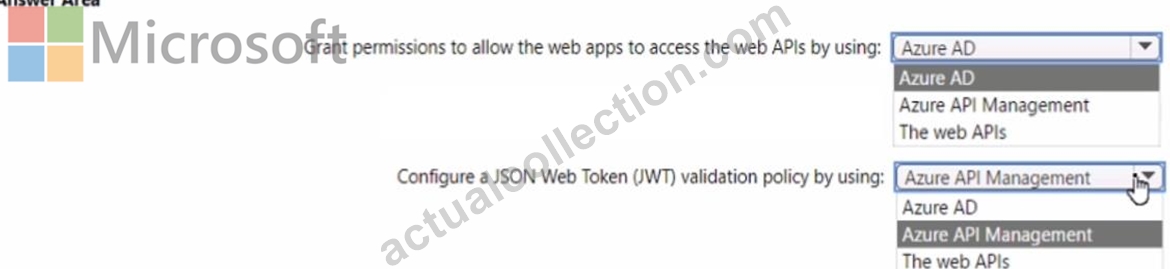
Answer:
Explanation: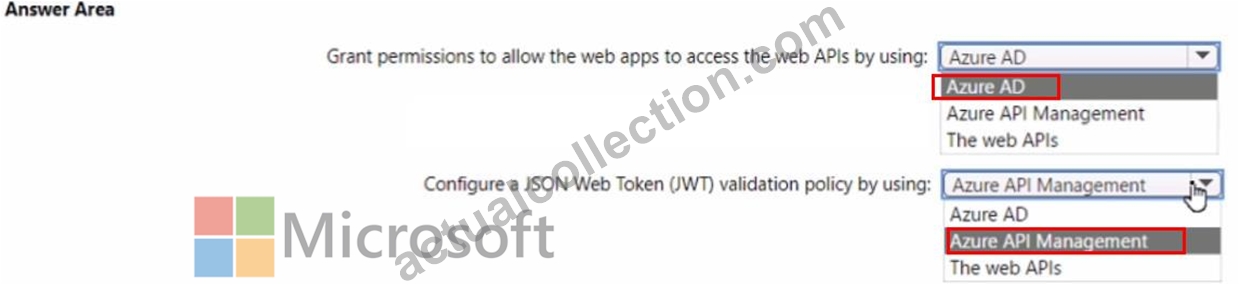
NEW QUESTION # 261
Your company, named Contoso, Ltd., implements several Azure logic apps that have HTTP triggers. The logic apps provide access to an on-premises web service.
Contoso establishes a partnership with another company named Fabrikam. IncL Fabrikam does not have an existing Azure Active Directory (Azure AD) tenant and uses third-party OAuth 2.0 identity management to authenticate its users.
I Developers at Fabrikam plan to use a subset of the logic apps to build applications that will integrate with the on-premises web service of Contoso.
You need to design a solution to provide the Fabrikam developers with access to the logic apps. The solution must meet the following requirements:
* Requests to the logic apps from the developers must be limited to lower rates than the requests from the users at Contoso.
* The developers must be able to rely on their existing OAuth 2.0 provider to gain access to the logic apps.
* The solution must NOT require changes to the logic apps.
* The solution must NOT use Azure AD guest accounts.
What should you include in the solution?
- A. Azure AD business-to-business (B2B)
- B. Azure AD Application Proxy
- C. Azure Front Door
- D. Azure API Management
Answer: D
Explanation:
API Management helps organizations publish APIs to external, partner, and internal developers to unlock the potential of their data and services.
You can secure API Management using the OAuth 2.0 client credentials flow.
Reference:
https://docs.microsoft.com/en-us/azure/api-management/api-management-key-concepts
https://docs.microsoft.com/en-us/azure/api-management/api-management-features
https://docs.microsoft.com/en-us/azure/api-management/api-management-howto-protect-backend-with-aad#enable-oauth-20-user-authorization-in-the-developer-console
NEW QUESTION # 262
You have 12 on-premises data sources that contain customer information and consist of Microsoft SQL Server, MySQL, and Oracle databases.
You have an Azure subscription.
You plan to create an Azure Data Lake Storage account that will consolidate the customer information for analysis and reporting.
You need to recommend a solution to automatically copy new information from the data sources to the Data Lake Storage account by using extract, transform and load (ETL). The solution must minimize administrative effort.
What should you include in the recommendation?
- A. Azure Data Explorer
- B. Azure Data Studio
- C. Azure Data Factory
- D. Azure Data Share
Answer: C
NEW QUESTION # 263
You have the resources shown in the following table.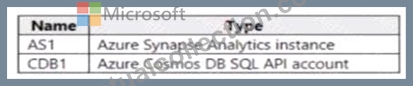
CDB1 hosts a container that stores continuously updated operational data You are designing a solution that will use AS1 to analyze the operational data dairy.
You need to recommend a solution to analyze the data without affecting the performance of the operational data store.
What should you include in the recommendation?
- A. Azure Synapse Analytics with PolyBase data loading
- B. Azure Cosmos DB change feed
- C. Azure Data Factory with Azure Cosmos DB and Azure Synapse Analytics connectors
Answer: A
NEW QUESTION # 264
You have an Azure subscription.
You need to recommend a solution to provide developers with the ability to provision Azure virtual machines. The solution must meet the following requirements:
- Only allow the creation of the virtual machines in specific regions.
- Only allow the creation of specific sizes of virtual machines.
What should you include in the recommendation?
- A. Conditional Access policies
- B. Azure Policy
- C. role-based access control (RBAC)
- D. Azure Resource Manager (ARM) templates
Answer: B
Explanation:
Allowed virtual machine size SKUs This policy enables you to specify a set of virtual machine size SKUs that your organization can deploy. Allowed locations This policy enables you to restrict the locations your organization can specify when deploying resources. Use to enforce your geo- compliance requirements. Excludes resource groups, Microsoft.AzureActiveDirectory/b2cDirectories, and resources that use the 'global' region.
https://docs.microsoft.com/en-us/azure/governance/policy/samples/built-in-policies
NEW QUESTION # 265
You need to design a solution that will execute custom C# code in response to an event routed to Azure Event Grid. The solution must meet the following requirements:
The executed code must be able to access the private IP address of a Microsoft SQL Server instance that runs on an Azure virtual machine.
Costs must be minimized.
What should you include in the solution?
- A. Azure Logic Apps in the integrated service environment
- B. Azure Functions in the Consumption plan
- C. Azure Logic Apps in the Consumption plan
- D. Azure Functions in the Dedicated plan and the Basic Azure App Service plan
Answer: B
Explanation:
When you create a function app in Azure, you must choose a hosting plan for your app. There are three basic hosting plans available for Azure Functions: Consumption plan, Premium plan, and Dedicated (App Service) plan.
For the Consumption plan, you don't have to pay for idle VMs or reserve capacity in advance.
Connect to private endpoints with Azure Functions
As enterprises continue to adopt serverless (and Platform-as-a-Service, or PaaS) solutions, they often need a way to integrate with existing resources on a virtual network. These existing resources could be databases, file storage, message queues or event streams, or REST APIs.
Reference:
https://docs.microsoft.com/en-us/azure/azure-functions/functions-scale
https://techcommunity.microsoft.com/t5/azure-functions/connect-to-private-endpoints-with-azure-functions/ba-p Reference:
https://docs.microsoft.com/en-us/azure/azure-functions/functions-scale#hosting-plans-comparison
NEW QUESTION # 266
You have two on-premises Microsoft SQL Server 2017 instances that host an Always On availability group named AG1. AG1 contains a single database named DB1.
You have an Azure subscription that contains a virtual machine named VM1VM1 runs Linux and contains a SQL Server 2019 instance.
You need to migrate DB1 to VMI. The solution must minimize downtime on DBI. What should you do? To answer, select the appropriate options in the answer area.
NOTE: Each correct selection is worth one point.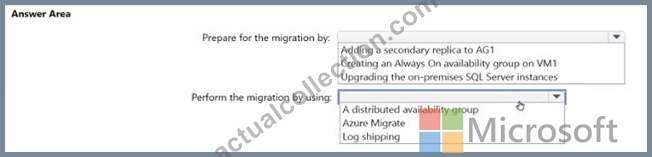
Answer:
Explanation: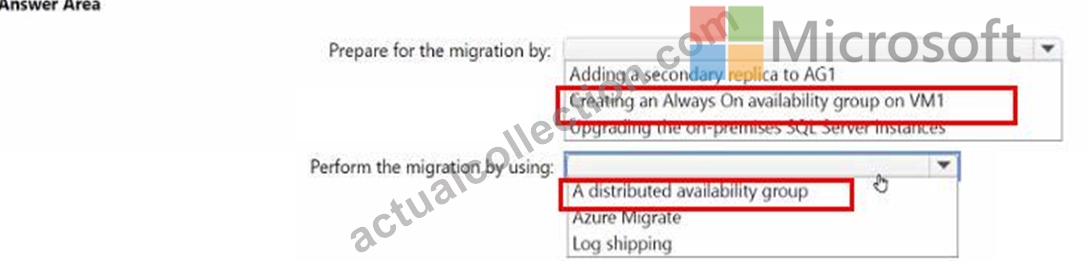
NEW QUESTION # 267
You need to implement the Azure RBAC role assignment. The solution must meet the authentication and authorization requirements.
How many assignment should you configure for the Network Contributor role for Role1? To answer, select appropriate in the answer area.
NOTE: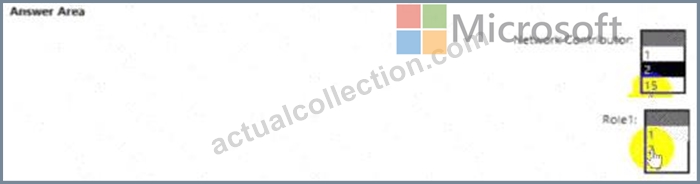
Answer:
Explanation: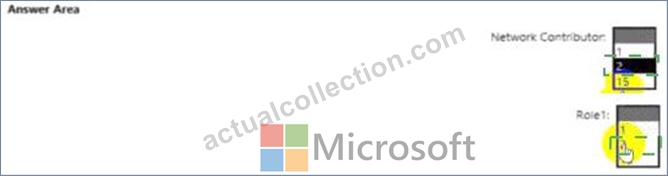
Explanation:
NEW QUESTION # 268
You are designing a microservices architecture that will be hosted in an Azure Kubernetes Service (AKS) cluster. Apps that will consume the microservices will be hosted on Azure virtual machines. The virtual machines and the AKS cluster will reside on the same virtual network.
You need to design a solution to expose the microservices to the consumer apps. The solution must meet the following requirements:
* Ingress access to the microservices must be restricted to a single private IP address and protected by using mutual TLS authentication.
* The number of incoming microservice calls must be rate-limited.
* Costs must be minimized.
What should you include in the solution?
- A. Azure API Management Standard tier with a service endpoint
- B. Azure API Management Premium tier with virtual network connection
- C. Azure Front Door with Azure Web Application Firewall (WAF)
- D. Azure App Gateway with Azure Web Application Firewall (WAF)
Answer: B
Explanation:
One option is to deploy APIM (API Management) inside the cluster VNet.
The AKS cluster and the applications that consume the microservices might reside within the same VNet, hence there is no reason to expose the cluster publicly as all API traffic will remain within the VNet. For these scenarios, you can deploy API Management into the cluster VNet. API Management Premium tier supports VNet deployment.
Reference:
https://docs.microsoft.com/en-us/azure/api-management/api-management-kubernetes
NEW QUESTION # 269
You are designing a cost-optimized solution that uses Azure Batch to run two types of jobs on Linux nodes. The first job type will consist of short-running tasks for a development environment. The second job type will consist of long-running Message Passing Interface (MPI) applications for a production environment that requires timely job completion.
You need to recommend the pool type and node type for each job type. The solution must minimize compute charges and leverage Azure Hybrid Benefit whenever possible.
What should you recommend? To answer, select the appropriate options in the answer area.
NOTE: Each correct selection is worth one point.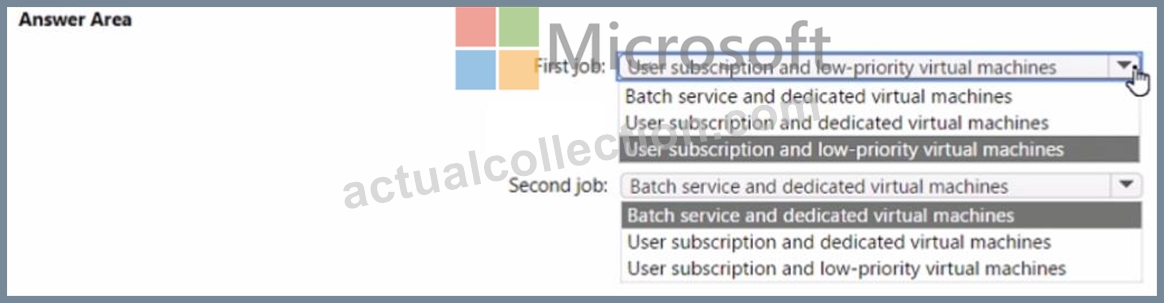
Answer:
Explanation: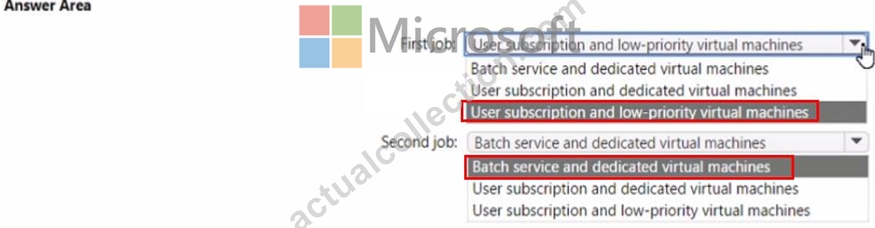
NEW QUESTION # 270
You have an Azure subscription. The subscription has a blob container that contains multiple blobs. Ten users in the finance department of your company plan to access the blobs during the month of April. You need to recommend a solution to enable access to the blobs during the month of April only. Which security solution should you include in the recommendation?
- A. certificates
- B. shared access signatures (SAS)
- C. conditional access policies
- D. access keys
Answer: B
Explanation:
Reference:
https://docs.microsoft.com/en-us/azure/storage/common/storage-sas-overview This allows for limited-time fine grained access control to resources. So you can generate URL, specify duration (for month of April) and disseminate URL to 10 team members. On May 1, the SAS token is automatically invalidated, denying team members continued access.
NEW QUESTION # 271
Case Study 1 - Litware
Existing Environment
Azure Environment
Litware has 10 Azure subscriptions that are linked to the Litware.com tenant and five Azure subscriptions that are linked to the dev.litware.com tenant. All the subscriptions are in an Enterprise Agreement (EA).
The litware.com tenant contains a custom Azure role-based access control (Azure RBAC) role named Role1 that grants the DataActions read permission to the blobs and files in Azure Storage.
On-Premises Environment
The on-premises network of Litware contains the resources shown in the following table.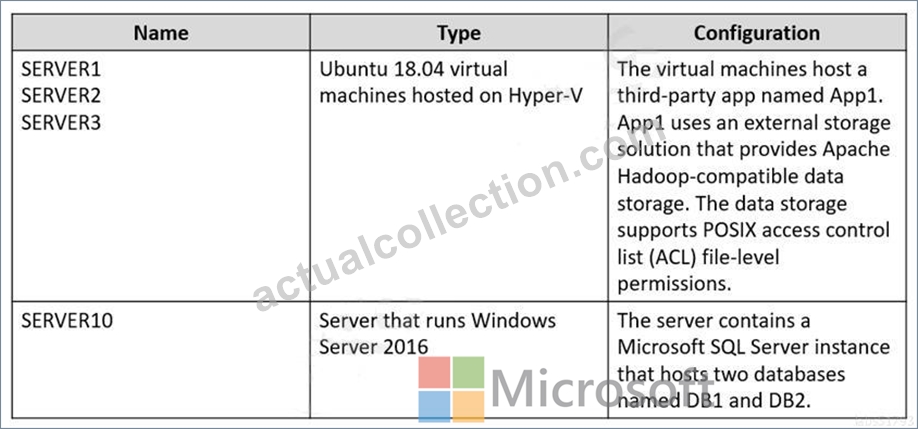
Network Environment
Litware has ExpressRoute connectivity to Azure.
Planned Changes and Requirements
Litware plans to implement the following changes:
* Migrate DB1 and DB2 to Azure.
* Migrate App1 to Azure virtual machines.
* Migrate the external storage used by App1 to Azure Storage.
* Deploy the Azure virtual machines that will host App1 to Azure dedicated hosts.
Authentication and Authorization Requirements
Litware identifies the following authentication and authorization requirements:
* Only users that manage the production environment by using the Azure portal must connect from a hybrid Azure AD-joined device and authenticate by using Azure Multi-Factor Authentication (MFA).
* The Network Contributor built-in RBAC role must be used to grant permissions to the network administrators for all the virtual networks in all the Azure subscriptions.
* To access the resources in Azure, App1 must use the managed identity of the virtual machines that will host the app.
* RBAC roles must be applied at the highest level possible.
Resiliency Requirements
Litware identifies the following resiliency requirements:
* Once migrated to Azure, DB1 and DB2 must meet the following requirements:
- Maintain availability if two availability zones in the local Azure region fail.
- Fail over automatically.
- Minimize I/O latency.
* App1 must meet the following requirements:
- Be hosted in an Azure region that supports availability zones.
- Be hosted on Azure virtual machines that support automatic scaling.
- Maintain availability if two availability zones in the local Azure region fail.
Security and Compliance Requirements
Litware identifies the following security and compliance requirements:
* Once App1 is migrated to Azure, you must ensure that new data can be written to the app, and the modification of new and existing data is prevented for a period of three years.
* On-premises users and services must be able to access the Azure Storage account that will host the data in App1.
* Access to the public endpoint of the Azure Storage account that will host the App1 data must be prevented.
* All Azure SQL databases in the production environment must have Transparent Data Encryption (TDE) enabled.
* App1 must NOT share physical hardware with other workloads.
Business Requirements
Litware identifies the following business requirements:
* Minimize administrative effort.
* Minimize costs.
You plan to migrate App1 to Azure. The solution must meet the authentication and authorization requirements.
Which type of endpoint should App1 use to obtain an access token?
- A. Azure AD
- B. Azure Instance Metadata Service (IMDS)
- C. Microsoft identity platform
- D. Azure Service Management
Answer: C
Explanation:
Scenario: To access the resources in Azure, App1 must use the managed identity of the virtual machines that will host the app.
Managed identities provide an identity for applications to use when connecting to resources that support Azure Active Directory (Azure AD) authentication. Applications may use the managed identity to obtain Azure AD tokens.
Reference:
https://docs.microsoft.com/en-us/azure/active-directory/managed-identities-azure- resources/overview
NEW QUESTION # 272
Note: This question is part of a series of questions that present the same scenario. Each question in the series contains a unique solution that might meet the stated goals. Some question sets might have more than one correct solution, while others might not have a correct solution.
After you answer a question in this section, you will NOT be able to return to it. As a result, these questions will not appear in the review screen.
You have an Azure Storage account that contains two 1-GB data files named File1 and File2. The data files are set to use the archive access tier.
You need to ensure that File1 is accessible immediately when a retrieval request is initiated.
Solution: For File1, you set Access tier to Cool.
Does this meet the goal?
- A. No
- B. Yes
Answer: B
Explanation:
Explanation
The data in the cool tier is "considered / intended to be stored for 30 days". But this is not a must. You can store data indefinitely in the cool tier. The mentioned reference (see below) even gives an example of large scientific or otherwise large data which is stored for long duration in the cool tier.
https://docs.microsoft.com/en-us/azure/storage/blobs/storage-blob-storage-tiers?tabs=azure-portal
NEW QUESTION # 273
A company has an existing web application that runs on virtual machines (VMs) in Azure.
You need to ensure that the application is protected from SQL injection attempts and uses a layer-7 load balancer. The solution must minimize disruption to the code for the existing web application.
What should you recommend? To answer, drag the appropriate values to the correct items. Each value may be used once, more than once, or not at all. You may need to drag the split bar between panes or scroll to view content.
NOTE: Each correct selection is worth one point.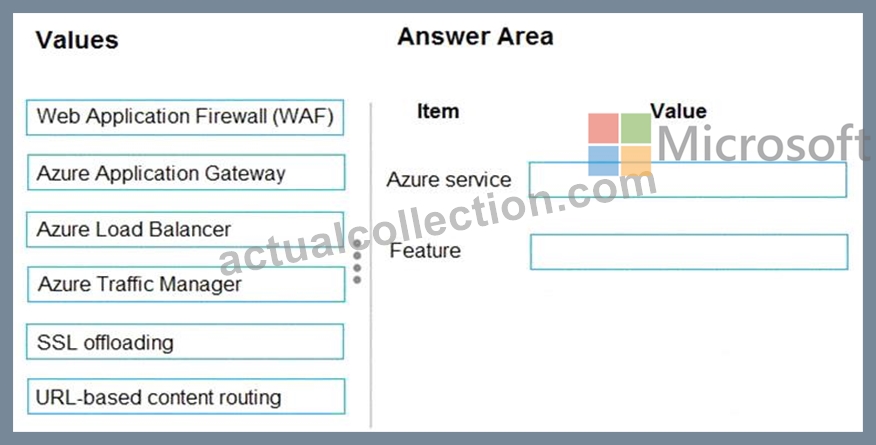
Answer:
Explanation: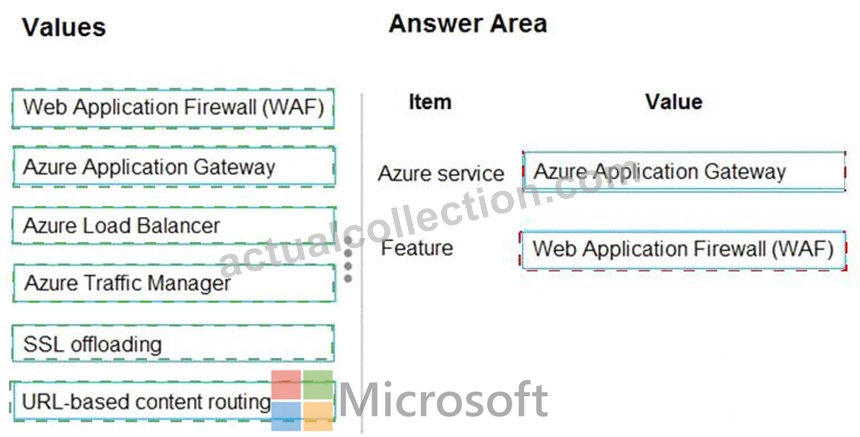
Explanation: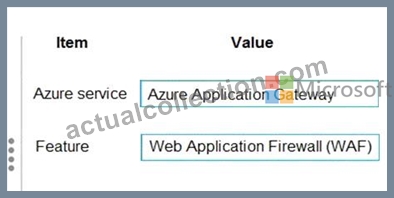
Box 1: Azure Application Gateway
Azure Application Gateway provides an application delivery controller (ADC) as a service. It offers various layer 7 load-balancing capabilities for your applications.
Box 2: Web Application Firwewall (WAF)
Application Gateway web application firewall (WAF) protects web applications from common vulnerabilities and exploits.
This is done through rules that are defined based on the OWASP core rule sets 3.0 or 2.2.9.
There are rules that detects SQL injection attacks.
References:
https://docs.microsoft.com/en-us/azure/application-gateway/application-gateway-faq
https://docs.microsoft.com/en-us/azure/application-gateway/waf-overview
NEW QUESTION # 274
You plan to migrate App1 to Azure.
You need to recommend a storage solution for App1 that meets the security and compliance requirements.
Which type of storage should you recommend, and how should you recommend configuring the storage? To answer, select the appropriate options in the answer area.
NOTE: Each correct selection is worth one point.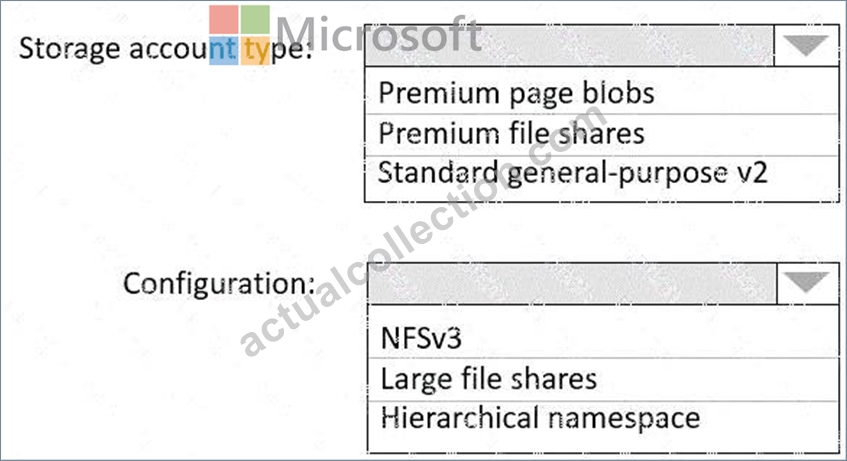
Answer:
Explanation: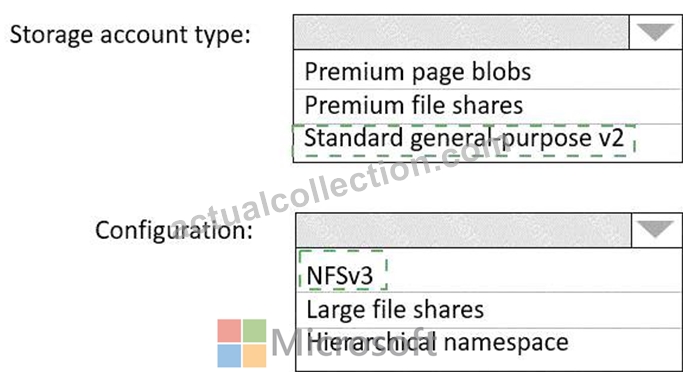
Explanation
Text, table Description automatically generated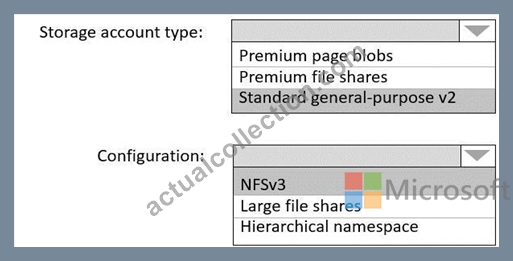
Box 1: Standard general-purpose v2
Standard general-purpose v2 supports Blob Storage.
Azure Storage provides data protection for Blob Storage and Azure Data Lake Storage Gen2.
Scenario:
Litware identifies the following security and compliance requirements:
* Once App1 is migrated to Azure, you must ensure that new data can be written to the app, and the modification of new and existing data is prevented for a period of three years.
* On-premises users and services must be able to access the Azure Storage account that will host the data in App1.
* Access to the public endpoint of the Azure Storage account that will host the App1 data must be prevented.
* All Azure SQL databases in the production environment must have Transparent Data Encryption (TDE) enabled.
* App1 must NOT share physical hardware with other workloads.
Box 2: NFSv3
Scenario: Plan: Migrate App1 to Azure virtual machines.
Blob storage now supports the Network File System (NFS) 3.0 protocol. This support provides Linux file system compatibility at object storage scale and prices and enables Linux clients to mount a container in Blob storage from an Azure Virtual Machine (VM) or a computer on-premises.
Reference:
https://docs.microsoft.com/en-us/azure/storage/blobs/data-protection-overview
NEW QUESTION # 275
You need to deploy resources to host a stateless web app in an Azure subscription. The solution must meet the following requirements:
* Provide access to the full .NET framework.
* Provide redundancy if an Azure region fails.
* Grant administrators access to the operating system to install custom application dependencies.
Solution: You deploy a Azure virtual machine scale set that uses autoscaling.
Does this meet the goal?
- A. Yes
- B. No
Answer: B
Explanation:
Instead, you should deploy two Azure virtual machines to two Azure regions, and you create a Traffic Manager profile.
NEW QUESTION # 276
You are designing an Azure web app.
You plan to deploy the web app to the North Europe Azure region and the West Europe Azure region.
You need to recommend a solution for the web app. The solution must meet the following requirements:
Users must always access the web app from the North Europe region, unless the region fails.
The web app must be available to users if an Azure region is unavailable.
Deployment costs must be minimized.
What should you include in the recommendation? To answer, select the appropriate options in the answer area.
NOTE: Each correct selection is worth one point.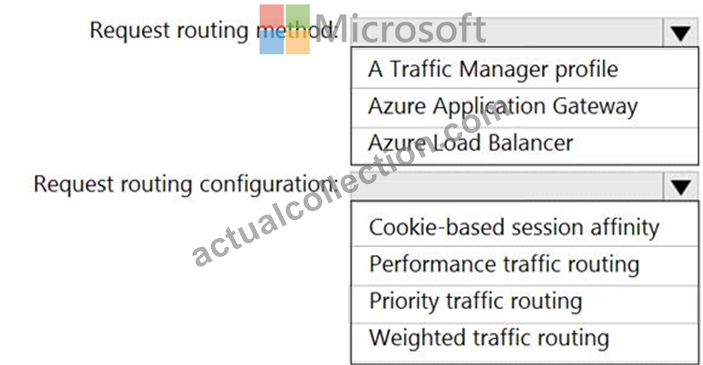
Answer:
Explanation: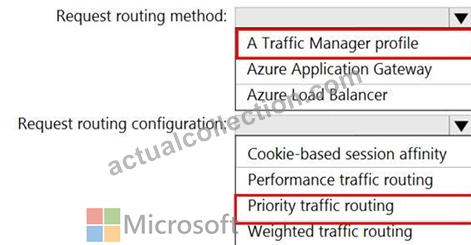
NEW QUESTION # 277
You have an app that generates 50,000 events daily.
You plan to Stream the events to an Azure event hub and use Event Hubs Capture to implement cold path processing Of the events Output Of Event Hubs Capture will be consumed by a reporting system.
You reed to identify which type of Azure storage must be provisioned to support Event Hubs Capture, and which inbound data format the reporting system must support.
What should you identity? To answer. select the appropriate options in the answer are a.
NOTE: Each correct selection is worth one point.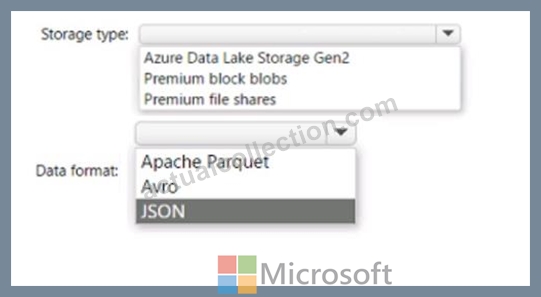
Answer:
Explanation: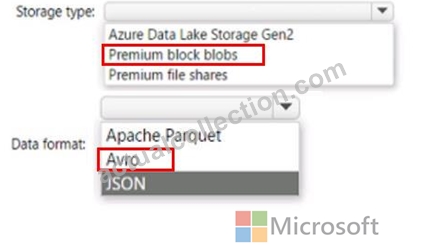
NEW QUESTION # 278
You need to implement the Azure RBAC role assignment. The solution must meet the authentication and authorization requirements.
How many assignment should you configure for the Network Contributor role for Role1? To answer, select appropriate in the answer area.
NOTE: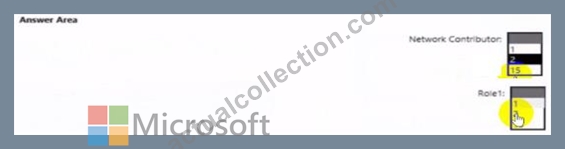
Answer:
Explanation: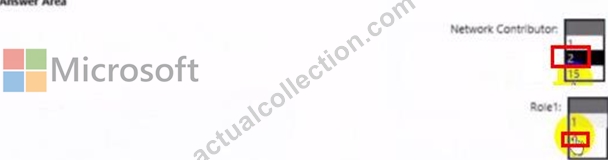
NEW QUESTION # 279
You are evaluating whether to use Azure Traffic Manager and Azure Application Gateway to meet the connection requirements for App1.
What is the minimum numbers of instances required for each service? To answer, select the appropriate options in the answer area.
NOTE: Each correct selection is worth one point.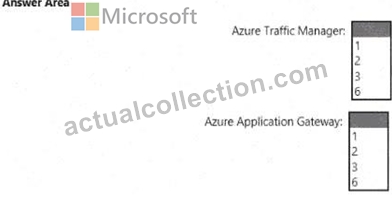
Answer:
Explanation: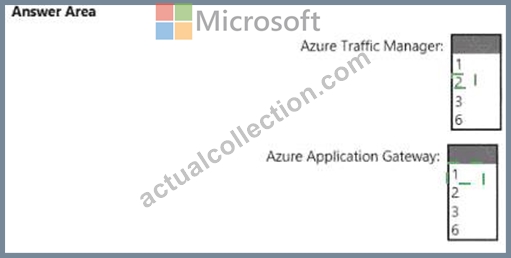
Explanation: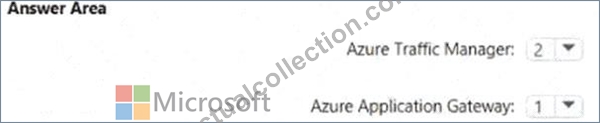
NEW QUESTION # 280
You need to design a storage solution for an app that will store large amounts of frequently used dat a. The solution must meet the following requirements:
Maximize data throughput.
Prevent the modification of data for one year.
Minimize latency for read and write operations.
Which Azure Storage account type and storage service should you recommend? To answer, select the appropriate options in the answer area.
NOTE: Each correct selection is worth one point.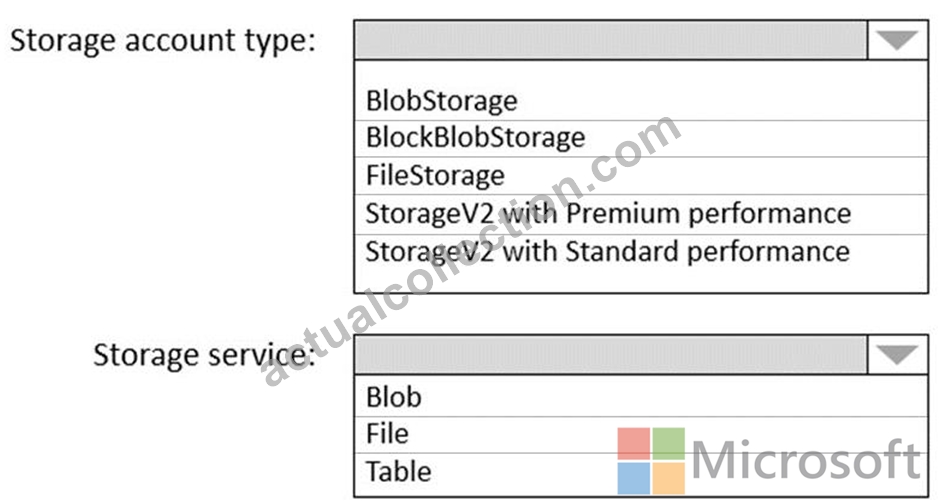
Answer:
Explanation: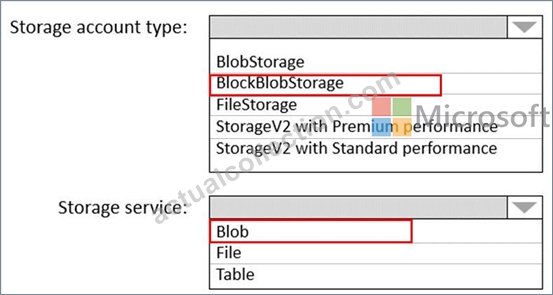
Reference:
https://docs.microsoft.com/en-us/azure/storage/blobs/archive-blob
NEW QUESTION # 281
Your company has the divisions shown in the following table.
You plan to deploy a custom application to each subscription. The application will contain the following:
* A resource group
* An Azure web app
* Custom role assignments
* An Azure Cosmos DB account
You need to use Azure Blueprints to deploy the application to each subscription.
What is the minimum number of objects required to deploy the application? To answer, select the appropriate options in the answer area.
NOTE: Each correct selection is worth one point.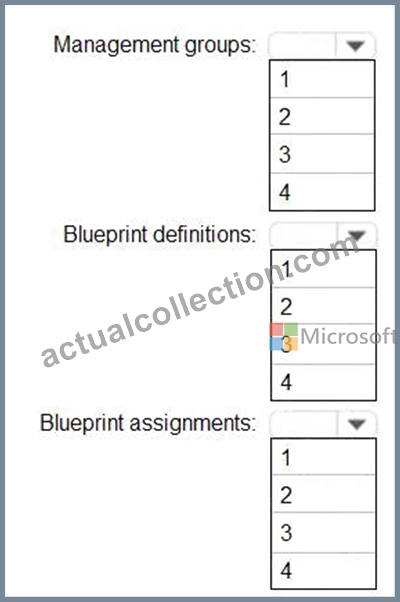
Answer:
Explanation: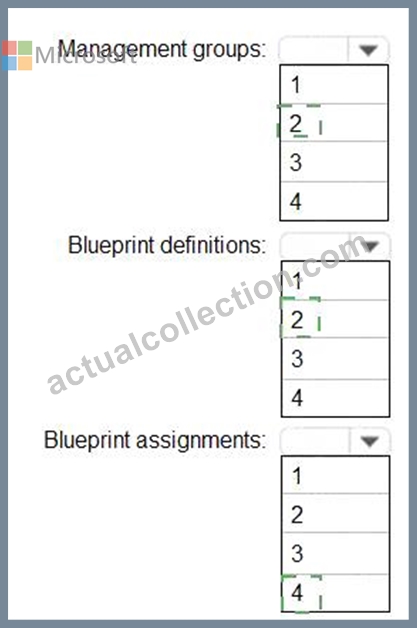
Explanation:
Box 1: 2
One management group for East, and one for West.
When creating a blueprint definition, you'll define where the blueprint is saved. Blueprints can be saved to a management group or subscription that you have Contributor access to. If the location is a management group, the blueprint is available to assign to any child subscription of that management group.
Box 2: 2
Box 3: 4
One assignment for each subscription.
"Assigning a blueprint definition to a management group means the assignment object exists at the management group. The deployment of artifacts still targets a subscription. To perform a management group assignment, the Create Or Update REST API must be used and the request body must include a value for properties.scope to define the target subscription."
https://docs.microsoft.com/en-us/azure/governance/blueprints/overview#blueprint-assignment
NEW QUESTION # 282
......
Real exam questions are provided for Microsoft Azure Solutions Architect Expert tests, which can make sure you 100% pass: https://www.actualcollection.com/AZ-305-exam-questions.html
Download AZ-305 exam with Microsoft AZ-305 Real Exam Questions: https://drive.google.com/open?id=1ebqK3V5eK6uaugE96Id--bX0hkYVnFy6