

Updated Microsoft DP-203 Dumps – Check Free DP-203 Exam Dumps (2025)
Updated DP-203 exam with Microsoft Real Exam Questions
Microsoft DP-203 (Data Engineering on Microsoft Azure) Certification Exam is a professional level certification exam offered by Microsoft for data engineers who design and implement data solutions on Azure. Data Engineering on Microsoft Azure certification is intended for professionals who have a working knowledge of Azure data services, including Azure SQL Database, Azure Data Lake Storage, Azure Synapse Analytics, and Azure Stream Analytics.
Earning the Microsoft DP-203 certification demonstrates that a candidate has the skills and knowledge needed to design, implement, and manage data solutions in a cloud-based environment. Data Engineering on Microsoft Azure certification is highly valued by employers and can help data professionals advance their careers by opening up new job opportunities and higher salaries. Overall, the DP-203 certification exam is an excellent way for data professionals to validate their skills and knowledge in data engineering on Microsoft Azure.
Microsoft DP-203 (Data Engineering on Microsoft Azure) exam is designed to assess the skills and knowledge of data professionals who work on the Azure platform. Data Engineering on Microsoft Azure certification exam is one of the most widely recognized and respected credentials in the field of data engineering. Passing DP-203 exam demonstrates that an individual has a thorough understanding of the tools and technologies used for data engineering on Microsoft Azure.
NEW QUESTION # 170
You have an Azure Synapse Analytics dedicated SQL pool.
You need to ensure that data in the pool is encrypted at rest. The solution must NOT require modifying applications that query the data.
What should you do?
- A. Enable encryption at rest for the Azure Data Lake Storage Gen2 account.
- B. Use a customer-managed key to enable double encryption for the Azure Synapse workspace.
- C. Create an Azure key vault in the Azure subscription grant access to the pool.
- D. Enable Transparent Data Encryption (TDE) for the pool.
Answer: D
Explanation:
Explanation
Transparent Data Encryption (TDE) helps protect against the threat of malicious activity by encrypting and decrypting your data at rest. When you encrypt your database, associated backups and transaction log files are encrypted without requiring any changes to your applications. TDE encrypts the storage of an entire database by using a symmetric key called the database encryption key.
Reference:
https://docs.microsoft.com/en-us/azure/synapse-analytics/sql-data-warehouse/sql-data-warehouse-overviewmana
NEW QUESTION # 171
You are building an Azure Data Factory solution to process data received from Azure Event Hubs, and then ingested into an Azure Data Lake Storage Gen2 container.
The data will be ingested every five minutes from devices into JSON files. The files have the following naming pattern.
/{deviceType}/in/{YYYY}/{MM}/{DD}/{HH}/{deviceID}_{YYYY}{MM}{DD}HH}{mm}.json You need to prepare the data for batch data processing so that there is one dataset per hour per deviceType.
The solution must minimize read times.
How should you configure the sink for the copy activity? To answer, select the appropriate options in the answer area.
NOTE: Each correct selection is worth one point.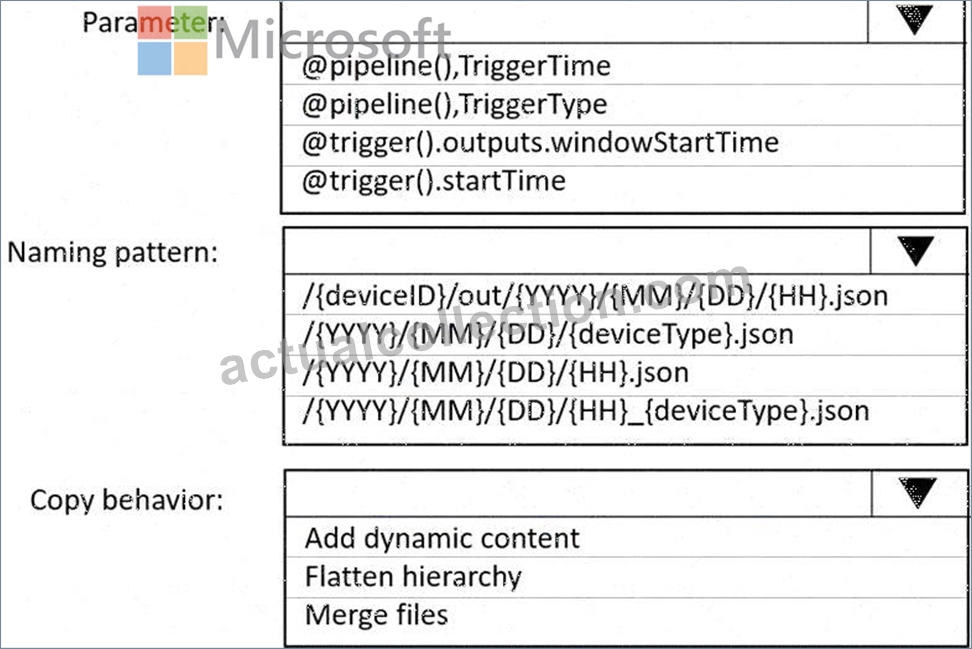
Answer:
Explanation: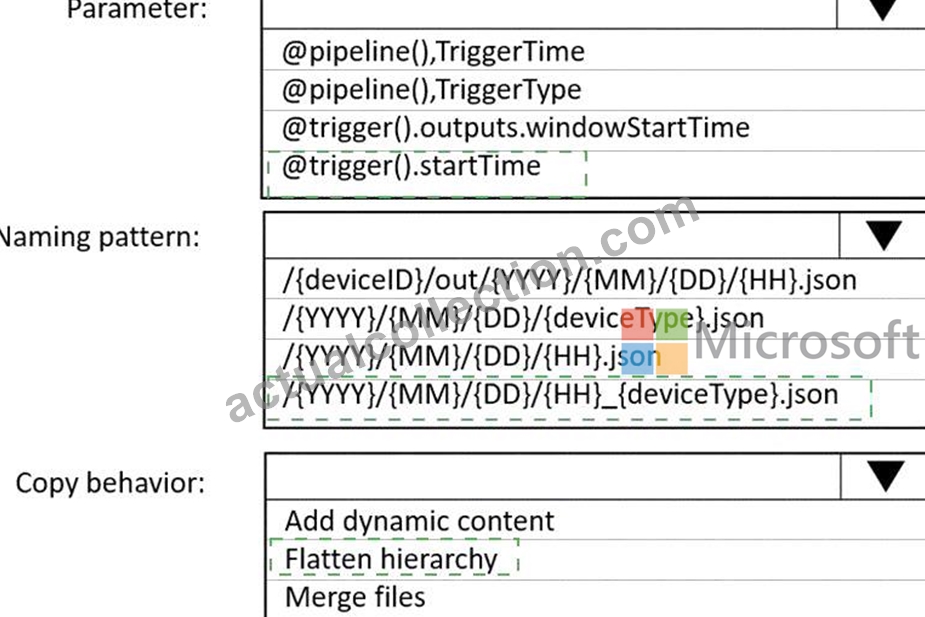
Explanation:
Box 1: @trigger().startTime
startTime: A date-time value. For basic schedules, the value of the startTime property applies to the first occurrence. For complex schedules, the trigger starts no sooner than the specified startTime value.
Box 2: /{YYYY}/{MM}/{DD}/{HH}_{deviceType}.json
One dataset per hour per deviceType.
Box 3: Flatten hierarchy
- FlattenHierarchy: All files from the source folder are in the first level of the target folder. The target files have autogenerated names.
Reference:
https://docs.microsoft.com/en-us/azure/data-factory/concepts-pipeline-execution-triggers
https://docs.microsoft.com/en-us/azure/data-factory/connector-file-system
NEW QUESTION # 172
You have an Azure Storage account that generates 200,000 new files daily. The file names have a format of
{YYYY}/{MM}/{DD}/{HH}/{CustomerID}.csv.
You need to design an Azure Data Factory solution that will load new data from the storage account to an Azure Data Lake once hourly. The solution must minimize load times and costs.
How should you configure the solution? To answer, select the appropriate options in the answer area.
NOTE: Each correct selection is worth one point.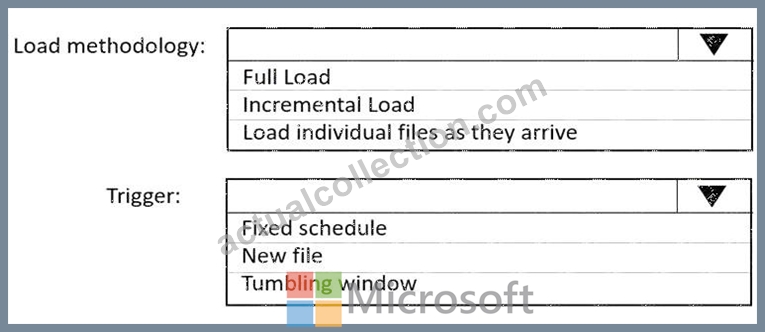
Answer:
Explanation: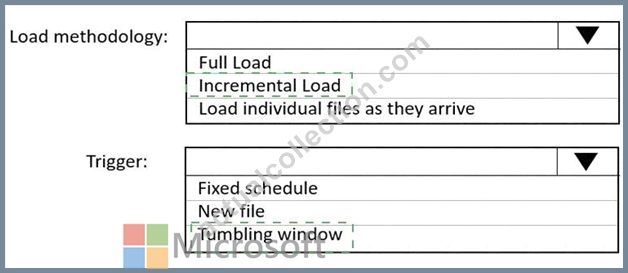
Explanation
Table Description automatically generated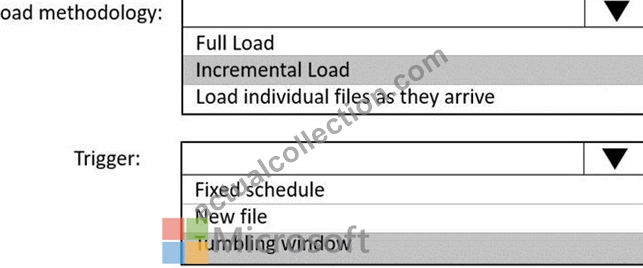
Box 1: Incremental load
Box 2: Tumbling window
Tumbling windows are a series of fixed-sized, non-overlapping and contiguous time intervals. The following diagram illustrates a stream with a series of events and how they are mapped into 10-second tumbling windows.
Timeline Description automatically generated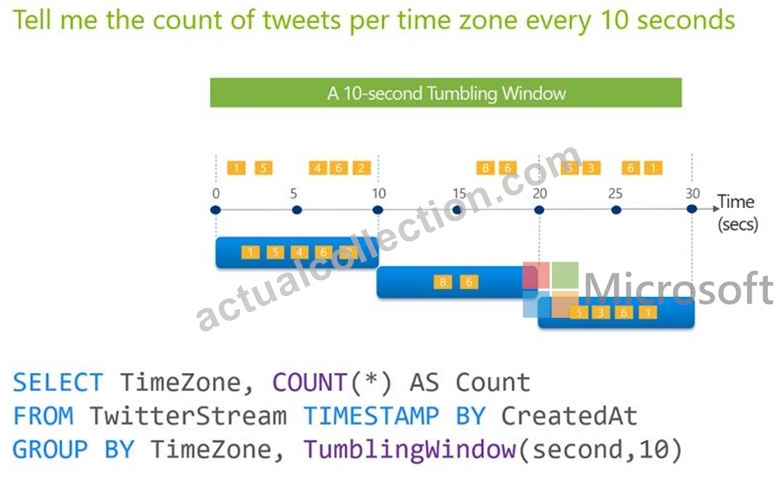
Reference:
https://docs.microsoft.com/en-us/stream-analytics-query/tumbling-window-azure-stream-analytics
NEW QUESTION # 173
You need to design an analytical storage solution for the transactional data. The solution must meet the sales transaction dataset requirements.
What should you include in the solution? To answer, select the appropriate options in the answer area.
NOTE: Each correct selection is worth one point.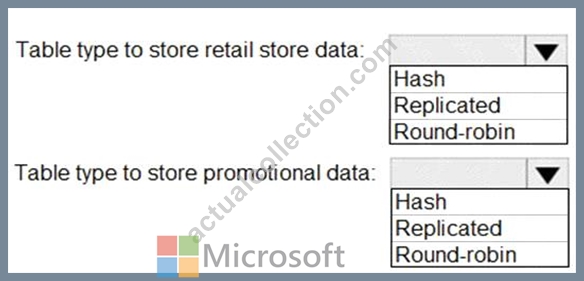
Answer:
Explanation: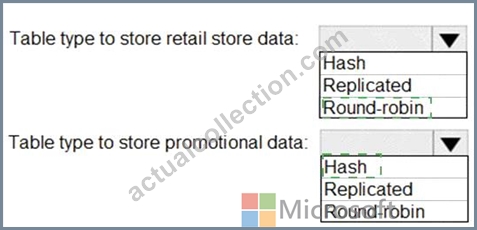
Explanation
Graphical user interface, text, application, table Description automatically generated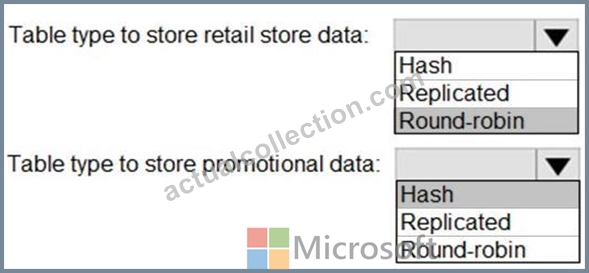
Box 1: Round-robin
Round-robin tables are useful for improving loading speed.
Scenario: Partition data that contains sales transaction records. Partitions must be designed to provide efficient loads by month.
Box 2: Hash
Hash-distributed tables improve query performance on large fact tables.
Reference:
https://docs.microsoft.com/en-us/azure/synapse-analytics/sql-data-warehouse/sql-data-warehouse-tables-distribu
NEW QUESTION # 174
You configure version control for an Azure Data Factory instance as shown in the following exhibit.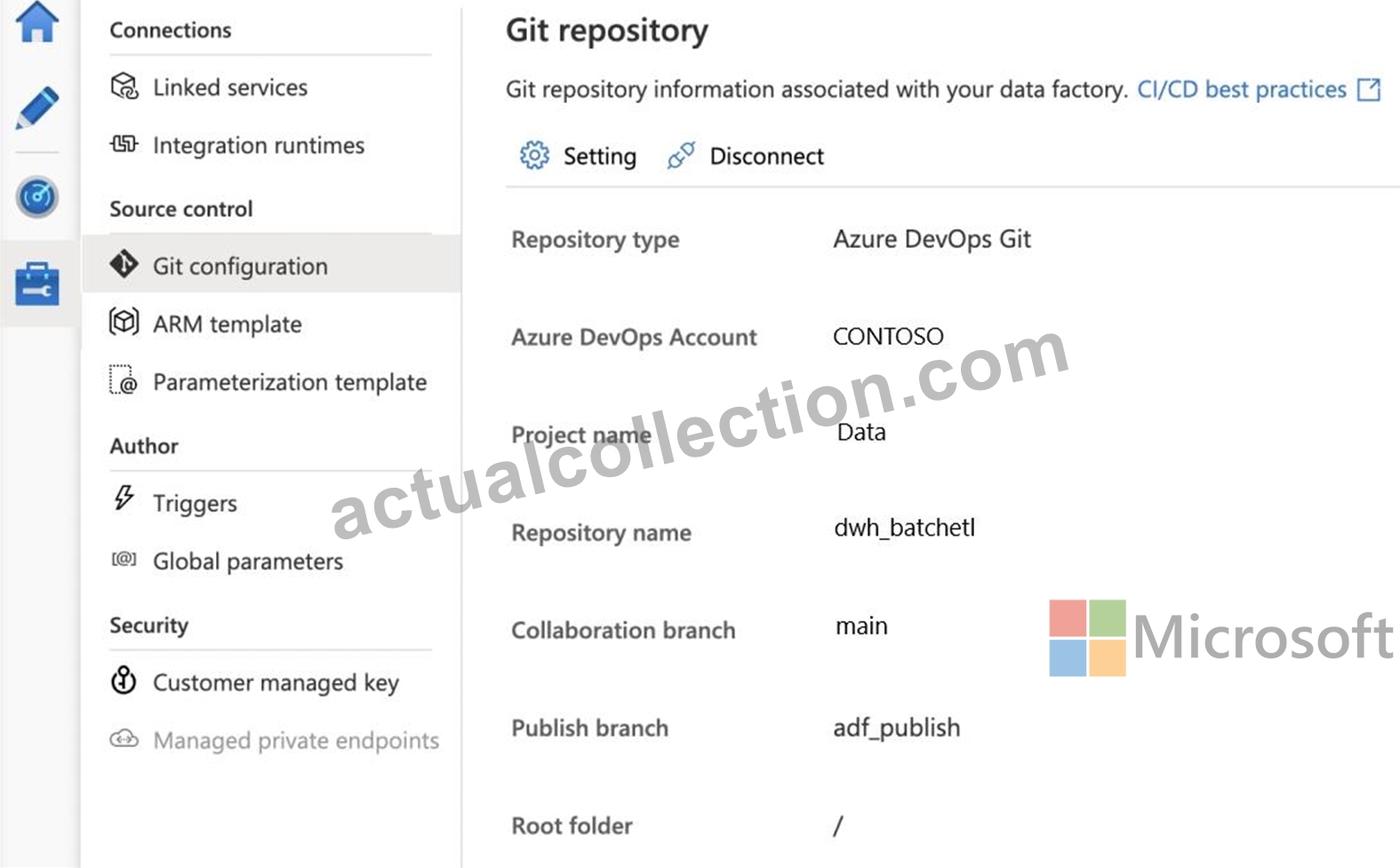
Use the drop-down menus to select the answer choice that completes each statement based on the information presented in the graphic.
NOTE: Each correct selection is worth one point.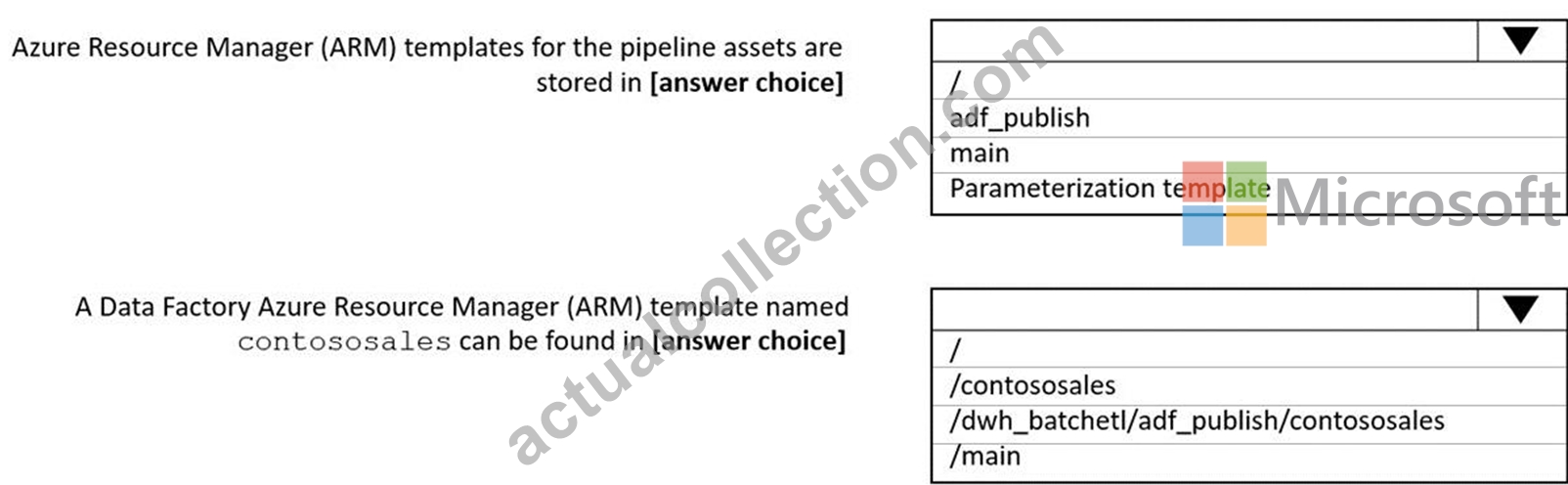
Answer:
Explanation: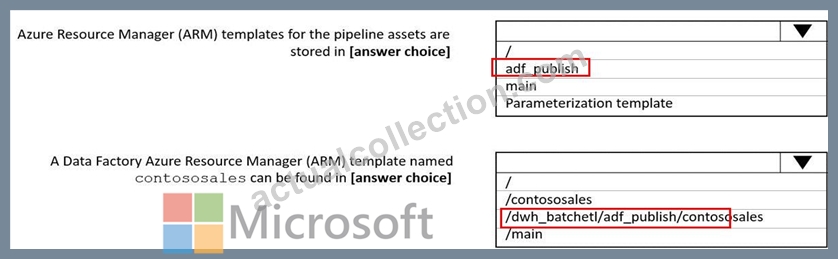
Reference:
https://docs.microsoft.com/en-us/azure/data-factory/source-control
NEW QUESTION # 175
You use Azure Data Factory to prepare data to be queried by Azure Synapse Analytics serverless SQL pools.
Files are initially ingested into an Azure Data Lake Storage Gen2 account as 10 small JSON files. Each file contains the same data attributes and data from a subsidiary of your company.
You need to move the files to a different folder and transform the data to meet the following requirements:
Provide the fastest possible query times.
Automatically infer the schema from the underlying files.
How should you configure the Data Factory copy activity? To answer, select the appropriate options in the answer area.
NOTE: Each correct selection is worth one point.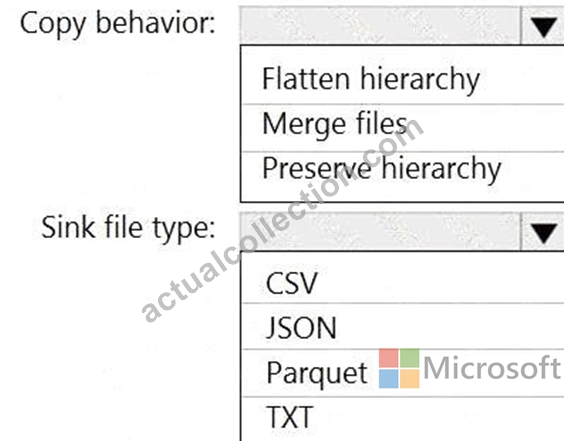
Answer:
Explanation: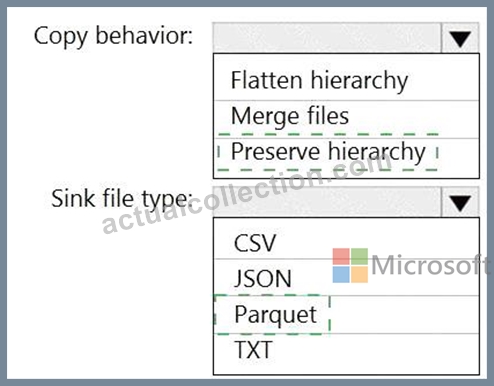
Explanation: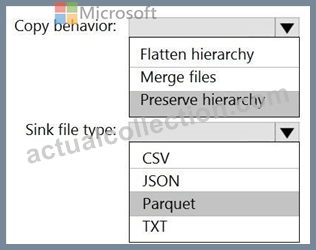
Box 1: Preserver herarchy
Compared to the flat namespace on Blob storage, the hierarchical namespace greatly improves the performance of directory management operations, which improves overall job performance.
Box 2: Parquet
Azure Data Factory parquet format is supported for Azure Data Lake Storage Gen2.
Parquet supports the schema property.
Reference:
https://docs.microsoft.com/en-us/azure/storage/blobs/data-lake-storage-introduction
https://docs.microsoft.com/en-us/azure/data-factory/format-parquet
NEW QUESTION # 176
You have an enterprise data warehouse in Azure Synapse Analytics that contains a table named FactOnlineSales. The table contains data from the start of 2009 to the end of 2012.
You need to improve the performance of queries against FactOnlineSales by using table partitions. The solution must meet the following requirements:
* Create four partitions based on the order date.
* Ensure that each partition contains all the orders places during a given calendar year.
How should you complete the T-SQL command? To answer, select the appropriate options in the answer area.
NOTE: Each correct selection is worth one point.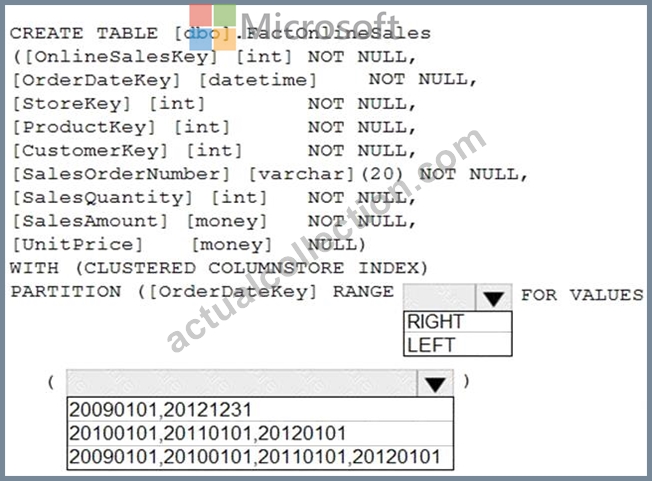
Answer:
Explanation: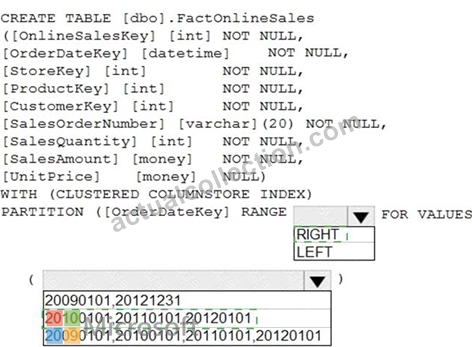
Explanation
Text Description automatically generated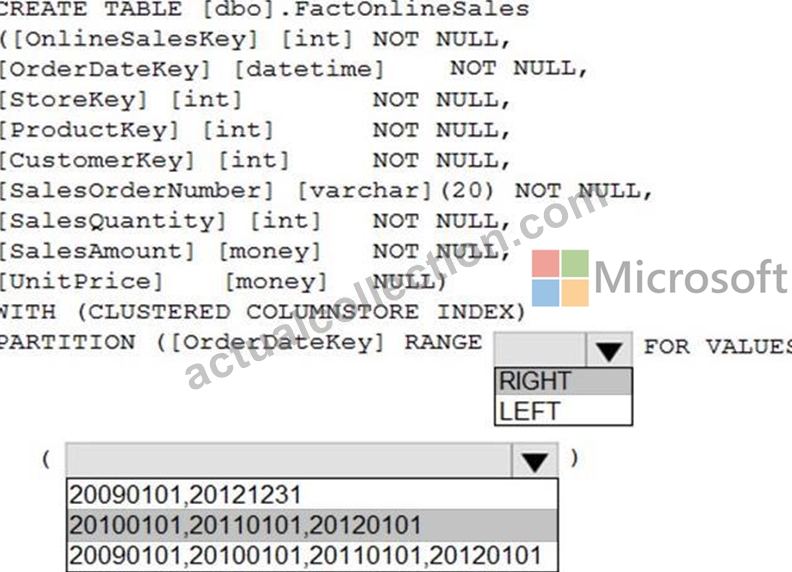
Range Left or Right, both are creating similar partition but there is difference in comparison For example: in this scenario, when you use LEFT and 20100101,20110101,20120101 Partition will be, datecol<=20100101, datecol>20100101 and datecol<=20110101, datecol>20110101 and datecol<=20120101, datecol>20120101 But if you use range RIGHT and 20100101,20110101,20120101 Partition will be, datecol<20100101, datecol>=20100101 and datecol<20110101, datecol>=20110101 and datecol<20120101, datecol>=20120101 In this example, Range RIGHT will be suitable for calendar comparison Jan 1st to Dec 31st Reference:
https://docs.microsoft.com/en-us/sql/t-sql/statements/create-partition-function-transact-sql?view=sql-server-ver1
NEW QUESTION # 177
You need to build a solution to ensure that users can query specific files in an Azure Data Lake Storage Gen2 account from an Azure Synapse Analytics serverless SQL pool.
Which three actions should you perform in sequence? To answer, move the appropriate actions from the list of actions to the answer area and arrange them in the correct order.
NOTE: More than one order of answer choices is correct. You will receive credit for any of the correct orders you select.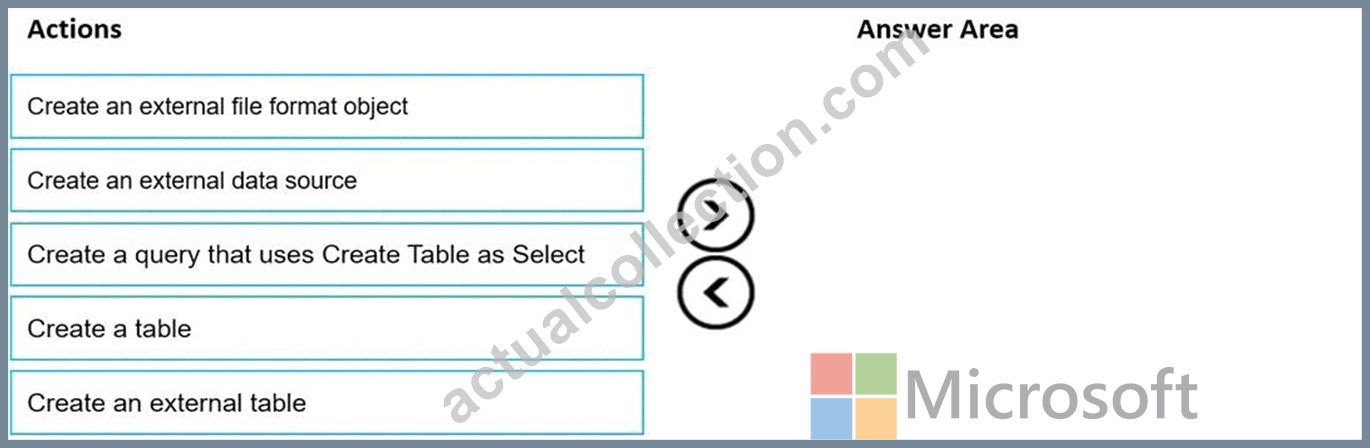
Answer:
Explanation: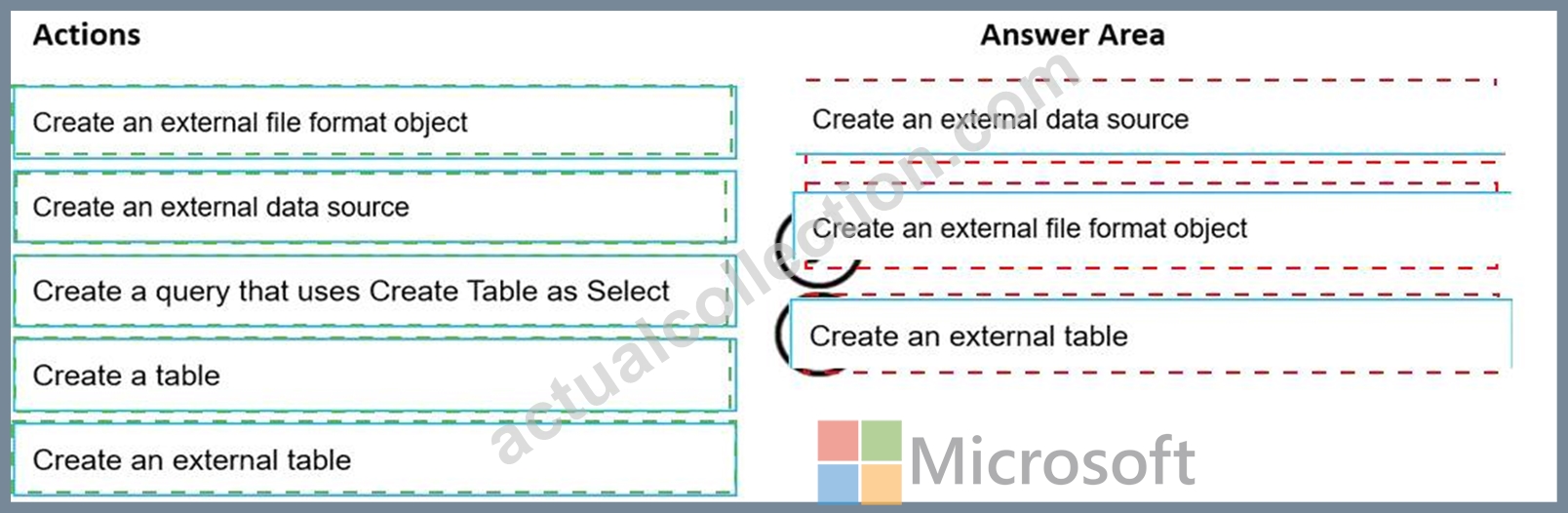
Explanation
Graphical user interface, text, application, email Description automatically generated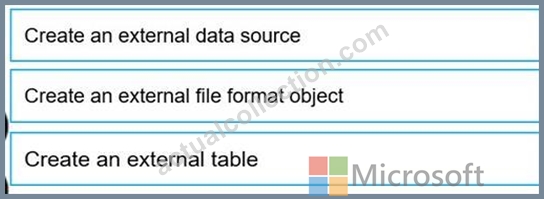
Step 1: Create an external data source
You can create external tables in Synapse SQL pools via the following steps:
* CREATE EXTERNAL DATA SOURCE to reference an external Azure storage and specify the credential that should be used to access the storage.
* CREATE EXTERNAL FILE FORMAT to describe format of CSV or Parquet files.
* CREATE EXTERNAL TABLE on top of the files placed on the data source with the same file format.
Step 2: Create an external file format object
Creating an external file format is a prerequisite for creating an external table.
Step 3: Create an external table
Reference:
https://docs.microsoft.com/en-us/azure/synapse-analytics/sql/develop-tables-external-tables
NEW QUESTION # 178
You have an Azure Storage account that generates 200,000 new files daily. The file names have a format of
{YYYY}/{MM}/{DD}/{HH}/{CustomerID}.csv.
You need to design an Azure Data Factory solution that will load new data from the storage account to an Azure Data Lake once hourly. The solution must minimize load times and costs.
How should you configure the solution? To answer, select the appropriate options in the answer area.
NOTE: Each correct selection is worth one point.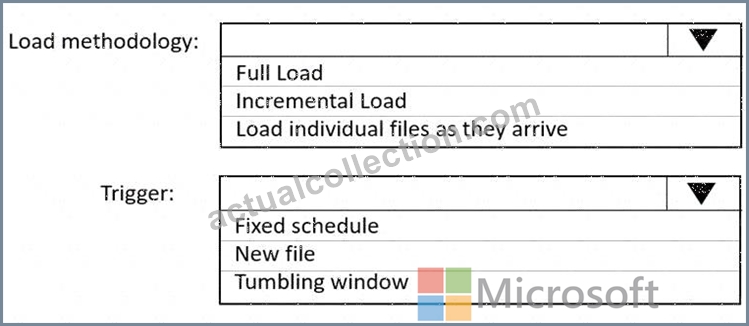
Answer:
Explanation: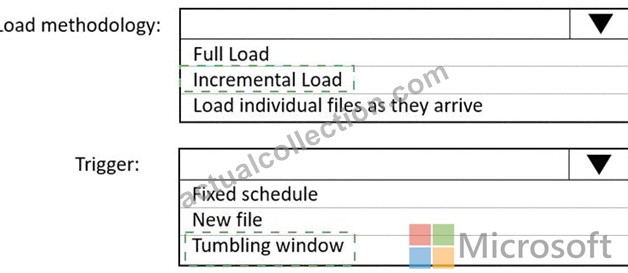
Explanation
Table Description automatically generated
Box 1: Incremental load
Box 2: Tumbling window
Tumbling windows are a series of fixed-sized, non-overlapping and contiguous time intervals. The following diagram illustrates a stream with a series of events and how they are mapped into 10-second tumbling windows.
Timeline Description automatically generated
Reference:
https://docs.microsoft.com/en-us/stream-analytics-query/tumbling-window-azure-stream-analytics
NEW QUESTION # 179
A company uses Azure Stream Analytics to monitor devices.
The company plans to double the number of devices that are monitored.
You need to monitor a Stream Analytics job to ensure that there are enough processing resources to handle the additional load.
Which metric should you monitor?
- A. Watermark delay
- B. Late Input Events
- C. Input Deserialization Errors
- D. Early Input Events
Answer: D
Explanation:
There are a number of resource constraints that can cause the streaming pipeline to slow down. The watermark delay metric can rise due to:
Not enough processing resources in Stream Analytics to handle the volume of input events.
Not enough throughput within the input event brokers, so they are throttled.
Output sinks are not provisioned with enough capacity, so they are throttled. The possible solutions vary widely based on the flavor of output service being used.
Reference:
https://docs.microsoft.com/en-us/azure/stream-analytics/stream-analytics-time-handling
NEW QUESTION # 180
You have two Azure Blob Storage accounts named account1 and account2?
You plan to create an Azure Data Factory pipeline that will use scheduled intervals to replicate newly created or modified blobs from account1 to account?
You need to recommend a solution to implement the pipeline. The solution must meet the following requirements:
* Ensure that the pipeline only copies blobs that were created of modified since the most recent replication event.
* Minimize the effort to create the pipeline.
What should you recommend?
- A. Create a pipeline that contains a Data Flow activity.
- B. Run the Copy Data tool and select Metadata-driven copy task.
- C. Create a pipeline that contains a flowlet.
- D. Run the Copy Data tool and select Built-in copy task.
Answer: C
NEW QUESTION # 181
You have an Azure Stream Analytics job that is a Stream Analytics project solution in Microsoft Visual Studio. The job accepts data generated by IoT devices in the JSON format.
You need to modify the job to accept data generated by the IoT devices in the Protobuf format.
Which three actions should you perform from Visual Studio on sequence? To answer, move the appropriate actions from the list of actions to the answer area and arrange them in the correct order.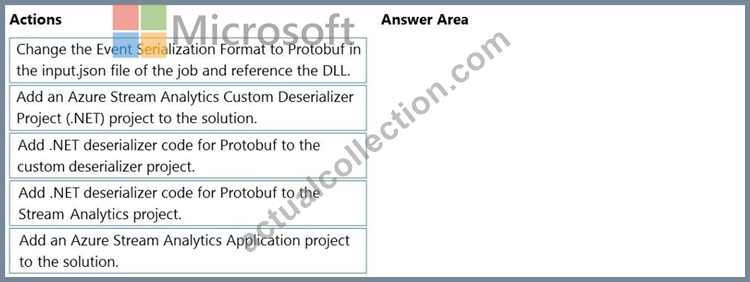
Answer:
Explanation: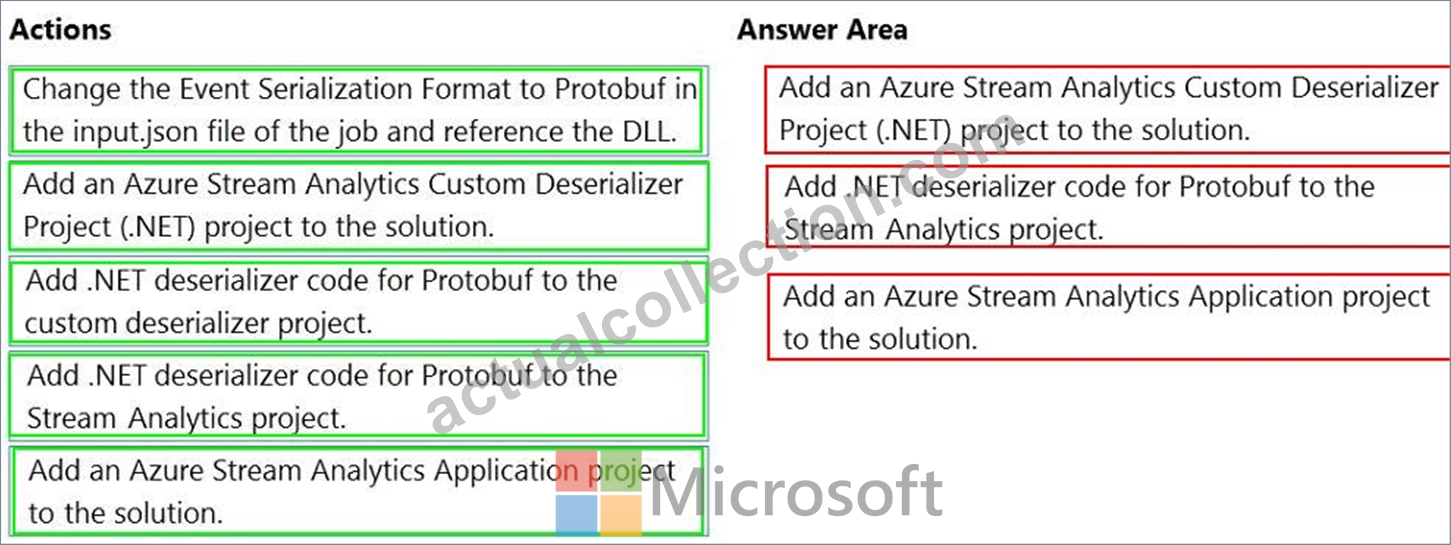
Reference:
https://docs.microsoft.com/en-us/azure/stream-analytics/custom-deserializer
NEW QUESTION # 182
You have an Azure Blob storage account that contains a folder. The folder contains 120,000 files. Each file contains 62 columns.
Each day, 1,500 new files are added to the folder.
You plan to incrementally load five data columns from each new file into an Azure Synapse Analytics workspace.
You need to minimize how long it takes to perform the incremental loads.
What should you use to store the files and format?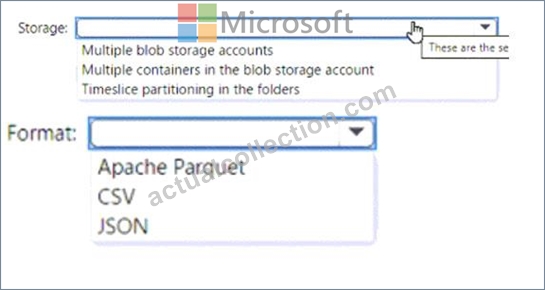
Answer:
Explanation: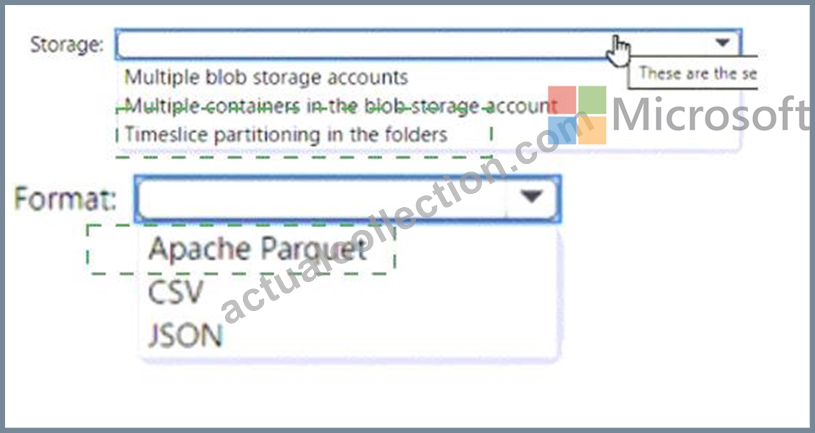
Explanation
Box 1 = timeslice partitioning in the foldersThis means that you should organize your files into folders based on a time attribute, such as year, month, day, or hour. For example, you can have a folder structure like
/yyyy/mm/dd/file.csv. This way, you can easily identify and load only the new files that are added each day by using a time filter in your Azure Synapse pipeline12. Timeslice partitioning can also improve the performance of data loading and querying by reducing the number of files that need to be scanned Box = 2 Apache Parquet This is because Parquet is a columnar file format that can efficiently store and compress data with many columns. Parquet files can also be partitioned by a time attribute, which can improve the performance of incremental loading and querying by reducing the number of files that need to be scanned1
23. Parquet files are supported by both dedicated SQL pool and serverless SQL pool in Azure Synapse Analytics2.
NEW QUESTION # 183
You have an Azure Synapse Analytics pipeline named Pipeline1 that contains a data flow activity named Dataflow1.
Pipeline1 retrieves files from an Azure Data Lake Storage Gen 2 account named storage1.
Dataflow1 uses the AutoResolveIntegrationRuntime integration runtime configured with a core count of 128.
You need to optimize the number of cores used by Dataflow1 to accommodate the size of the files in storage1.
What should you configure? To answer, select the appropriate options in the answer area.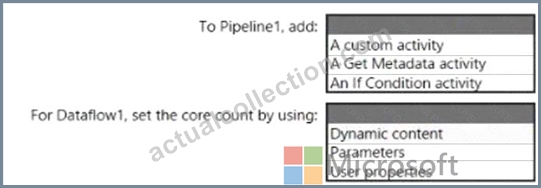
Answer:
Explanation: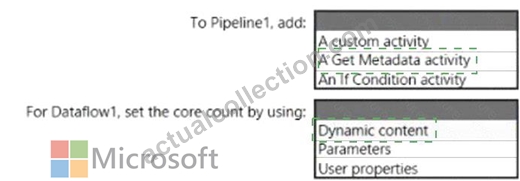
Explanation
Box 1: A Get Metadata activity
Dynamically size data flow compute at runtime
The Core Count and Compute Type properties can be set dynamically to adjust to the size of your incoming source data at runtime. Use pipeline activities like Lookup or Get Metadata in order to find the size of the source dataset data. Then, use Add Dynamic Content in the Data Flow activity properties.
Box 2: Dynamic content
Reference: https://docs.microsoft.com/en-us/azure/data-factory/control-flow-execute-data-flow-activity
NEW QUESTION # 184
You have an Azure Synapse Analytics dedicated SQL pool named Pool1. Pool1 contains a table named table1.
You load 5 TB of data intotable1.
You need to ensure that columnstore compression is maximized for table1.
Which statement should you execute?
- A. ALTER INDEX ALL on table1 REBUILD
- B. DBCC INDEXDEFRAG (pool1,tablel)
- C. DBCC DBREINOEX (table1)
- D. ALTER INDEX ALL on table1 REORGANIZE
Answer: C
NEW QUESTION # 185
You have a Microsoft SQL Server database that uses a third normal form schema.
You plan to migrate the data in the database to a star schema in an Azure Synapse Analytics dedicated SQI pool.
You need to design the dimension tables. The solution must optimize read operations.
What should you include in the solution? to answer, select the appropriate options in the answer area.
NOTE: Each correct selection is worth one point.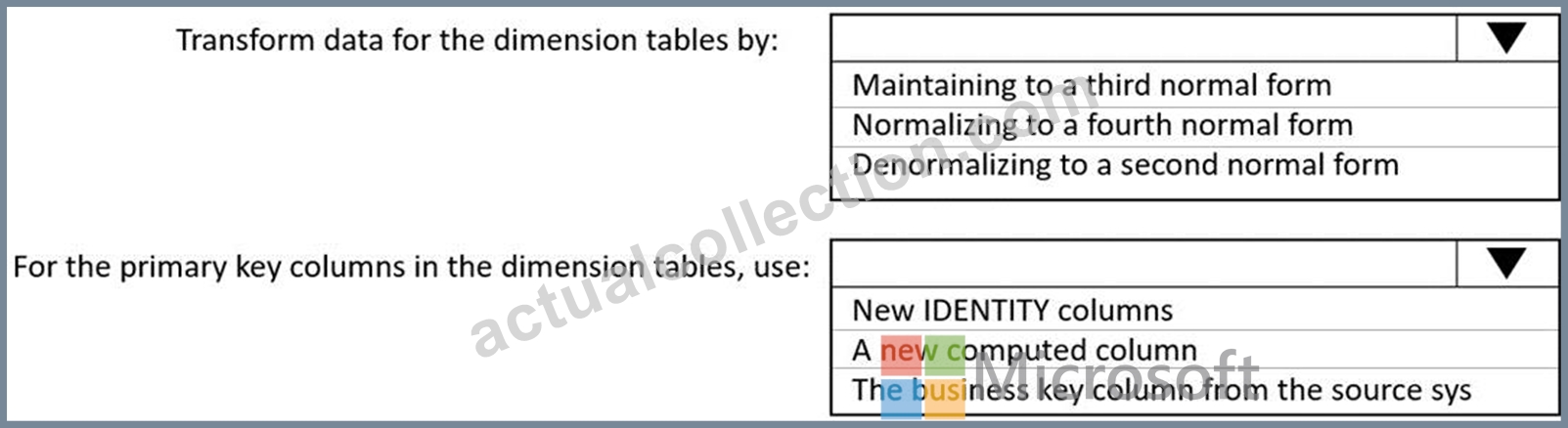
Answer:
Explanation: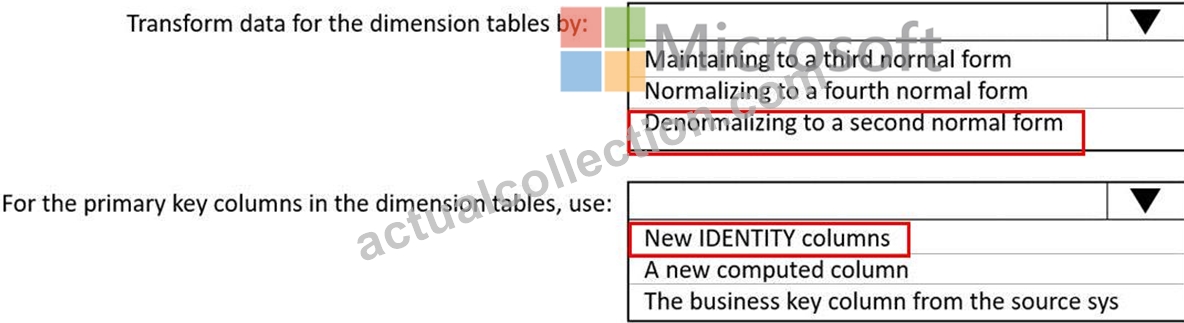
Reference:
https://www.mssqltips.com/sqlservertip/5614/explore-the-role-of-normal-forms-in-dimensional-modeling/
https://docs.microsoft.com/en-us/azure/synapse-analytics/sql-data-warehouse/sql-data-warehouse-tables-identity
NEW QUESTION # 186
You have an Azure event hub named retailhub that has 16 partitions. Transactions are posted to retailhub. Each transaction includes the transaction ID, the individual line items, and the payment details. The transaction ID is used as the partition key.
You are designing an Azure Stream Analytics job to identify potentially fraudulent transactions at a retail store. The job will use retailhub as the input. The job will output the transaction ID, the individual line items, the payment details, a fraud score, and a fraud indicator.
You plan to send the output to an Azure event hub named fraudhub.
You need to ensure that the fraud detection solution is highly scalable and processes transactions as quickly as possible.
How should you structure the output of the Stream Analytics job? To answer, select the appropriate options in the answer area.
NOTE: Each correct selection is worth one point.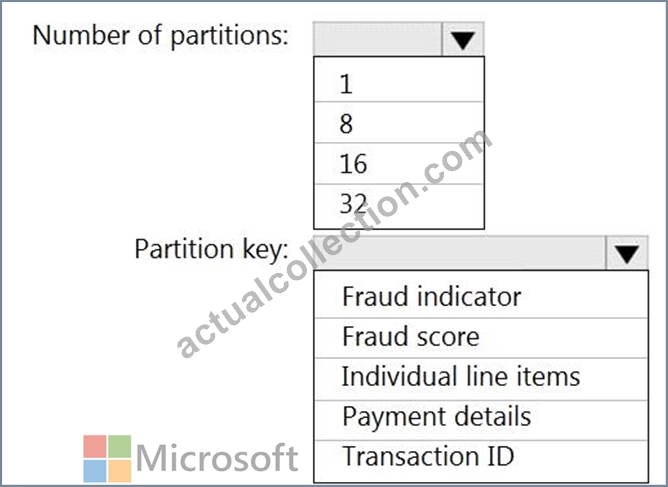
Answer:
Explanation: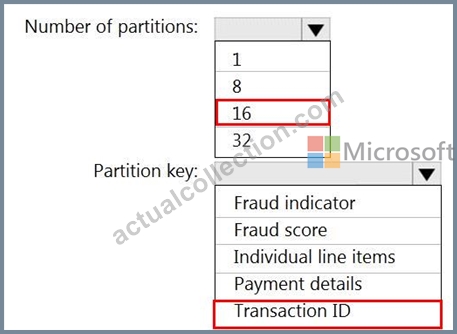
Reference:
https://docs.microsoft.com/en-us/azure/event-hubs/event-hubs-features#partitions
NEW QUESTION # 187
......
Actual DP-203 Exam Recently Updated Questions with Free Demo: https://www.actualcollection.com/DP-203-exam-questions.html
Free Microsoft DP-203 Exam Questions: https://drive.google.com/open?id=1cvckDJe4NOlnGF6tV9Dqw8FknwTBMz4d