

Latest [Sep 22, 2021] AZ-500 Exam with Accurate Microsoft Azure Security Technologies PDF Questions
Take a Leap Forward in Your Career by Earning Microsoft 295 Questions
NEW QUESTION 144
You have an Azure subscription that contains the resources shown in the following table.
User1 is a member of Group1. Group1 and User2 are assigned the Key Vault Contributor role for Vault1.
On January 1, 2019, you create a secret in Vault1. The secret is configured as shown in the exhibit. (Click the Exhibit tab.)
User2 is assigned an access policy to Vault1. The policy has the following configurations:
* Key Management Operations: Get, List, and Restore
* Cryptographic Operations: Decrypt and Unwrap Key
* Secret Management Operations: Get, List, and Restore
Group1 is assigned an access to Vault1. The policy has the following configurations:
Key Management Operations: Get and Recover
Secret Management Operations: List, Backup, and Recover
For each of the following statements, select Yes if the statement is true. Otherwise, select No.
Answer:
Explanation:
NEW QUESTION 145
Note: This question is part of a series of questions that present the same scenario. Each question in the series contains a unique solution that might meet the stated goals. Some question sets might have more than one correct solution, while others might not have a correct solution.
After you answer a question in this section, you will NOT be able to return to it. As a result, these questions will not appear in the review screen.
You use Azure Security Center for the centralized policy management of three Azure subscriptions.
You use several policy definitions to manage the security of the subscriptions.
You need to deploy the policy definitions as a group to all three subscriptions.
Solution: You create a policy definition and assignments that are scoped to resource groups.
Does this meet the goal?
- A. No
- B. Yes
Answer: A
Explanation:
References:
https://4sysops.com/archives/apply-governance-policy-to-multiple-azure-subscriptions-with-management-groups/
Topic 1, Litware, inc
This is a case study. Case studies are not timed separately. You can use as much exam time as you would like to complete each case. However, there may be additional case studies and sections on this exam. You must manage your time to ensure that you are able to complete all questions included on this exam in the time provided.
To answer the questions included in a case study, you will need to reference information that is provided in the case study. Case studies might contain exhibits and other resources that provide more information about the scenario that is described in the case study. Each question is independent of the other question on this case study.
At the end of this case study, a review screen will appear. This screen allows you to review your answers and to make changes before you move to the next sections of the exam. After you begin a new section, you cannot return to this section.
To start the case study
To display the first question on this case study, click the Next button. Use the buttons in the left pane to explore the content of the case study before you answer the questions. Clicking these buttons displays information such as business requirements, existing environment, and problem statements. If the case study has an All Information tab, note that the information displayed is identical to the information displayed on the subsequent tabs. When you are ready to answer a question, click the Question button to return to the question.
Overview
Litware, Inc. is a digital media company that has 500 employees in the Chicago area and 20 employees in the San Francisco area.
Existing Environment
Litware has an Azure subscription named Sub1 that has a subscription ID of 43894a43-17c2-4a39-8cfc-3540c2653ef4.
Sub1 is associated to an Azure Active Directory (Azure AD) tenant named litwareinc.com. The tenant contains the user objects and the device objects of all the Litware employees and their devices. Each user is assigned an Azure AD Premium P2 license. Azure AD Privileged Identity Management (PIM) is activated.
The tenant contains the groups shown in the following table.
The Azure subscription contains the objects shown in the following table.
Azure Security Center is set to the Free tier.
Planned changes
Litware plans to deploy the Azure resources shown in the following table.
Litware identifies the following identity and access requirements:
* All San Francisco users and their devices must be members of Group1.
* The members of Group2 must be assigned the Contributor role to Resource Group2 by using a permanent eligible assignment.
* Users must be prevented from registering applications in Azure AD and from consenting to applications that access company information on the users' behalf.
Platform Protection Requirements
Litware identifies the following platform protection requirements:
* Microsoft Antimalware must be installed on the virtual machines in Resource Group1.
* The members of Group2 must be assigned the Azure Kubernetes Service Cluster Admin Role.
* Azure AD users must be to authenticate to AKS1 by using their Azure AD credentials.
* Following the implementation of the planned changes, the IT team must be able to connect to VM0 by using JIT VM access.
* A new custom RBAC role named Role1 must be used to delegate the administration of the managed disks in Resource Group1. Role1 must be available only for Resource Group1.
Security Operations Requirements
Litware must be able to customize the operating system security configurations in Azure Security Center.
NEW QUESTION 146
You need to deploy an Azure firewall to a virtual network named VNET3.
To complete this task, sign in to the Azure portal and modify the Azure resources.
This task might take several minutes to complete. You can perform other tasks while the task completes.
See the explanation below.
Answer:
Explanation:
Explanation
To add an Azure firewall to a VNET, the VNET must first be configured with a subnet named AzureFirewallSubnet (if it doesn't already exist).
Configure VNET3.
* In the Azure portal, type Virtual Networks Virtual Networks from the search results then select VNET3. Alternatively, browse to in the left navigation pane.
* In the Overview section, note the Resource Group of the virtual network. We'll need these when we add the firewall.
* Click on Subnets.
* Click on + Subnet to add a new subnet.
* Enter AzureFirewallSubnet in the Name box. The subnet must be named AzureFirewallSubnet.
* Enter an appropriate IP range for the subnet in the Address range box.
* Click the OK button to create the subnet.
Add the Azure Firewall.
* In the settings of VNET3 click on Firewall.
* Click the Click here to add a new firewall link.
* The Resource group will default to the VNET3 resource group. Leave this default.
* Enter a name for the firewall in the Name box.
* In the Region box, select the same region as VNET3.
* In the Public IP address box, select an available public IP address if one exists, or click Add new to add a new public IP address.
* Click the Review + create button.
* Review the settings and click the Create button to create the firewall.
Reference:
https://docs.microsoft.com/en-us/azure/firewall/tutorial-firewall-deploy-portal
NEW QUESTION 147
Use the following login credentials as needed:
To enter your username, place your cursor in the Sign in box and click on the username below.
To enter your password, place your cursor in the Enter password box and click on the password below.
Azure Username: [email protected]
Azure Password: Ag1Bh9!#Bd
The following information is for technical support purposes only:
Lab Instance: 10598168


The developers at your company plan to create a web app named App10598168 and to publish the app to
https://www.contoso.com.
You need to perform the following tasks:
* Ensure that App10598168 is registered to Azure Active Directory (Azure AD).
* Generate a password for App10598168.
To complete this task, sign in to the Azure portal.
Answer:
Explanation:
See the explanation below.
Explanation
Step 1: Register the Application
1. Sign in to your Azure Account through the Azure portal.
2. Select Azure Active Directory.
3. Select App registrations.
4. Select New registration.
5. Name the application App10598168 . Select a supported account type, which determines who can use the application. Under Redirect URI, select Web for the type of application you want to create. Enter the URI:
https://www.contoso.com , where the access token is sent to.
6. Click Register
Step 2: Create a new application secret
If you choose not to use a certificate, you can create a new application secret.
7 Select Certificates & secrets.
8. Select Client secrets -> New client secret.
9. Provide a description of the secret, and a duration. When done, select Add.
After saving the client secret, the value of the client secret is displayed. Copy this value because you aren't able to retrieve the key later. You provide the key value with the application ID to sign in as the application.
Store the key value where your application can retrieve it.
Reference:
https://docs.microsoft.com/en-us/azure/active-directory/develop/howto-create-service-principal-portal
NEW QUESTION 148
You have an Azure subscription that contains the resources shown in the following table.
User1 is a member of Group1. Group1 and User2 are assigned the Key Vault Contributor role for Vault1.
On January 1, 2019, you create a secret in Vault1. The secret is configured as shown in the exhibit. (Click the Exhibit tab.)
User2 is assigned an access policy to Vault1. The policy has the following configurations:
Key Management Operations: Get, List, and Restore
Cryptographic Operations: Decrypt and Unwrap Key
Secret Management Operations: Get, List, and Restore
Group1 is assigned an access to Vault1. The policy has the following configurations:
Key Management Operations: Get and Recover
Secret Management Operations: List, Backup, and Recover
For each of the following statements, select Yes if the statement is true. Otherwise, select No.
Answer:
Explanation:
NEW QUESTION 149
You have an Azure subscription that contains the Azure virtual machines shown in the following table.
You create an MDM Security Baseline profile named Profile1.
You need to identify to which virtual machines Profile1 can be applied.
Which virtual machines should you identify?
- A. VM1, VM2, VM3, and VM4
- B. VM1 only
- C. VM1, VM2, and VM3 only
- D. VM1 and VM3 only
Answer: B
Explanation:
Explanation/Reference:
https://docs.microsoft.com/en-us/mem/intune/protect/security-baselines
NEW QUESTION 150
You need to meet the identity and access requirements for Group1.
What should you do?
- A. Delete Group1. Create a new group named Group1 that has a membership type of Office 365. Add users and devices to the group.
- B. Add a membership rule to Group1.
- C. Modify the membership rule of Group1.
- D. Change the membership type of Group1 to Assigned. Create two groups that have dynamic memberships. Add the new groups to Group1.
Answer: D
Explanation:
Explanation
https://docs.microsoft.com/en-us/azure/active-directory/users-groups-roles/groups-dynamic-membership Scenario:
Litware identifies the following identity and access requirements: All San Francisco users and their devices must be members of Group1.
The tenant currently contain this group:
References:
https://docs.microsoft.com/en-us/azure/active-directory/users-groups-roles/groups-dynamic-membership
https://docs.microsoft.com/en-us/azure/active-directory/fundamentals/active-directory-groups-create-azure-porta
NEW QUESTION 151
You plan to create an Azure Kubernetes Service (AKS) cluster in an Azure subscription.
The manifest of the registered server application is shown in the following exhibit.
You need to ensure that the AKS cluster and Azure Active Directory (Azure AD) are integrated.
Which property should you modify in the manifest?
- A. acceptMappedClaims
- B. groupMembershipClaims
- C. accessTokenAcceptedVersion
- D. keyCredentials
Answer: B
Explanation:
Reference:
https://docs.microsoft.com/en-us/azure/aks/azure-ad-integration-cli
https://www.codeproject.com/Articles/3211864/Operation-and-Maintenance-of-AKS-Applications
NEW QUESTION 152
You need to configure WebApp1 to meet the data and application requirements.
Which two actions should you perform? Each correct answer presents part of the solution.
NOTE: Each correct selection is worth one point.
- A. Upload a public certificate.
- B. Turn on the HTTPS Only protocol setting.
- C. Turn on the Incoming client certificates protocol setting.
- D. Set the Minimum TLS Version protocol setting to 1.2.
- E. Change the pricing tier of the App Service plan.
Answer: B,C
Explanation:
Reference:
https://docs.microsoft.com/en-us/azure/app-service/app-service-web-configure-tls-mutual-auth
NEW QUESTION 153
You have an Azure Active Directory (Azure AD) tenant that contains the users shown in the following table.
From Azure AD Privileged Identity Management (PIM), you configure the settings for the Security Administrator role as shown in the following exhibit.
From PIM, you assign the Security Administrator role to the following groups:
* Group1: Active assignment type, permanently assigned
* Group2: Eligible assignment type, permanently eligible
For each of the following statements, select Yes if the statement is true. Otherwise, select No.
NOTE: Each correct selection is worth one point.
Answer:
Explanation:
Explanation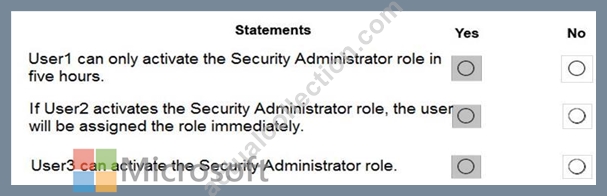
Box 1: Yes
Eligible Type: A role assignment that requires a user to perform one or more actions to use the role. If a user has been made eligible for a role, that means they can activate the role when they need to perform privileged tasks. There's no difference in the access given to someone with a permanent versus an eligible role assignment. The only difference is that some people don't need that access all the time.
You can choose from two assignment duration options for each assignment type (eligible and active) when you configure settings for a role. These options become the default maximum duration when a user is assigned to the role in Privileged Identity Management.
Use the Activation maximum duration slider to set the maximum time, in hours, that a role stays active before it expires. This value can be from one to 24 hours.
Box 2: Yes
Active Type: A role assignment that doesn't require a user to perform any action to use the role. Users assigned as active have the privileges assigned to the role Box 3: Yes User3 is member of Group2.
Reference:
https://docs.microsoft.com/en-us/azure/active-directory/privileged-identity-management/pim-configure
https://docs.microsoft.com/bs-cyrl-ba/azure/active-directory/privileged-identity-management/pim-resource-roles
NEW QUESTION 154
You have an Azure subscription named Sub1 that contains the Azure key vaults shown in the following table.
In Sub1, you create a virtual machine that has the following configurations:
* Name:VM1
* Size: DS2v2
* Resource group: RG1
* Region: West Europe
* Operating system: Windows Server 2016
You plan to enable Azure Disk Encryption on VM1.
In which key vaults can you store the encryption key for VM1?
- A. Vault1, Vault2, Vault3, or Vault4
- B. Vault1 or Vault2 only
- C. Vault1 or Vault3 only
- D. Vault1 only
Answer: B
NEW QUESTION 155
You plan to use Azure Resource Manager templates to perform multiple deployments of identically configured Azure virtual machines. The password for the administrator account of each deployment is stored as a secret in different Azure key vaults.
You need to identify a method to dynamically construct a resource ID that will designate the key vault containing the appropriate secret during each deployment. The name of the key vault and the name of the secret will be provided as inline parameters.
What should you use to construct the resource ID?
- A. a key vault access policy
- B. an automation account
- C. a linked template
- D. a parameters file
Answer: D
Explanation:
You reference the key vault in the parameter file, not the template. The following image shows how the parameter file references the secret and passes that value to the template.
Reference:
https://docs.microsoft.com/en-us/azure/azure-resource-manager/resource-manager-keyvault-parameter Implement platform protection Testlet 1 This is a case study. Case studies are not timed separately. You can use as much exam time as you would like to complete each case. However, there may be additional case studies and sections on this exam. You must manage your time to ensure that you are able to complete all questions included on this exam in the time provided.
To answer the questions included in a case study, you will need to reference information that is provided in the case study. Case studies might contain exhibits and other resources that provide more information about the scenario that is described in the case study. Each question is independent of the other question on this case study.
At the end of this case study, a review screen will appear. This screen allows you to review your answers and to make changes before you move to the next sections of the exam. After you begin a new section, you cannot return to this section.
To start the case study
To display the first question on this case study, click the Next button. Use the buttons in the left pane to explore the content of the case study before you answer the questions. Clicking these buttons displays information such as business requirements, existing environment, and problem statements. If the case study has an All Information tab, note that the information displayed is identical to the information displayed on the subsequent tabs. When you are ready to answer a question, click the Question button to return to the question.
Overview
Litware, Inc. is a digital media company that has 500 employees in the Chicago area and 20 employees in the San Francisco area.
Existing Environment
Litware has an Azure subscription named Sub1 that has a subscription ID of 43894a43-17c2-4a39-8cfc-
3540c2653ef4.
Sub1 is associated to an Azure Active Directory (Azure AD) tenant named litwareinc.com. The tenant contains the user objects and the device objects of all the Litware employees and their devices. Each user is assigned an Azure AD Premium P2 license. Azure AD Privileged Identity Management (PIM) is activated.
The tenant contains the groups shown in the following table.
The Azure subscription contains the objects shown in the following table.
Identity and Access Requirements
Azure Security Center is set to the Free tier.
Planned changes
Litware plans to deploy the Azure resources shown in the following table.
Litware identifies the following identity and access requirements:
* All San Francisco users and their devices must be members of Group1.
* The members of Group2 must be assigned the Contributor role to Resource Group2 by using a permanent eligible assignment.
* Users must be prevented from registering applications in Azure AD and from consenting to applications that access company information on the users' behalf.
Platform Protection Requirements
Litware identifies the following platform protection requirements:
* Microsoft Antimalware must be installed on the virtual machines in Resource Group1.
* The members of Group2 must be assigned the Azure Kubernetes Service Cluster Admin Role.
* Azure AD users must be to authenticate to AKS1 by using their Azure AD credentials.
* Following the implementation of the planned changes, the IT team must be able to connect to VM0 by using JIT VM access.
* A new custom RBAC role named Role1 must be used to delegate the administration of the managed disks in Resource Group1. Role1 must be available only for Resource Group1.
Security Operations Requirements
Litware must be able to customize the operating system security configurations in Azure Security Center.
Data and Application Requirements
Litware identifies the following data and applications requirements:
* The users in Group2 must be able to authenticate to SQLDB1 by using their Azure AD credentials.
* WebApp1 must enforce mutual authentication.
General Requirements
Litware identifies the following general requirements:
* Whenever possible, administrative effort must be minimized.
* Whenever possible, use of automation must be minimized.
NEW QUESTION 156
You create a new Azure subscription.
You need to ensure that you can create custom alert rules in Azure Security Center.
Which two actions should you perform? Each correct answer presents part of the solution.
NOTE: Each correct selection is worth one point.
- A. Upgrade the pricing tier of Security Center to Standard.
- B. Implement Azure Advisor recommendations.
- C. Create an Azure Storage account.
- D. Create an Azure Log Analytics workspace.
- E. Onboard Azure Active Directory (Azure AD) Identity Protection.
Answer: C,D
Explanation:
Explanation
D: You need write permission in the workspace that you select to store your custom alert.
References:
https://docs.microsoft.com/en-us/azure/security-center/security-center-custom-alert
NEW QUESTION 157
You have an Azure Active Directory (Azure AD) tenant that contains the users shown in the following table.
The tenant contains the named locations shown in the following table.
You create the conditional access policies for a cloud app named App1 as shown in the following table.
For each of the following statements, select Yes if the statement is true. Otherwise, select No.
NOTE: Each correct selection is worth one point.
Answer:
Explanation:
NEW QUESTION 158
You have an Azure Container Registry named Registry1.
You add role assignment for Registry1 as shown in the following table.
Which users can upload images to Registry1 and download images from Registry1? To answer, select the appropriate options in the answer area.
NOTE: Each correct selection is worth one point.
Answer:
Explanation:
Explanation:
Box 1: User1 and User4 only
Owner, Contributor and AcrPush can push images.
Box 2: User1, User2, and User4
All, except AcrImagineSigner, can download/pull images.
References:
https://docs.microsoft.com/bs-latn-ba/azure/container-registry/container-registry-roles
NEW QUESTION 159
You create a new Azure subscription that is associated to a new Azure Active Directory (Azure AD) tenant.
You create one active conditional access policy named Portal Policy. Portal Policy is used to provide access to the Microsoft Azure Management cloud app.
The Conditions settings for Portal Policy are configured as shown in the Conditions exhibit. (Click the Conditions tab.)
The Grant settings for Portal Policy are configured as shown in the Grant exhibit. (Click the Grant tab.)
For each of the following statements, select Yes if the statement is true. Otherwise, select No.
NOTE: Each correct selection is worth one point.
Answer:
Explanation:
Explanation
Box 1: No
The Contoso location is excluded
Box 2: Yes
Box 3: Yes
Reference:
https://docs.microsoft.com/en-us/azure/active-directory/conditional-access/location-condition
NEW QUESTION 160
SIMULATION
You need to ensure that a user named Danny11597200 can sign in to any SQL database on a Microsoft SQL server named web11597200 by using SQL Server Management Studio (SSMS) and Azure Active Directory (Azure AD) credentials.
To complete this task, sign in to the Azure portal.
- A. You need to provision an Azure AD Admin for the SQL Server.
* In the Azure portal, type SQL Server in the search box, select SQL Server from the search results then select the server named web11597288. Alternatively, browse to SQL Server in the left navigation pane.
* In the SQL Server properties page, click on Active Directory Admin.
* Click the Set Admin button.
* In the Add Admin window, search for and select Danny11596200.
* Click the Select button to add Danny11596200.
* Click the Save button to save the changes. - B. You need to provision an Azure AD Admin for the SQL Server.
* In the Azure portal, type SQL Server in the search box, select SQL Server from the search results then select the server named web11597200. Alternatively, browse to SQL Server in the left navigation pane.
* In the SQL Server properties page, click on Active Directory Admin.
* Click the Set Admin button.
* In the Add Admin window, search for and select Danny11597200.
* Click the Select button to add Danny11597200.
* Click the Save button to save the changes.
Answer: B
Explanation:
Reference:
https://docs.microsoft.com/en-us/azure/azure-sql/database/authentication-aad-configure?tabs=azure-powershell
NEW QUESTION 161
You are testing an Azure Kubernetes Service (AKS) cluster. The cluster is configured as shown in the exhibit.
(Click the Exhibit tab.)
You plan to deploy the cluster to production. You disable HTTP application routing.
You need to implement application routing that will provide reverse proxy and TLS termination for AKS services by using a single IP address.
What should you do?
- A. Create an Azure Basic Load Balancer.
- B. Create an Azure Standard Load Balancer.
- C. Install the container network interface (CNI) plug-in.
- D. Create an AKS Ingress controller.
Answer: D
Explanation:
Explanation
An ingress controller is a piece of software that provides reverse proxy, configurable traffic routing, and TLS termination for Kubernetes services.
References:
https://docs.microsoft.com/en-us/azure/aks/ingress-tls
Topic 1, Contoso
This is a case study. Case studies are not timed separately. You can use as much exam time as you would like to complete each case. However, there may be additional case studies and sections on this exam. You must manage your time to ensure that you are able to complete all questions included on this exam in the time provided.
To answer the questions included in a case study, you will need to reference information that is provided in the case study. Case studies might contain exhibits and other resources that provide more information about the scenario that is described in the case study. Each question is independent of the other question on this case study.
At the end of this case study, a review screen will appear. This screen allows you to review your answers and to make changes before you move to the next sections of the exam. After you begin a new section, you cannot return to this section.
To start the case study
To display the first question on this case study, click the Next button. Use the buttons in the left pane to explore the content of the case study before you answer the questions. Clicking these buttons displays information such as business requirements, existing environment, and problem statements. If the case study has an All Information tab, note that the information displayed is identical to the information displayed on the subsequent tabs. When you are ready to answer a question, click the Question button to return to the question.
Overview
Contoso, Ltd. is a consulting company that has a main office in Montreal and two branch offices in Seattle and New York.
The company hosts its entire server infrastructure in Azure.
Contoso has two Azure subscriptions named Sub1 and Sub2. Both subscriptions are associated to an Azure Active Directory (Azure AD) tenant named contoso.com.
Technical requirements
Contoso identifies the following technical requirements:
* Deploy Azure Firewall to VNetWork1 in Sub2.
* Register an application named App2 in contoso.com.
* Whenever possible, use the principle of least privilege.
* Enable Azure AD Privileged Identity Management (PIM) for contoso.com
Existing Environment
Azure AD
Contoso.com contains the users shown in the following table.
Contoso.com contains the security groups shown in the following table.
Sub1
Sub1 contains six resource groups named RG1, RG2, RG3, RG4, RG5, and RG6.
User2 creates the virtual networks shown in the following table.
Sub1 contains the locks shown in the following table.
Sub1 contains the Azure policies shown in the following table.
Sub2
Sub2 contains the virtual machines shown in the following table.
All virtual machines have the public IP addresses and the Web Server (IIS) role installed. The firewalls for each virtual machine allow ping requests and web requests.
Sub2 contains the network security groups (NSGs) shown in the following table.
NSG1 has the inbound security rules shown in the following table.
NSG2 has the inbound security rules shown in the following table.
NSG3 has the inbound security rules shown in the following table.
NSG4 has the inbound security rules shown in the following table.
NSG1, NSG2, NSG3, and NSG4 have the outbound security rules shown in the following table.
Contoso identifies the following technical requirements:
* Deploy Azure Firewall to VNetwork1 in Sub2.
* Register an application named App2 in contoso.com.
* Whenever possible, use the principle of least privilege.
* Enable Azure AD Privileged Identity Management (PIM) for contoso.com.
NEW QUESTION 162
You have an Azure subscription that contains an Azure key vault named Vault1.
On January 1, 2019, Vault1 stores the following secrets.
Which can each secret be used by an application? To answer, select the appropriate options in the answer area.
NOTE: Each correct selection is worth one point.
Answer:
Explanation:
Reference:
https://docs.microsoft.com/en-us/powershell/module/azurerm.keyvault/set-azurekeyvaultsecretattribute
NEW QUESTION 163
You network contains an on-premises Active Directory domain that syncs to an Azure Active Directory (Azure AD) tenant. The tenant contains the users shown in the following table.
The tenant contains the groups shown in the following table.
You configure a multi-factor authentication (MFA) registration policy that and the following settings:
* Assignments:
* Include: Group1
* Exclude Group2
* Controls: Require Azure MFA registration
* Enforce Policy: On
For each of the following statements, select Yes if the statement is true. Otherwise, select No.
Answer:
Explanation:
NEW QUESTION 164
You have an Azure subscription named Sub1 that contains the Azure key vaults shown in the following table:
In Sub1, you create a virtual machine that has the following configurations:
* Name: VM1
* Size: DS2v2
* Resource group: RG1
* Region: West Europe
* Operating system: Windows Server 2016
You plan to enable Azure Disk Encryption on VM1.
In which key vaults can you store the encryption key for VM1?
- A. Vault1, Vault2, Vault3, or Vault4
- B. Vault1 or Vault3 only
- C. Vault1 or Vault2 only
- D. Vault1 only
Answer: B
Explanation:
In order to make sure the encryption secrets don't cross regional boundaries, Azure Disk Encryption needs the Key Vault and the VMs to be co-located in the same region. Create and use a Key Vault that is in the same region as the VM to be encrypted.
Reference:
https://docs.microsoft.com/en-us/azure/security/azure-security-disk-encryption-prerequisites
NEW QUESTION 165
You have an Azure key vault named KeyVault1 that contains the items shown in the following table.
In KeyVault, the following events occur in sequence:
Item1 is deleted
Administrator enables soft delete
Item2 and Policy1 are deleted.
For each of the following statements, select Yes if the statement is true. Otherwise, select No.
NOTE: Each correct selection is worth one point.
Answer:
Explanation:
Reference:
https://docs.microsoft.com/en-us/azure/key-vault/general/soft-delete-overview
NEW QUESTION 166
You create a new Azure subscription that is associated to a new Azure Active Directory (Azure AD) tenant.
You create one active conditional access policy named Portal Policy. Portal Policy is used to provide access to the Microsoft Azure Management cloud app.
The Conditions settings for Portal Policy are configured as shown in the Conditions exhibit. (Click the Conditions tab.)
The Grant settings for Portal Policy are configured as shown in the Grant exhibit. (Click the Grant tab.)
For each of the following statements, select Yes if the statement is true. Otherwise, select No.
NOTE: Each correct selection is worth one point.
Answer:
Explanation:
Explanation
Box 1: No
The Contoso location is excluded
Box 2: Yes
Box 3: Yes
Reference:
https://docs.microsoft.com/en-us/azure/active-directory/conditional-access/location-condition
NEW QUESTION 167
......
Authentic Best resources for AZ-500 Online Practice Exam: https://www.actualcollection.com/AZ-500-exam-questions.html
Practice To AZ-500 - ActualCollection Remarkable Practice On your Microsoft Azure Security Technologies Exam: https://drive.google.com/open?id=1Tc-HqELScRlQvGklNCnLcn4toRuBcx0j