

Master 2021 Latest The Questions Aruba Certified Switching Professional (ACSP) V1 and Pass HPE6-A45 Real Exam!
Penetration testers simulate HPE6-A45 exam PDF
NEW QUESTION 77
Refer to the exhibit.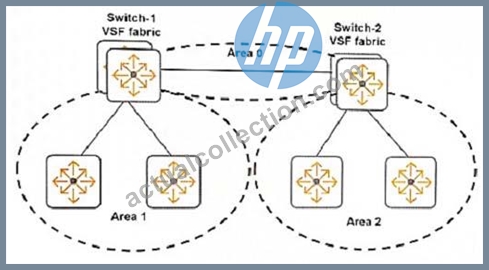
The routing switches shown in the exhibit run OSPF on the links between each other. The commander in the Switch-1 VSF fabric goes down. Traffic is disrupted for several seconds.
What should a network administrator do to support a faster failover in a similar situation?
- A. Create a redundant virtual link between Switch-1 and Switch-2.
- B. Configure echo mode BFD on the VLAN that connects Switch-1 and Switch-2.
- C. Configure graceful restart, or nonstop OSPF, on Switch-1 and Switch-2, with a proper timer.
- D. Add VRRP on the VLAN between Switch-1 and Switch-2.
Answer: B
NEW QUESTION 78
Refer to the exhibit.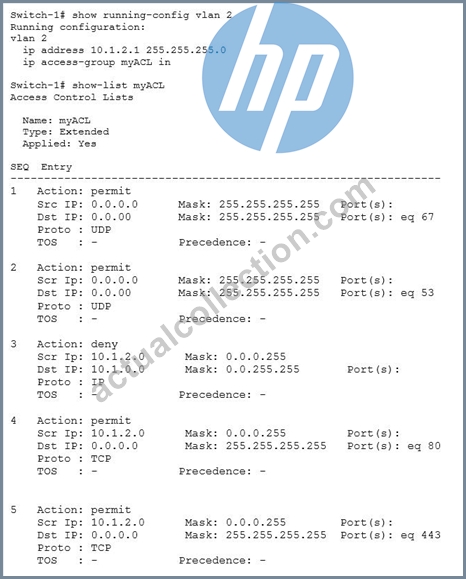
A network administrator needs to alter myACL so that it permits all traffic that arrives in VLAN 2 and is destined to 10.1.10.0/24. Besides this change, the ACL must continue to act as it does now. The administrator plans this new rule:
permit ip any 10.1.10.0/24
- A. Apply the new rule without a rule ID to ensure that the switch applies the automatic processing order to it.
- B. Resequence the ACL with more space, then add the new rule with a sequence ID before the ID for the current third rule.
- C. Remove the ACL from the VLAN and re-apply it as an inbound VLAN ACL (VACL). Then, add the new rule with any ID higher than 2.
- D. Enable ACL grouping on the switch. Add the new rule in anew ACL. Then, group the new ACL with myACL.
Answer: B
NEW QUESTION 79
Refer to the exhibits.
Exhibit 1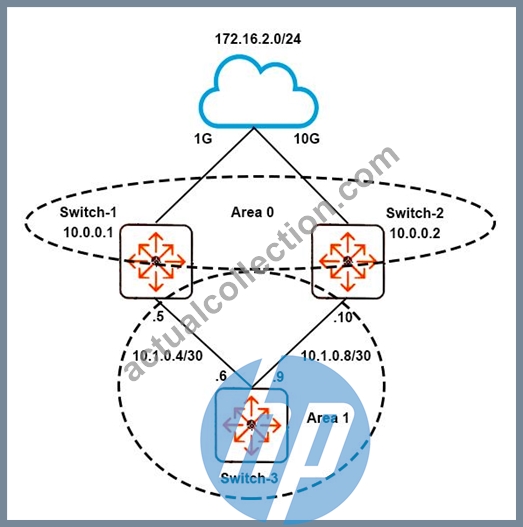
Exhibit 2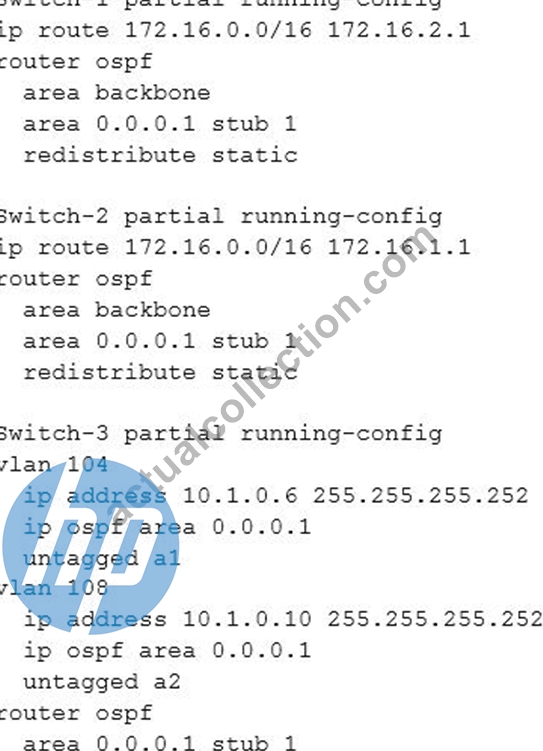
The exhibits show the current operational state for routes on Switch-3. The company wants Switch-3 to send all traffic to 172.16.0.0/16 through Switch-2.
Which single configuration change creates the desired behavior?
- A. Set a cost of 5 in the router ospf area 0.0.0.1 stub command on Switch-1.
- B. Change the OSPF external metric type to 2 on Switch-1 and Switch-2.
- C. Set a cost of 15 in the redistribute static command on Switch-2.
- D. Change the OSPF external metric type to 1 on Switch-1 and Switch-3.
Answer: C
NEW QUESTION 80
A network administrator needs to create a QoS policy on an AOS-Switch. What is one component that the administrator must create before the policy?
- A. a traffic class
- B. an extended IPv4 ACL
- C. an extended MAC ACL
- D. a traffic behavior
Answer: A
NEW QUESTION 81
Exhibit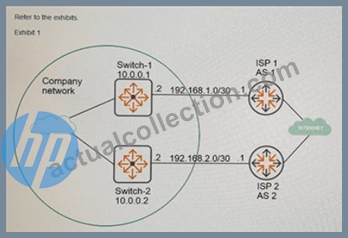
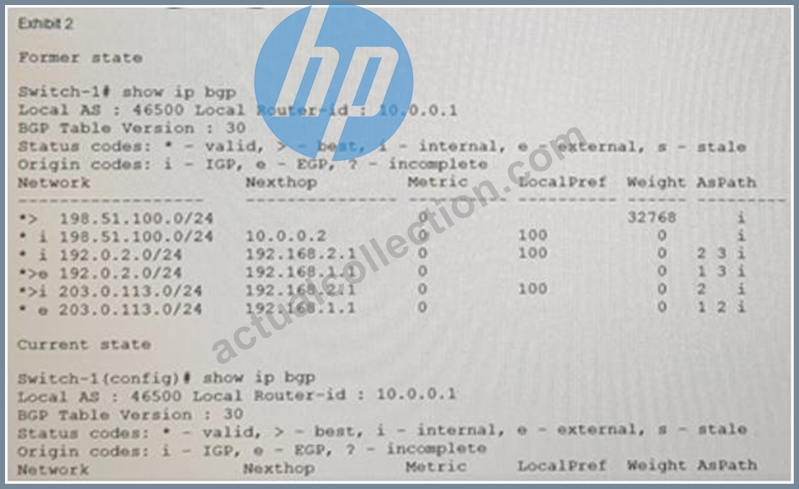

Exhibit 1 shows a portion of the BGP routing table when the BGP solution was first deployed. Exhibit 2 shows the same portion at the current time. What can explain the current state?
- A. An administrator has applied a route map on Switch-1 that filters advertised routes.
- B. Due to changes at ISP 1, Switch-1 now selects a different best route.
- C. Due to changes in the private network. Switch-1 can no longer reach 192.168. 2.1
- D. Switch-1 can no longer reach ISP 1 at 192.068.1.1
Answer: D
NEW QUESTION 82
Refer to the exhibit.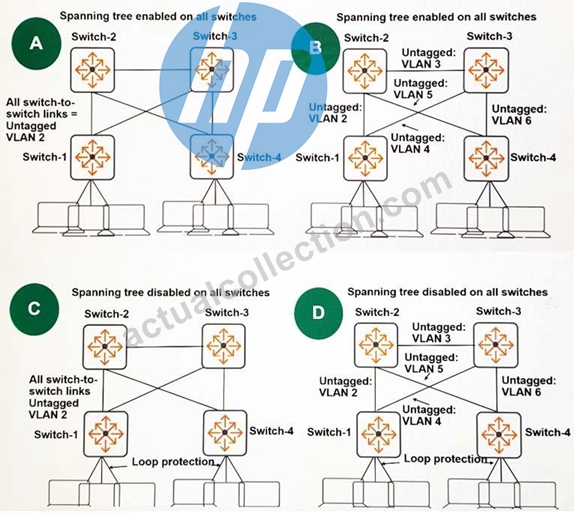
Every switch in the exhibit will route traffic. The company requires a topology in which failover for switch-to- switch links is exclusively handled by the routing protocol and occurs as quickly as possible. Which topology should the administrator use?
- A. D
- B. C
- C. A
- D. B
Answer: D
NEW QUESTION 83
Which switches can be deployed in a mesh topology for backplane stacking?
- A. Aruba 3810 switches
- B. Aruba 2920 switches
- C. Aruba 2930M switches
- D. Aruba 2930F switches
Answer: A
Explanation:
Explanation: References:
NEW QUESTION 84
AOS-Switches authenticate guests to ClearPass with captive portal. When guests first connect their device to the network, they are redirected to a captive portal in which they log in. ClearPass then stores the guest MAC addresses, and the guests are permitted access. Due to a conflict, the network administrator needs to change the dynamic authorization port, port 3799 on Aruba ClearPass.
If the administrator forgets to also change the port on one of the AOS-Switches, what will be one symptom?
- A. Guests are redirected to the system listening on port 3799
- B. Some guests are unable to reach the captive portal page. Instead, they receive no access at all
- C. When some guests successfully authenticate in the captive portal, they are redirected back to the portal page
- D. Some guests receive full access to the network when they first connect instead of being redirected to the portal page
Answer: B
NEW QUESTION 85
AOS-Switch runs IGMP in data-driven mode. What behavior does it exhibit?
- A. It preempts the querier role even if another device has higher priority
- B. It floods multicasts on all ports in the VLAN if the group has at least one member
- C. It disables automatic fast leave on ports that connect to a single device
- D. It drops multicasts destined to groups that have no members
Answer: D
NEW QUESTION 86
A company requires AOS-Switches at the campus core. The switches:
Will act as the default gateways for several campus VLANs
Must provide redundancy for their services and tolerate the loss of a link or an entire switch Must recover from the failure of one of the switches within a second or less VRRP and MSTP are proposed to meet these requirements. What is an issue with this proposal?
- A. VRRP provides routing redundancy but not default gateway redundancy
- B. VRRP does not interoperate with MSTP
- C. VRRP takes longer than a second to fail over
- D. VRRP provides redundancy against lost links but not a failed switch
Answer: C
NEW QUESTION 87
Refer to the exhibits.
Exhibit 1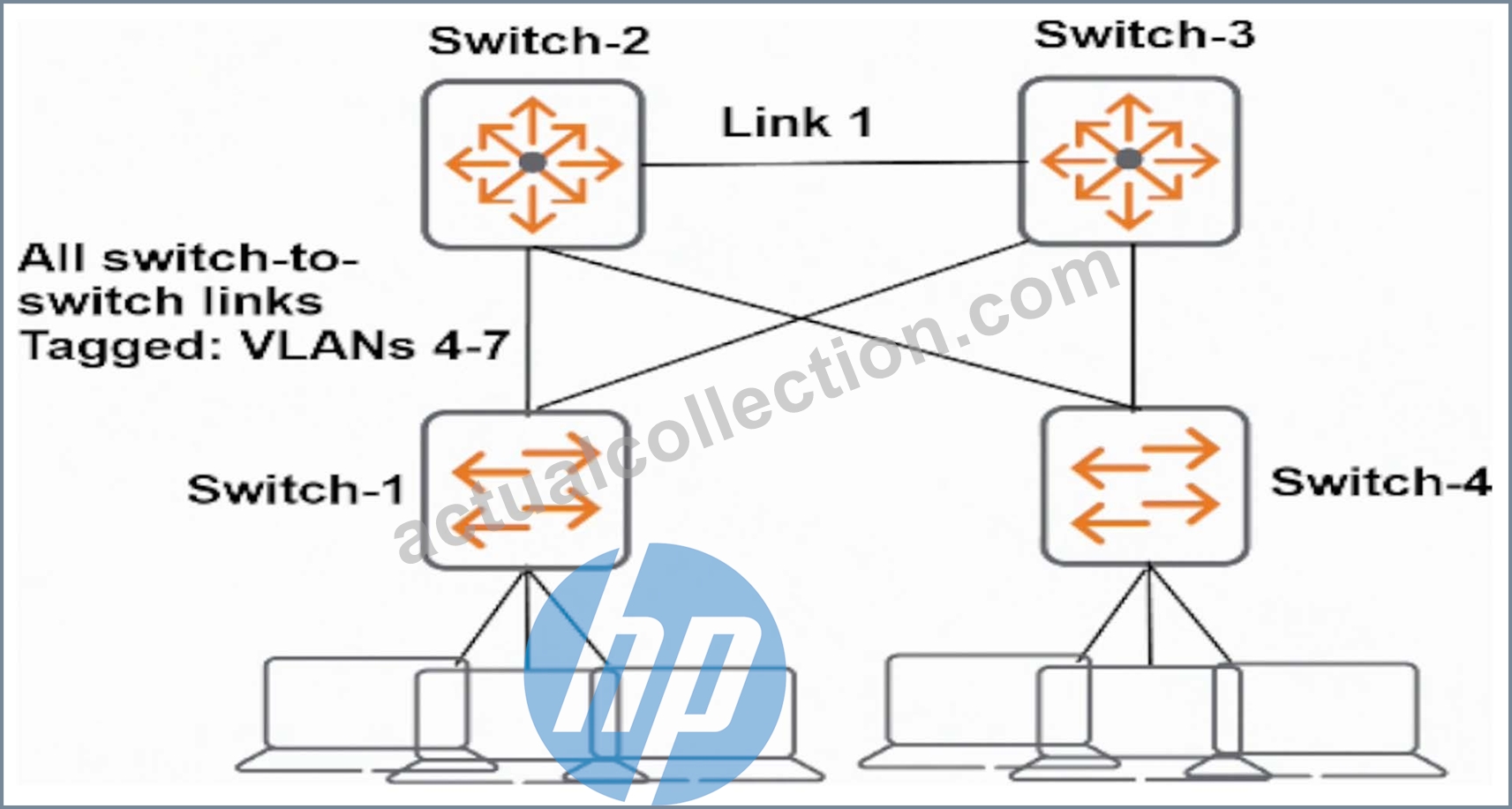
Exhibit 2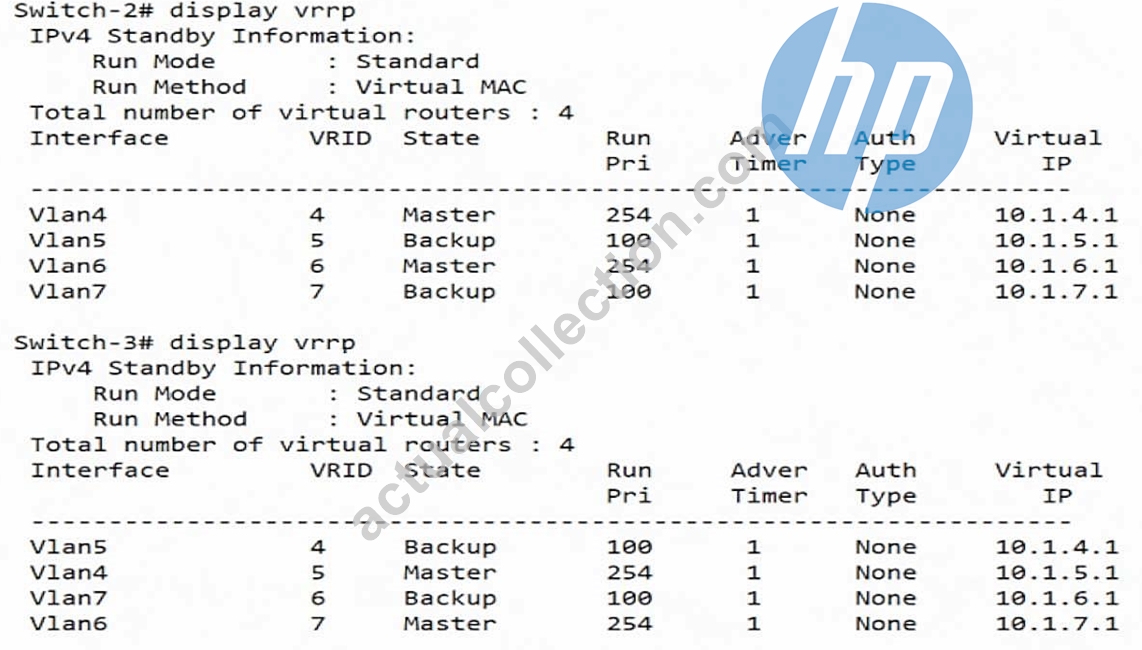
The company wants to minimize congestion on Link 1. Which spanning tree implementation meets this goal?
- A. Instance 1 = VLANs 4-5 Instance 2 = VLANs 6-7Switch 2 instance 1 priority = 0 Switch 2 instance 2 priority = 1Switch 3 instance 1 priority = 0 Switch 3 instance 2 priority = 1
- B. Instance 1 = VLANs 4,6 Instance 2 = VLANs 5,7Switch 2 instance 1 priority = 0 Switch 2 instance 2 priority = 1Switch 3 instance 1 priority = 1 Switch 3 instance 2 priority = 0
- C. Instance 1 = VLANs 4-5 Instance 2 = VLANs 6-7Switch 2 instance 1 priority = 0 Switch 2 instance 2 priority = 1Switch 3 instance 1 priority = 1 Switch 3 instance 2 priority = 0
- D. Instance 1 = VLANs 4,6 Instance 2 = VLANs 5,7Switch 2 instance 1 priority = 0 Switch 2 instance 2 priority = 1Switch 3 instance 1 priority = 0 Switch 3 instance 2 priority = 1
Answer: A
NEW QUESTION 88
A customer wants access layer switches that support routing, ACLs, backplane stacking, and Smart rate ports. The customer asks about Aruba 5400R z 12 switches.
Which Aruba Switch model would better meet the customer's requirements?
- A. 0
- B. 1
- C. 2930F
- D. 2
Answer: B
NEW QUESTION 89
Two 5400R AOS-Switches are OSPF neighbors. The network administrator wants routing paths to update as quickly as possible in the event of a failure on a neighboring switch.
Which technology should the administrator implement on the connected switch interfaces?
- A. MAC Lockdown
- B. Bidirectional Forwarding Detection (BFD)
- C. Spanning Tree Root Guard
- D. Unidirectional Link Detection (UDLD)
Answer: B
NEW QUESTION 90
An AOS-Switch enforces 802.1X. It receives an Access-Accept with this HPE VSA from its Radius server:
Attribute Name and ID = HPE-User-Role (25) Value = contractor
The switch then rejects the client. What is one requirement for the switch to accept the message and authorize the client?
- A. The initial user role must be set to the factory default permit any role.
- B. The RADIUS server settings must permit dynamic authorization.
- C. User role authorization must be enabled globally on the switch.
- D. An aaa authentication local user group must have the contractor name.
Answer: B
NEW QUESTION 91
Refer to the exhibit.
A network administrator sets up prioritization for an application that runs between Device 1 and Device 2.
However, the QoS for the application is not what the administrator expects.
How can the administrator check if the network infrastructure prioritizes traffic from Device 1 and Device 2?
- A. Set up RMON alarms on the switches that trigger when a high number of packets are dropped. Then, run the application and check for the alarm.
- B. Run a packet capture on Device 1, run the application, and look in the packet capture for a high value DSCP in the IP header.
- C. Clear interface statistics on the switches. Then, run the application and check the interface queue statistics for the switch-to-switch links.
- D. Run a packet capture on Device 2, run the application, and look in the packet capture for a high value DSCP in the IP header.
Answer: D
NEW QUESTION 92
Refer to the exhibits.
Exhibit 1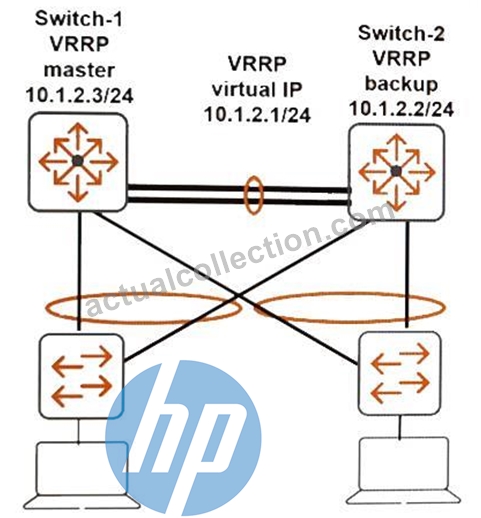
Exhibit 2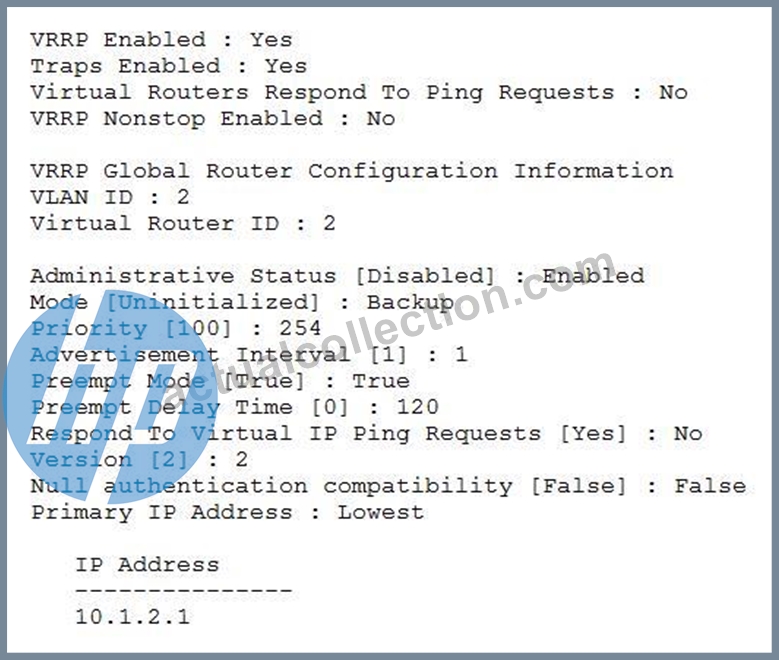
Switch-1 and Switch-2 are configured to provide VRRP in VLAN 2. The default gateway for VLAN 2 is set to the VRRP virtual IP. Client-1 in VLAN 2 cannot ping its default gateway.
Based on the exhibits, what can administrators determine?
- A. This is the expected behavior, and Switch-1 should still be able to route traffic for Client-1.
- B. The VRRP preempt delay time has not yet expired, and administrators should try to ping the gateway again in several minutes.
- C. Preempt mode is enabled on both Switch-1 and Switch-2, so the Master role continues to alternate between them, and the pings go astray.
- D. Switch-1 and Switch-2 have the same virtual router ID. The conflict interferes with connectivity.
Answer: B
NEW QUESTION 93
Refer to the exhibit.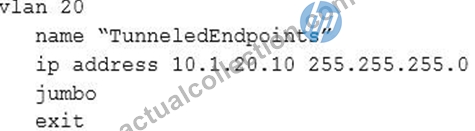
A network administrator needs to deploy AOS-Switches that implement port-based tunneled node. Their Aruba controller has IP address 10.1.10.5/24. The architect has assigned tunneled-node endpoints to VLAN
20.
What is one issue with the current configuration planned for VLAN 20 on the switch?
- A. VLAN 20 cannot have an IP address.
- B. VLAN 20 must have GRE enabled on it.
- C. VLAN 20 must have an IP address in the same subnet as the controller.
- D. VLAN 20 must not enable jumbo frames.
Answer: D
NEW QUESTION 94
The security plan for AOS-Switches requires protection from incoming malware traffic: generated from a worm-or virus-infected host.
Which feature should be implemented to provide the required protection?
- A. connection-rate filtering
- B. port security
- C. proxy ARP
- D. DHCP snooping
Answer: A
Explanation:
Explanation/Reference:
Reference: http://h22208.www2.hpe.com/eginfolib/networking/docs/switches/K-KA-KB/15-18/5998-
8150_access_security_guide/content/s_about_connection-rate_filtering.html
NEW QUESTION 95
A network administrator sets up MAC-Auth and captive portal to Aruba ClearPass on AOS-Switches. The solution seems to work for most guests. However, some guests open their browsers and are not redirected to the captive portal.
How should the administrator address the likely cause of the issue?
- A. Set the RADIUS server time window to 0 because some guest computers likely have the incorrect system time.
- B. Reconfigure the captive portal URL hash key on some of the switches, which likely have the wrong password.
- C. Replace MAC-Auth on switch ports with Web-Auth because this authentication method offers more reliability with captive portal.
- D. Replace expired certificates on the switches and set their usage to captive portal since some guests have an HTTPS homepage.
Answer: D
NEW QUESTION 96
Exhibit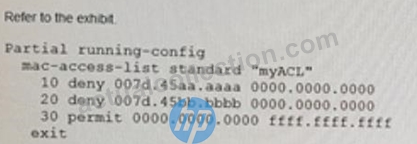
An AOS-Switch has the ACL shown in the exhibit. A network administrator enters these commands:
How does this ACL treat these frames:
1 = 007d.45cc.ffff 2 = 007d.45cc.0000
- A. It denies frame 1 and permits frame 2.
- B. It permits both frames
- C. It permits frame 1 and denies frame 2.
- D. It denies both frames
Answer: A
NEW QUESTION 97
A network administrator enters this command on an AOS-Switch:
Switch(config)# radius-server host 10.1.3.3 time-window 60
Which behavior will the switch show?
- A. It will wait one minute for a response from the RADIUS server before it sends another message
- B. It will maintain idle user sessions for one minute before it re-authenticates the user to the RADIUS server
- C. It will reject RADIUS server change of authorization (CoA) messages with timestamps that are more than one minute old
- D. It will give supplicants up to one minute to respond to RADIUS challenges before it considers authentication failed
Answer: A
NEW QUESTION 98
......
Penetration testers simulate HPE6-A45 exam: https://www.actualcollection.com/HPE6-A45-exam-questions.html