

Real HP HPE7-A07 Exam Questions Study Guide
Updated and Accurate HPE7-A07 Questions for passing the exam Quickly
NEW QUESTION # 23
Your customer recently decided to build a new wireless network based on AOS-10. The following legacy settings still exist:
* The DHCP server still sends option 60 "ArubaInstantAP" and option 43 including the IP address of the AirWave server in the ZTP VLAN.
* The DNS server has an entry for "aruba-airwave" pointing to the AirWave server.
The customer purchased new AP-655 access points and HPE Aruba Networking Central subscriptions.
Each AP is assigned to the "ACX-Group" in the Device Pre-provisioning section of Central, and the external firewall allows HTTPS traffic between APs and the Internet.
What will happen when the new factory default APs are connected to the customer's network for the first time?
- A. The new APs will contact the cloud and will be pointed to the IP address of AirWave
- B. The new APs will contact the cloud and get the "ACX-Group" configuration in HPE Aruba Networking Central
- C. The new APs will contact the IP address of AirWave learned from the DNS entry "aruba-airwave"
- D. The new APs will contact the IP address of AirWave from DHCP option 43
Answer: B
NEW QUESTION # 24
The ACME company has an AOS-CX 6200 VSF switch slack with an uplink over subscription ratio of 9.6:1.
They have indicated that their low-priority TCP traffic has been flagged with a DSCP marking coloring them yellow.
Refer to the exhibit.
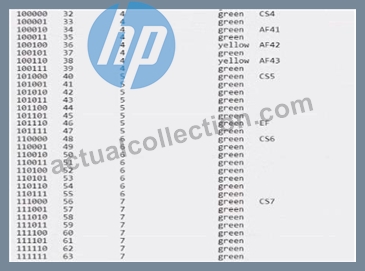
They are considering adding two more nodes to thestack without adding any additional uplinks due to existing wiring constraints.One of their architects has suggested adding the following configuration:
What would be the impact of applying the acmethreshold profile as shown? (Select two.)
- A. All upper-layer protocol traffic egressing LAG1 will be subject to drop probability.
- B. Yellow-flagged TCP traffic egressing LAG1 will be subject to drop probability
- C. Only VoIP packets egressing queue 5 on LAG1 will likely be protected from uplink over-utilization.
- D. VoIP packets egressing any queue on LAG1 will more likely be protected from uplink over-utilization
- E. All TCP traffic egressing LAG1 wail be subject to drop probability
Answer: A,B
Explanation:
Applying the 'acmethreshold' profile as shown in the exhibit would set a minimum and maximum threshold for queue 0, which affects the drop probability for traffic that exceeds these thresholds. The yellow marking indicates a medium drop precedence, so yellow-flagged traffic would be more likely to be dropped when congestion occurs, and the uplink is over-utilized. This action is intended to protect higher-priority traffic, such as VoIP, by giving it a lower probability of being dropped.
NEW QUESTION # 25
A network administrator accesses HPE Aruba Networking Central and notices that visitors consume too much internet bandwidth starving employee traffic when accessing an external service. Therefore, the administrator wants to limit wireless bandwidth to 60 Mops in both directions among all users in the voice rote and no more than 10 Mops in both directions for YouTube traffic. Deep packet inspection, web content classification, and firewall visibility are enabled.
Which configurations are required to accomplish this task? (Select two.)
- A.

- B.
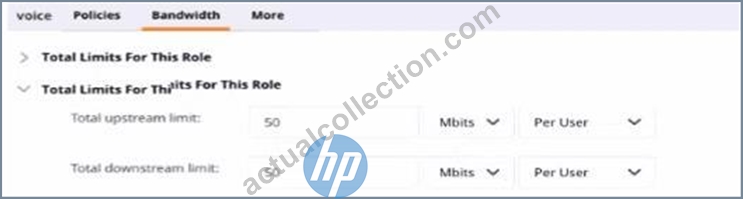
- C.
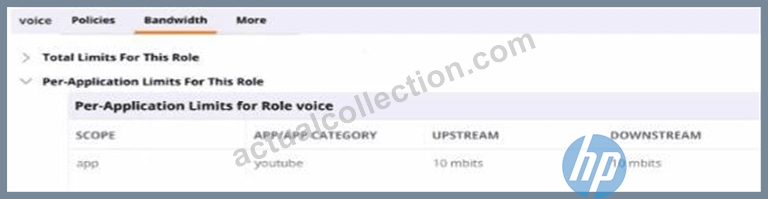
- D.

Answer: A,C
Explanation:
To achieve the bandwidth limits set by the network administrator, both per-application and total limits need to be configured. Option B shows the configuration for setting a per-application bandwidth limit, which can restrict YouTube traffic to 10 Mbps in both directions. Option D shows the configuration for setting a total bandwidth limit for all users within the voice role to 50000 Kbps (or 50 Mbps), satisfying the requirement to restrict total wireless bandwidth. By applying these configurations in HPE Aruba Networking Central, the administrator will successfully implement the necessary controls to ensure that visitor traffic does not impede the network performance for employee traffic, aligning with the capabilities of Aruba solutions to manage and prioritize network resources effectively.
NEW QUESTION # 26
An ACME company employee complained about a recent poor-quality VoIP call while moving around their office environment HPE Aruba Networking Central reported a fair UCC score for this call while your VoIP engineer reported that their systems reported a MOS of 2, 3. The VoIP devices are operating over the 5GHz frequency band.
What are the possible contributing factors? (Select two.)
- A. 802.tr is enabled in the WLAN Security settings.
- B. Coverage AP deployment plans generally don't support enough cell overlap for VoIP.
- C. 802.1K is disabled in the WLAN Security settings
- D. There was localized interference at the caller's location
- E. The client roamed into an area that continuously operates Zigbee.
Answer: B,E
Explanation:
VoIP quality can be negatively impacted by insufficient cell overlap in AP deployment plans, which can cause poor handoffs between APs as a user moves around. This results in a degraded VoIP experience.
Additionally, roaming into an area with continuous Zigbee operation can cause interference with the 5GHz frequency band, further contributing to poor VoIP call quality. The Zigbee communication protocol operates on the same frequency band as Wi-Fi and can introduce noise and interference, which leads to a reduced MOS score, as reported by the VoIP engineer.
NEW QUESTION # 27
A customer is running out of IP addresses in a network segment. What will happen If they add an additional IPsubnet to the same VLAN?
- A. Broadcasts for me two subnets win arrive on all ports in the same VLAN
- B. IGMP will not work in both of the subnets in the same VLAN
- C. Users can reach each other and establish PTP traffic without passing an L3 point in the same VLAN
- D. This would result in a single SVI using two subinterfaces.
Answer: C
Explanation:
Adding an additional IP subnet to the same VLAN means that devices configured with either subnet can communicate at Layer 2 without the need for routing. This is because they are on the same VLAN and thus in the same broadcast domain. However, to communicate between subnets, an L3 device or inter-VLAN routing would be required.
NEW QUESTION # 28
A network administrator wants to configure an 802.1X supplicant for a wireless network that includes the following:
* AES encryption
* EAP-MSCHAPv2-based user and machine authentication
* Validation of server certificate in Microsoft Windows 10
The network administrator creates a WLAN profile and selects the Change connection settings option. Then the network administrator changes the security type to Microsoft: Protected EAP (PEAP) and enables user and machine authentication under Additional Settings.
What must the network administrator do next to accomplish the task? (Select two)
- A. Enable user authentication
- B. Change default RC4 encryption for AES
- C. EAP-TLS-based user and machine authentication
- D. Enable server certificate validation
Answer: A,D
Explanation:
Comprehensive and Detailed Explanation From Exact Extract of HPE Aruba Networking Switching:
When configuring an 802.1X supplicant in Microsoft Windows for EAP-PEAP (Protected EAP) using EAP-MSCHAPv2, both user and machine credentials can be used for authentication. The network administrator has already enabled user and machine authentication under Additional Settings, but to meet the stated requirements (AES encryption and server certificate validation), two critical steps remain:
* Enable server certificate validationThis ensures the client validates the identity of the RADIUS server (such as Aruba ClearPass or another authentication server) to prevent man-in-the-middle attacks.
It satisfies the requirement for "validation of server certificate in Windows 10".
Exact Extract:
"For EAP-PEAP with EAP-MSCHAPv2, select 'Validate server certificate' to ensure the client trusts the authentication server's identity. The server certificate must be signed by a CA trusted by the client."
* Enable user authenticationWhile both user and machine authentication are possible, user authentication must be explicitly enabled so that credentials (domain or local user) are sent after machine authentication completes. This enables the full EAP-MSCHAPv2-based user and machine authentication process.
Exact Extract:
"In EAP-PEAP properties, ensure 'Enable user authentication' is selected to authenticate both the workstation and logged-on user credentials when using EAP-MSCHAPv2." Additionally, Windows 10 uses AES encryption automatically when WPA2/WPA3-Enterprise is configured, fulfilling requirement (1). RC4 encryption is not applicable because AES is the default cipher for WPA2 Enterprise networks.
Why the Other Options Are Incorrect:
* C. EAP-TLS-based user and machine authentication:The question specifies EAP-MSCHAPv2, not EAP-TLS. EAP-TLS uses digital certificates for mutual authentication, while PEAP with EAP- MSCHAPv2 uses username and password-based credentials.
"EAP-TLS is certificate-based; PEAP-MSCHAPv2 uses password-based authentication."
* D. Change default RC4 encryption for AES:RC4 is used in older WPA or TKIP security types. When using WPA2-Enterprise, AES is automatically selected and cannot be manually overridden.
"WPA2-Enterprise (802.1X) uses AES-CCMP encryption; RC4/TKIP is not applicable to modern configurations." References of HPE Aruba Networking Switching Documents or Study Guide:
* Aruba Secure Connectivity and Authentication Guide (AOS-10) - "Configuring Windows 802.1X Supplicant for PEAP-MSCHAPv2."
* Microsoft Windows 10 Enterprise Network Configuration Guide - "PEAP with EAP-MSCHAPv2 Setup and Server Certificate Validation."
* Aruba ClearPass Deployment Guide - "Certificate Validation and EAP Methods Overview."
* Aruba WLAN Security and AAA Configuration Guide - "EAP Frameworks and Supported Encryption Methods."
NEW QUESTION # 29
Exhibit.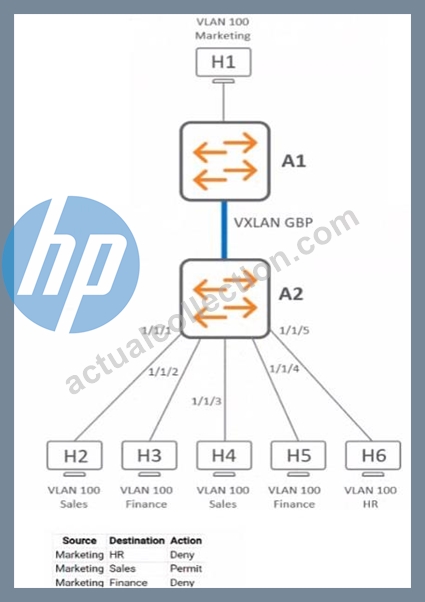
What is me expected behavior for ARP traffic sent from H1?
- A. A2 will send the ARP traffic out of ports 1/1/1-1/1/4.
- B. A2 will drop the ARP traffic.
- C. A2 will send the ARP traffic out of ports 1/1/1 and 1/1/3.
- D. A2 will flood the ARP traffic out of all interfaces.
Answer: D
Explanation:
In a VXLAN environment, unknown unicast traffic, such as ARP requests from H1, which does not have a specific destination MAC address learned by the switch A2, will be flooded out of all interfaces. This flooding behavior is necessary because A2 needs to ensure that the ARP request reaches its intended destination, which might be on any of the interfaces. It's a part of the standard behavior of switches to handle ARP traffic when the destination hardware address is unknown.
NEW QUESTION # 30
A customer has recently deployed a wireless system using AP-535S to provide connectivity for their employees who are responsible tor uploading large video files for review. The customer wants to use features that provide throughput gains for large data uploads.
Which feature can be enabled to meet the requirement and simultaneously allow spatially separated clients access to the channel?
- A. DL MU-MIMO
- B. OFOMA
- C. Ul-TXBF
- D. UL MU-MIMO
Answer: D
Explanation:
UL MU-MIMO, or Uplink Multi-User Multiple Input Multiple Output, is a technology that allows multiple clients to transmit data to the access point simultaneously, increasing overall throughput and efficiency, especially for upload-heavy scenarios like video file uploads. This technology enables spatially separated clients to access the channel at the same time, which can improve performance for clients when uploading large files.
NEW QUESTION # 31
You are a wireless network administrator at an outdoor container yard. A new multicast application that communicates with the GPS on the container handling equipment is being added to the network.
Which setting will increase the reliability and send traffic at the highest possible data rate?
- A. Increase the basic rate from 6 to 24 Mbps.
- B. Enable WiFi Multimedia.
- C. Multicast Transmission Optimization
- D. Dynamic Multicast Optimization
Answer: D
Explanation:
Comprehensive and Detailed Explanation From Exact Extract of HPE Aruba Networking Documentation Multicast frames over Wi-Fi are traditionally transmitted at the lowest basic data rate, making them slow and unreliable, particularly outdoors where environmental RF effects are more significant.
Aruba provides a feature designed for this scenario:
# Dynamic Multicast Optimization (DMO)
* Converts multicast streams into unicast transmissions per associated client
* Allows the AP to use the highest possible unicast data rate supported
* Significantly improves reliability, throughput, and range for critical multicast applications HPE Aruba documentation statement:
"Dynamic Multicast Optimization increases the reliability of multicast traffic by converting multicast frames to unicast and allows transmissions using higher data rates." This directly supports the requirement in the question:
# increase reliability
# use the highest possible data rate
Why the Other Options Are Incorrect
Option
Reason Incorrect
A). Increase basic rate
Raising basic rates often reduces coverage range and can disconnect distant outdoor clients B). Multicast Transmission Optimization This older mode still transmits multicast over the air, not at highest rate D). Enable WMM WMM is for QoS prioritization, not for increasing multicast PHY rates or reliability
# Final Verified answer: C. Dynamic Multicast Optimization
# Reference Sources (HPE Aruba Official Materials):
* Aruba Mobility and WLAN Optimization Guides - Dynamic Multicast Optimization operation and benefits
* Aruba Outdoor Wi-Fi Deployment Best Practices - Multicast performance enhancements
* ACMP (Aruba Certified Mobility Professional) Study Material - Multicast Optimization for IoT and GPS Applications
NEW QUESTION # 32
Which option shows the correct Banawidth Control for 1024 kbps down and 2048 Kops up for the SSID?
- A.

- B.

- C.
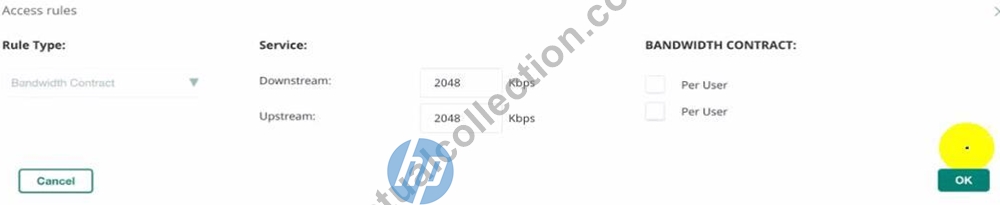
- D.

Answer: B
Explanation:
The correct Bandwidth Control settings for 1024 Kbps down and 2048 Kbps up for the SSID are shown in Option D. In Option D, the downstream is set at 1024 Kbps and the upstream at 2048 Kbps, both configured per user, which matches the requested configuration. This setup ensures that each user has a guaranteed bandwidth allocation of the specified rates when connected to the SSID, providing a controlled and predictable user experience.
NEW QUESTION # 33
You recently added HPE Aruba Networking ClearPass as an authentication server to a group in HPE Aruba Networking Central. RADIUS authentication with Local User Roles (LUR) works fine, but the same access points cannot use Downloadable User Roles (DUR).
What should be corrected in this configuration to fix the issue with DUR?
- A. Add a new Enforcement Policy of type "WEBAUTH" on ClearPass and associate it with the matching service on ClearPass
- B. Modify the shared secret on the switch to match CPPM using the "radius-server host" command
- C. Uncheck the "Dynamic Authorization" checkbox in the authentication server configuration on HPE Aruba Networking Central
- D. Add the correct values for "CPPM Username" and "CPPM Password" in the authentication server configuration on HPE Aruba Networking Central
Answer: D
Explanation:
Comprehensive and Detailed Explanation From Exact Extract of HPE Aruba Networking Switching:
When using Downloadable User Roles (DUR) with HPE Aruba Networking ClearPass, the Aruba device (AP, gateway, or switch) must authenticate to ClearPass to retrieve and install the user role that ClearPass sends dynamically. This process differs from normal RADIUS authentication, where only the user credentials are verified.
In Aruba Central, when you configure an authentication server (ClearPass) and enable Downloadable Roles
, the system requires CPPM Username and CPPM Password fields. These credentials are specifically used by the Aruba device to establish a secure HTTPS (TLS) session to the ClearPass server for DUR retrieval.
If the CPPM Username or CPPM Password values are missing, incorrect, or not synchronized with the corresponding credentials defined on ClearPass, the device will fail to authenticate to ClearPass for DUR retrieval. This results in RADIUS authentication succeeding (because LUR is still functioning), but the DUR cannot be downloaded.
Exact Extract from HPE Aruba Networking Switching and ClearPass Configuration Guides:
"When Downloadable User Roles are enabled, the Aruba device must authenticate with ClearPass using configured credentials. The device uses the CPPM Username and Password for HTTPS-based role retrieval. If the credentials are not defined or are invalid, role download will fail even if RADIUS authentication succeeds."
"The CPPM Username and Password define the credentials the device uses to connect to ClearPass for downloadable role retrieval. These credentials must match the admin or API credentials configured on the ClearPass Policy Manager server." This explains why Local User Roles (LUR) work (standard RADIUS), but Downloadable User Roles (DUR) do not - the HTTPS/TLS authentication for DUR fails because the required credentials were not configured correctly.
Why the Other Options Are Incorrect:
* A. Add a new Enforcement Policy of type "WEBAUTH" on ClearPass:WebAuth enforcement policies are unrelated to DUR. Downloadable User Roles are delivered using an Aruba Downloadable Role enforcement profile, not WebAuth.
"Downloadable roles are defined and enforced through the Aruba Downloadable Role profile type. WebAuth policies are used for captive portal authentication only."
* C. Uncheck the "Dynamic Authorization" checkbox:Dynamic Authorization (RFC 3576 or CoA) allows session reauthentication or role changes. Disabling this feature would not fix DUR, as DUR relies on CPPM credentials for HTTPS authentication.
"Dynamic Authorization (CoA) enables session updates but does not control role download authentication."
* D. Modify the shared secret on the switch using the 'radius-server host' command:This option applies to switch RADIUS configuration, not Aruba Central APs or gateways. The DUR process uses HTTPS with ClearPass credentials, not the RADIUS shared secret.
"The RADIUS shared secret is used for authentication requests, not for downloadable role retrieval.
Downloadable roles require valid CPPM credentials."
References of HPE Aruba Networking Switching Documents or Study Guide:
* Aruba Central Management and Configuration Guide - Downloadable Roles Section(Explains CPPM Username/Password requirement and DUR HTTPS authentication process.)
* Aruba ClearPass Policy Manager Configuration Guide - Aruba Downloadable Role Enforcement Profiles(Details the role download process and ClearPass credential validation.)
* ArubaOS-Switch and AOS-CX Security Configuration Guide - Role-Based Access Control and ClearPass Integration(Describes the mechanism for DUR retrieval and the use of HTTPS between the Aruba device and ClearPass.)
NEW QUESTION # 34
A deployment using AP-635S is connectedto a stack of CX 6300s as shown.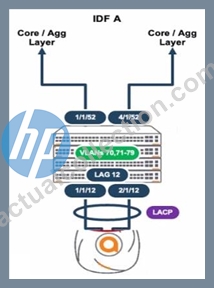
The output of the snow LACPinterfaces shews the following: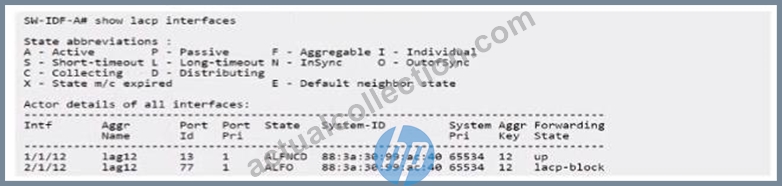
What is causing this issue?
- A. Spanning tree and loop protect are enabled on both AP uplink ports.
- B. Each AP interface is connected to a routed-only interlace on different networks
- C. The AP is configured with LACP active
- D. e0 is connected to a smart rate interface, and e1 is connected to a non-smart rate interface.
Answer: C
Explanation:
In an Aruba deployment, if an AP's interfaces show different LACP states, it often indicates a configuration mismatch. If one interface is up and the other is blocked as shown in the output,it's likely due to both interfaces on the AP being set to LACP active mode, which is a correct setting for establishing an LACP channel with Aruba switches like the CX 6300 series.
NEW QUESTION # 35
A customer's infrastructure is set up to use both primary and secondary gateway clusters on the SSID profile based on best practices What is a valid cause tor having an equal spirt in APs connected to the primary and secondary gateway clusters?
- A. The secondary gateway cluster is homogeneous
- B. The primary gateway cluster is up. out some APs are unable to reach the primary gateway cluster. These APs would connect to the secondary gateway cluster
- C. The primary gateway cluster is up. out some APs cannot reach the secondary gateway cluster. These APs would connect to the secondary gateway cluster
- D. The secondary gateway cluster is heterogeneous
Answer: B
Explanation:
In a high availability setup where both primary and secondary gateway clusters are present, APs are typically designed to connect to the primary cluster. If the APs are equally split between the primary and secondary, this may indicate that some APs cannot reach the primary cluster due to connectivity issues or reachability constraints, thus falling back to the secondary cluster.
NEW QUESTION # 36
You configured a tunneled SSID with captive portal and a ClearPass Guest Self Registration workflow when testing and launching the self-registration workflow, after successful registration, the login action shows the following error: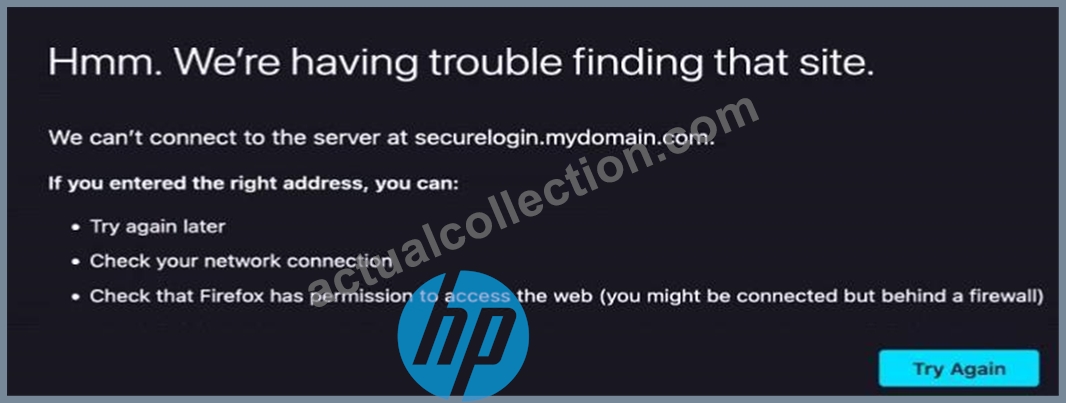
What is the best solution to resolve this error?
- A. You need to De connected to the guest SSiD while testing.
- B. You need to change the Login Address in ClearPass to securelogin arubanetworKs.com
- C. You need to include the root and intermediate certificates in the captive portal certificate for your access points
- D. You need to include the root and intermediate certificates in the captive portal certificate for your gateway
Answer: D
Explanation:
Including the root and intermediate certificates in the captive portal certificate for the gateway will resolve the error seen during the login action after successful registration. This is necessary to ensure the SSL/TLS handshake can be completed successfully, as the client browser needs to validate the entire certificate chain.
NEW QUESTION # 37
What should be defined on the Edge-1 to establish valid BGP routing between agg-sw1 and agg-sw2 using BGP protocol using the IP addresses above?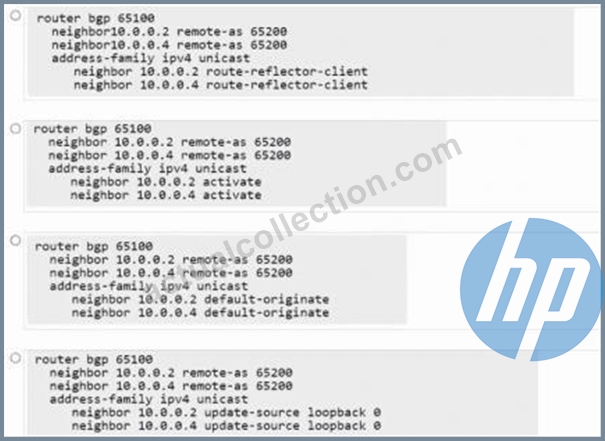
- A. OPTION D
- B. OPTION A
- C. OPTION B
- D. OPTION C
Answer: A
Explanation:
In the design shown:
* The BGP peering between agg-sw1 and agg-sw2 is being established using loopback interfaces as the BGP neighbor addresses (10.0.0.2 and 10.0.0.4)
* When BGP peering uses loopbacks, you must configure the BGP session to originate updates from the same loopback interface that the neighbor's address resolves to Otherwise, the TCP session fails because:
The source IP does not match the configured neighbor remote-IP which is based on the loopback address Aruba AOS-CX requirement:
"When configuring eBGP or iBGP neighbors using loopback interfaces, apply update-source <loopback> under the IPv4 unicast address family so BGP uses the correct source interface for peering."
NEW QUESTION # 38
A university owns a campus with several buildings segmented into east and west wings, which are L3 separated. The east wing has 1600 APs. and the west wing has 1200 Aps. Each wing has a single gateway cluster managed by HPE Aruba Networking Central. Each cluster contains one 7210 mobility gateway The gateways are configured with DHCP relay and route all client VLANs. A new business-critical facultyreal-time application requires users to roam within wings but not across wings without disconnections or delay increments.
Which changes must the network administrator make lo successfully meet the requirement without performance degradation matching best practices? (Select two.)
- A. Replace me 7210 mobility gateway in the east wing with a pair or 9012 mobility gateways
- B. Run L2 for all SSIDs and permit the users' VLANs in the gateway's uplinks.
- C. Remove the DHCP relay from the gateways and enable the DHCP server instead
- D. Add a single 7210 mobility gateway to each cluster.
- E. Replace the 7210 mobility gateway in the west wing with a pair of 7030 mobility gateways.
Answer: B,D
Explanation:
To support a business-critical faculty real-time application that requires seamless roaming within wings without cross-wing roaming, it's essential to ensure high availability and sufficient capacity. Adding an additional 7210 mobility gateway to each cluster would provide the required redundancy and capacity.
Running L2 for all SSIDs and permitting user VLANs on gateway uplinks would facilitate the necessary traffic flow without L3 segmentation issues, thus supporting seamless roaming within each wing.
NEW QUESTION # 39 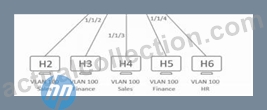

What is the expected behavior for ARP traffic sent from H1?
- A. A2 will flood the ARP traffic out of all interfaces.
- B. A2 will send the ARP traffic out of ports 1/1/1-1/1/4.
- C. A2 will drop the ARP traffic.
- D. A2 will send the ARP traffic out of ports 1/1/1 and 1/1/3.
Answer: D
Explanation:
In this scenario:
* All hosts are in VLAN 100
* Group-Based Policy (GBP) is applied
* H1 belongs to the Marketing role
* Policy table for Marketing:
Source
Destination
Action
Marketing
HR
Deny
Marketing
Sales
Permit
Marketing
Finance
Deny
Role Mapping:
* Sales: H2, H4
* Finance: H3, H5
* HR: H6
# Key Aruba GBP Behavior for ARP
Aruba AOS-CX GBP enforces policy at L3 and L2, and ARP is not treated as unconditional broadcast when GBP roles restrict communication.
Aruba documentation states:
"ARP requests are only forwarded to ports associated with permitted roles.
ARP behavior follows the GBP access-policy rules."
Since Marketing is only permitted to communicate with Sales, ARP from H1 must only be forwarded toward:
# H2 (Sales)
# H4 (Sales)
Interfaces:
* H2 # port 1/1/1
* H4 # port 1/1/3
Therefore, the ARP request is NOT flooded to Finance (H3/H5) or HR (H6), where communication is denied.
# Why Other Options Are Incorrect
Option
Why Wrong
B
Would ignore GBP enforcement; too wide of a flood
C
Not dropped - allowed paths exist to Sales
D
ARP is not broadcasted when GBP denies connectivity
NEW QUESTION # 40
Exhibit.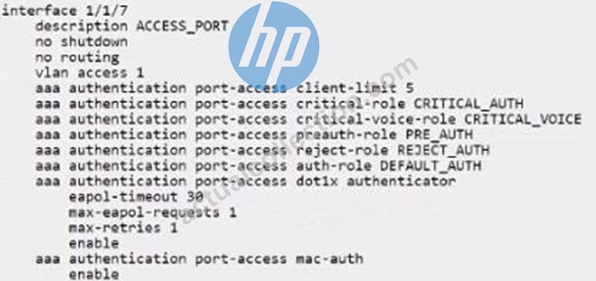
Which user role will be assigned when a voice client tries to connect for the first time, but the RADIUS server is unavailable?
- A. PRE_AUTH
- B. CRIT1CAL_V0ICE
- C. DEFAULT_AUTH
- D. CRITICAl_AUTH
Answer: B
Explanation:
In the provided configuration for interface 1/1/7, there are roles specified for different scenarios concerning authentication. When a voice client attempts to connect and the RADIUS server is unreachable, the role that is assigned is the one specified as the "critical-voice-role". In this case, the "CRITICAL_VOICE" role is configured to be assigned under such circumstances, ensuring that voice clients receive appropriate network access permissions even when the RADIUS server is not available to authenticate them.
NEW QUESTION # 41
Refer to the exhibit.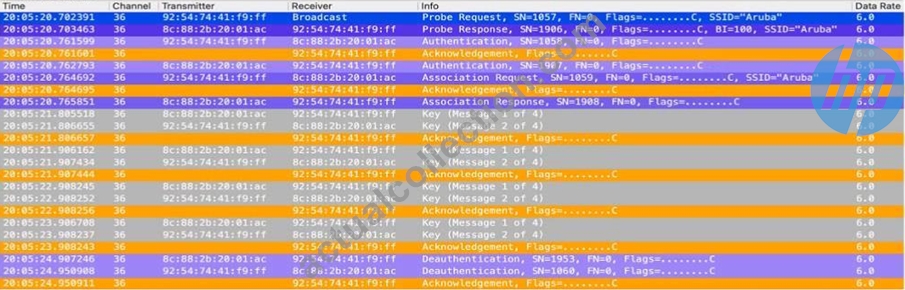
Which statement is true?
- A. The client is failing 802.1X authentication
- B. The client is using BSS Fast Transition
- C. The client performed passive scanning
- D. The client used an incorrect passphrase
Answer: A
Explanation:
The exhibit shows a series of 802.1X authentication steps with multiple "Deauthentication" frames, which indicate that the client is not successfully completing the authentication process. Since the frames show repeated attempts at authentication followed by deauthentication, this suggests that the client is failing the
802.1X authentication process, which is required for network access in a WPA2/WPA3-Enterprise security environment.
NEW QUESTION # 42
Refer to the exhibit.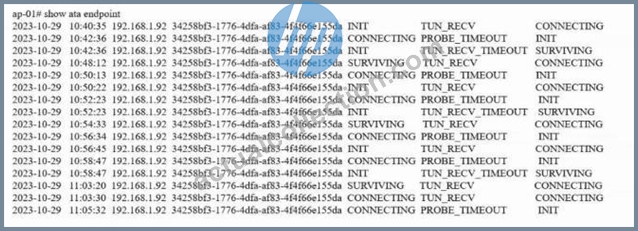
Given the log output, which statement is true?
- A. The gateway with IP address 192.168.1.92 is offline.
- B. AP-01 cannot communicate with the HPE Aruba Networking Central tunnel orchestrator.
- C. AP-01's tunnel to 192.168.1.92 is in a survived state.
- D. The gateway tunnel to the AP has a path MTU issue.
Answer: A
Explanation:
* The show ata endpoint output lists the AP's AP Tunnel Agent (ATA) state transitions with a given gateway.
* Key state/result fields:
* CONNECTING # PROBE_TIMEOUT # INIT: the AP tries to bring up the IPSec tunnel, health probes to the gateway time out, then the state resets to INIT and retries.
* TUN_RECV_TIMEOUT: the AP stops receiving tunnel keepalives/packets from the gateway within the expected interval.
* SURVIVING indicates the AP is maintaining service with an already-up tunnel while control connectivity is impaired; it is not the state shown at the end here.
In the log, AP-01 repeatedly cycles through CONNECTING # PROBE_TIMEOUT # INIT, with intermittent TUN_RECV_TIMEOUT. This pattern is the documented symptom of the gateway being unreachable or down (no response to probes/keepalives), rather than a Central/orchestrator outage or PMTU problem.
Therefore, the correct conclusion is that the gateway at 192.168.1.92 is offline or not reachable.
* A is incorrect: the final/recurring state is not SURVIVING.
* C is incorrect: a Central/orchestrator issue would show SURVIVING (existing tunnel continues) rather than repeated probe timeouts to the gateway.
* D is incorrect: PMTU issues do not generate recurring PROBE_TIMEOUT/TUN_RECV_TIMEOUT cycles; they appear as ESP/IKE negotiation problems, not persistent probe loss.
NEW QUESTION # 43
......
HP HPE7-A07 Exam Syllabus Topics:
| Topic | Details |
|---|---|
| Topic 1 |
|
| Topic 2 |
|
| Topic 3 |
|
| Topic 4 |
|
| Topic 5 |
|
| Topic 6 |
|
| Topic 7 |
|
Prepare Important Exam with HPE7-A07 Exam Dumps: https://www.actualcollection.com/HPE7-A07-exam-questions.html
Download Real HPE7-A07 Exam Dumps for candidates. 100% Free Dump Files: https://drive.google.com/open?id=1in08lhyqR3n5BwS2u1UUmEIt2Cnw-92p